Peddle Plus One ERP: The Diligent ERP Choice for Retail CEOs in India 2026
Peddle Plus One ERP: The Diligent ERP Choice for Retail CEOs in India 2026
It is 9 PM on a Tuesday. You are somewhere between boarding gate and runway. Before your phone switches to flight mode, three things happen in the span of ninety seconds. Your Ludhiana store manager messages asking whether to reorder a fast-moving SKU and you have no idea what the current stock level is without calling someone. Your CA sends a follow-up on last month's GSTR reconciliation because two purchase entries still do not match across your billing and accounting tools. And your operations head forwards a message from your Pune warehouse flagging a discrepancy between what was dispatched and what the delivery partner claims was received.
You land two hours later. Seven messages deep. Zero of them resolved. This is not a management failure. This is a systems failure. And it is playing out across retail businesses all over India businesses that have genuinely scaled, built real customer bases, and developed serious operational complexity but are running on infrastructure that was never designed for what they have become.
ERP for retail CEOs in India is no longer a future investment. It is a present-day operational necessity. India's retail market reached USD 1,060 billion in 2025 and is projected to reach USD 3,121 billion by 2035 at a CAGR of 11.40% (Expert Market Research, 2025). The Deloitte-FICCI report published in August 2025 put the sector at USD 1.06 trillion and forecast it will nearly double to USD 1.93 trillion by 2030 alone. The businesses that will capture meaningful share of that growth are not necessarily the most aggressive they are the most operationally controlled. This blog explains why Peddle Plus One ERP is the platform that serious retail CEOs in India are choosing and exactly what that choice changes about how a business operates day to day.
Table Of Contents
Why This Problem Is Getting Worse in 2026
What Is One ERP And What Makes Peddle Plus Different?
Key Benefits of Peddle Plus One ERP for Retail CEOs
Peddle Plus One ERP vs The Alternatives
What This Looks Like in Practice
Industry Trends and Market Outlook
Common Mistakes Retail Businesses Make When Choosing ERP
How to Choose the Right ERP for Your Retail Business
The Future of Retail ERP in India: The Next Five to Ten Years
The Conclusion
Why This Problem Is Getting Worse in 2026
If you are running a multi-location retail operation in India today, your operational complexity has not just grown, it has compounded. Three structural forces are colliding at once, and the businesses caught in the middle are the ones that have scaled past basic tools but have not yet built the systems their current size actually demands.
The Compliance Burden Is No Longer Manageable Manually
India's GST e-invoicing mandate has been tightened progressively and significantly in 2025. As of August 1, 2023, e-invoicing is mandatory for all B2B businesses with annual turnover above Rs.5 crore. From April 1, 2025, a further tightening kicked in: businesses with Annual Aggregate Turnover of Rs.10 crore or more must now upload e-invoices to the IRP within 30 days of invoice issuance, or the invoice is rejected as invalid. Non-compliance attracts penalties of Rs.10,000 per invoice or 100% of tax due, whichever is higher (Source: GSTN Advisory No. 461, November 2024 | India-Briefing, April 2025). For a retail CEO managing 5 or 15 locations with hundreds of daily transactions across multiple GST categories, manual compliance is not just inefficient, it is a growing and measurable liability. A single mismatch or late upload can trigger cascading ITC denials for your buyers and scrutiny you do not want.
Consumer Speed Expectations Have Permanently Raised the Bar
UPI transactions in India crossed INR 18.68 billion in volume in May 2025 alone, and smartphone penetration has surpassed 880 million (Expert Market Research, 2025). Same-day and next-day delivery has moved from a premium differentiator to a basic consumer expectation. Quick commerce is growing at 70-80% CAGR and now operates across 80+ Indian cities, with India recognised as the world's first scaled quick-commerce market (Deloitte-FICCI, August 2025). Customers expect real-time stock accuracy, instant order confirmation, and fast fulfilment. None of that is deliverable when your inventory data is 24 hours old and your sales channels are not connected to the same live system.
The Technology Gap Is Widening Between Operators
ERP adoption among Indian SMEs grew 24% between 2022 and 2024, primarily driven by affordable cloud-based solutions (Market Reports World, 2024). The India ERP market was valued at USD 1.78 billion in 2025 and is projected to reach USD 2.73 billion by 2031 at 7.39% CAGR (TechSci Research, 2025). The businesses investing in integrated operational systems are compounding advantages every month. The businesses still running on disconnected tools are not standing still, they are falling behind. The operational drag of manual processes compounds just as much as the advantage of automation does.
What Is One ERP And What Makes Peddle Plus Different?
The word 'ERP' has been stretched so thin that it barely carries meaning anymore. Accounting software vendors call themselves ERP. Inventory tools call themselves ERP. Let's be precise about what the term should actually mean for a retail business and what makes Peddle Plus One ERP a distinct category of solution.
The Real Problem: Multiple Tools That Do Not Talk to Each Other
Most growing retail businesses are not running one system. They are running five or six loosely connected ones. A billing platform. An inventory spreadsheet or standalone tool. A delivery app. An accounting package. A WhatsApp group for inter-branch stock queries. A separate process for purchase orders. Each does it's individual job. None of them share a common data layer. And the person bridging all of these gaps manually, usually the business owner or operations head is spending hours every week on work that a connected system would eliminate entirely.
What One ERP Actually Means in Practice
One ERP means a single platform where billing, inventory, purchasing, GST compliance, online orders, delivery, and multi-location reporting all share the same underlying data. When a sale happens at your Jaipur store, inventory updates immediately. The accounting entry posts automatically. If the stock crosses a reorder threshold, an alert fires. If it was an e-invoice transaction, it routes to the IRP without a separate step. Nothing requires manual data transfer between systems, and nothing falls through the operational gaps between tools that were never designed to connect.
Why Peddle Plus Calls It 'One ERP'
Peddle Plus One ERP is not a Western enterprise platform adapted for Indian use. It is built from the ground up for how Indian retail actually operates, GST-native from day one, Hindi and English support, direct integration with Indian payment partners (GPay, PhonePe, Razorpay, Paytm), direct integration with delivery partners (Shiprocket, Delhivery), and pricing built for serious mid-scale businesses rather than for corporations with dedicated IT budgets. The 'One' in One ERP means exactly that: one platform, one data layer, one source of truth across your entire operation.
Key Benefits of Peddle Plus One ERP for Retail CEOs
Real-Time Operational Visibility
The most transformative thing a retail ERP gives a CEO is not a feature, it is the ability to know what is actually happening in your business right now, not yesterday. Live stock levels across every location. Sales performance by branch, updated at point of sale. Low-stock alerts triggered before the shelf goes empty. Purchase orders in transit, with expected delivery dates. All of it visible from a single dashboard, on mobile or desktop, from anywhere.
• Live inventory across all stores and warehouses, updated at point of sale
• Branch-by-branch sales and margin performance on one consolidated screen
• Automated low-stock alerts before stockouts affect the customer experience
• Real-time purchase order tracking from PO creation to GRN confirmation
Shrinkage and Theft Control
India has one of the highest retail shrinkage rates in the world. According to the Global Retail Theft Barometer (Centre for Retail Research / Checkpoint Systems), India's shrinkage rate runs at approximately 1.44% of sales, the highest in Asia-Pacific. Shoplifting accounts for 45.2% of shrinkage, employee theft for 23.3%, and administrative errors for 22.6% (Indian Retailer, 2024). Globally, retail shrink is projected to reach USD 132 billion in losses in 2024, up from USD 112 billion in 2022, an 18% acceleration in two years (Capital One estimates via NRF 2024). For an Indian business doing Rs.8 crore in annual stock movement, even a conservative 2% shrinkage rate means Rs.16 lakh disappearing every year. Accounting software finds this at year-end, after the damage is irretrievable. Peddle Plus One ERP flags discrepancies the moment they appear, giving you hours to investigate rather than months.
• Barcode-level tracking from supplier receipt to customer dispatch
• Real-time stock reconciliation catches variances within the same business day
• Role-based access prevents unauthorized adjustments at any location
• Complete audit trail on every transaction, who, when, where, and what device
Dead Stock Elimination
Dead stock is working capital in a coma, products sitting on shelves tying up rupees that should be buying fast-moving inventory. Peddle Plus tracks every SKU's movement velocity continuously, surfacing products that have not moved in 30, 60, or 90 days before they become write-offs. For businesses carrying thousands of SKUs across multiple locations, this single capability regularly frees up significant working capital every quarter.
• SKU-level velocity reporting by location and time period
• Automated slow-mover identification with reorder suppression
• Expiry tracking and FIFO enforcement for perishable categories
GST and Compliance Automation
GSTR-I, GSTR-3B, e-invoices, and e-way bills are generated automatically from the same transactions driving your billing and inventory. Your CAs month-end workload shrinks from four days to one. No double entry. No manual reconciliation across disconnected systems. No compliance risk from data that does not match between your billing tool and your accounting platform. Clean data in, clean filings out.
• IRP-integrated e-invoicing for applicable turnover thresholds
• Automated e-way bill generation on qualifying dispatch transactions
• GSTR-I and GSTR-III B auto-populated from live billing data
• Direct data push to accounting platforms, no disruption to existing CA workflow
Multi-Location Governance
For a retail CEO managing multiple stores, warehouses, or franchise locations, governance is the ability to manage ten locations with the same confidence you once managed one. Peddle Plus gives you a consolidated view of every location's real-time performance, inventory position, and financial contribution, so strategic decisions are based on current data rather than last week's manually assembled report.
• Consolidated P&L visibility across all branches in real time
• Inter-branch stock transfers tracked end-to-end with full audit trails
• Location-wise margin comparison to identify underperformers early
• Role-based access, store staff see their location, leadership sees everything
Data-Driven Purchasing Decisions
Most retail purchasing in India is still driven by gut feel and supplier pressure. Peddle Plus replaces instinct with evidence, showing exactly what is selling, at what velocity, in which locations, so purchase orders are driven by actual demand rather than assumptions that lead to overstock in one place and stockout in another.
• Automated reorder alerts triggered when SKU thresholds are crossed
• Supplier performance tracking on delivery timeliness and accuracy
• Demand trend visibility across locations for seasonal and category planning
Peddle Plus One ERP vs The Alternatives
A retail CEO evaluating systems will typically be comparing three options: continuing with disconnected tools, investing in a legacy enterprise ERP, or choosing a modern cloud retail ERP like Peddle Plus. Here is the honest comparison
Capability | Disconnected Tools | Peddle Plus One ERP |
Real-time inventory | Delayed / manual sync | Live across all locations |
Multi-store dashboard | Not available | Single screen, all branches |
GST e-invoicing | Manual / separate tool | Auto-generated at billing |
Shrinkage detection | Year-end discovery | Real-time discrepancy alerts |
Purchase management | WhatsApp / reactive | Integrated PO-to-GRN flow |
Dead stock visibility | Quarterly stocktake only | Live velocity by SKU |
Role-based access | Not available | Configurable per user/role |
Implementation cost | Low upfront, high hidden cost | Transparent, no hidden charges |
Legacy ERP comparison | Rs.30-50L implementation | Same control, fraction of cost |
What This Looks Like in Practice
BEFORE: Disconnected Operations | AFTER: Peddle Plus One ERP |
Stock checked by calling location managers every morning | Live stock dashboard on phone before the first meeting of the day |
Month-end GST filing required 3-4 days of manual data assembly | CA generates returns from live data - same-day close, every month |
Shrinkage discovered at annual stock take - already too late to trace | Discrepancies flagged within hours- traced and resolved same week |
Purchase orders raised on gut feel and supplier calls | Auto-reorder alerts driven by real velocity data across all locations |
Dead stock discovered at end of quarter or financial year | Slow movers flagged at 30/60/90 days - liquidated before write-off |
Real Scenario: Suresh - Electronics Distributor, 5 Locations, RajasthanSuresh operates a consumer electronics distribution business name Suresh Enterprises across five locations in Rajasthan, comprising two warehouses and three retail points. Before Peddle Plus One ERP, his operations manager spent the first two hours of every day making calls to confirm stock positions across locations. Purchase orders were placed after an empty shelf was noticed. Month-end compliance consumed four to five days and still produced discrepancies. Shrinkage was running at roughly 2.6% annually, written off as an unavoidable cost. Seven months after implementing Peddle Plus One ERP, the morning calls stopped. Stock is live on a dashboard before anyone arrives at the office. Shrinkage has dropped to 0.9% because discrepancies are caught and investigated within hours rather than discovered a year later. Month-end compliance takes one day. And Suresh for the first time in eight years of running this business, has a clear view of which location is actually profitable, which SKUs are slowing down, and where his working capital is sitting. The financial impact in year one: shrinkage savings of approximately Rs. 10-12 lakh on Rs. 6 crore in annual stock movement. CA billing reduced by roughly 60% at month-end. Zero GST discrepancy notices since go-live. |
Industry Trends and Market Outlook
The shift toward integrated retail ERP in India is not a trend driven by technology enthusiasm. It is driven by operational necessity and the numbers behind it are significant.
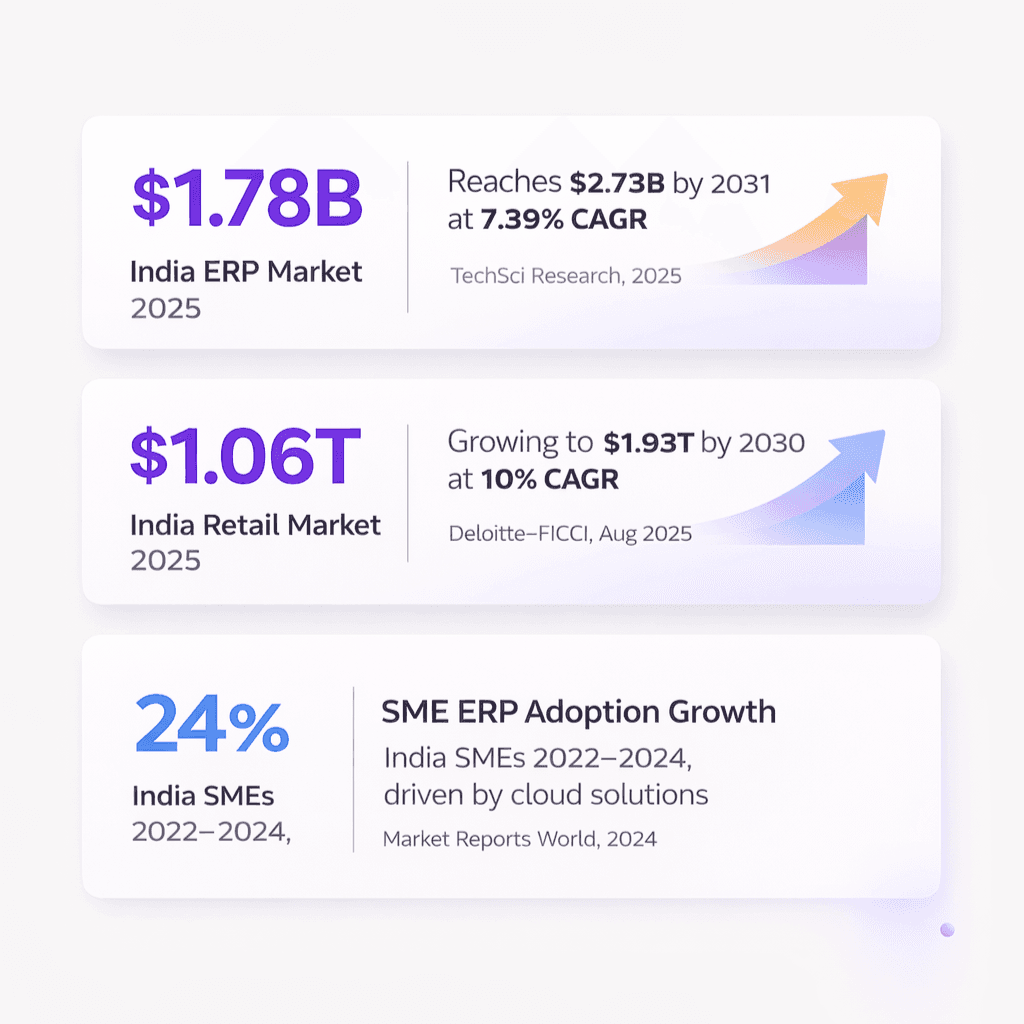
Cloud Is Now the Standard, Not the Exception: Cloud-based ERP represents 70% of all global ERP implementations in 2025, with the global ERP market valued at USD 73 billion (Cargoson / HG Insights, 2025). In India specifically, cloud is the fastest-growing ERP deployment segment, as businesses eliminate hardware costs and IT dependency. The India ERP software market is forecast to reach USD 7.8 billion by 2030 at 16.2% CAGR (Grand View Research, 2025). Peddle Plus One ERP is cloud-native by design, nothing to install, accessible on any device from day one.
AI Is Entering Retail ERP Now, Not in the Future: 65% of CIOs foresaw AI integration into ERP systems, and cloud-based solutions accounted for over 57% of ERP market share in recent years (Market Reports World, 2024). The Indian smart retail market is driven by AI, IoT, and analytics, is forecasted to grow at 34.3% CAGR between 2025 and 2033, reaching USD 12.7 billion (Grand View Research, 2025). Demand forecasting, automated reorder intelligence, and predictive stockout alerts are moving from enterprise-only features to mainstream retail ERP capabilities.
GST Compliance Is a Forcing Function in 2025: From April 1, 2025, businesses with AATO above Rs. 10 crore must upload e-invoices to the IRP within 30 days of issuance or face rejection and penalties of Rs. 10,000 per invoice or 100% of tax due (GSTN Advisory, November 2024). The e-invoicing threshold has been reduced from Rs. 500 crore in 2020 all the way down to Rs. 5 crore in 2023, and further tightening is expected. Businesses not yet integrated with the IRP through their billing system are operating on borrowed time.
Quick Commerce Is Reshaping Retail Expectations: India is now the world's first scaled quick commerce market, operating across 80+ cities at 70-80% CAGR growth (Deloitte-FICCI, August 2025). Two-thirds of all online grocery orders in India now go through quick commerce channels. Over 60% of e-commerce transactions originate from Tier II and III cities, meaning the demand for real-time inventory accuracy and fast fulfilment is no longer a metro phenomenon.
Retail Leasing and Physical Expansion Is Accelerating: India's retail sector leasing surged to 3.2 million sq ft in Q3 2025 alone, marking 65% year-on-year growth across the top 7 cities (JLL India Retail Report, Q3 2025). D2C brands, domestic retailers, and fashion chains are aggressively opening new stores, creating exactly the kind of multi-location operational complexity that demands integrated ERP infrastructure, not spreadsheets and WhatsApp groups
Common Mistakes Retail Businesses Make When Choosing ERP
01 | Choosing on price alone, not on total cost of ownership. A Rs.1,500/month tool that cannot track inventory across locations costs far more in operational inefficiency than it saves in subscription fees. Calculate total cost including CA time, manual errors, stockout losses, and shrinkage you cannot detect -- not just the platform price. |
02 | Importing messy historical data without cleaning it first. Migrating years of inconsistent stock records and incorrectly categorized transactions into a new ERP creates a new problem in a better system. Conduct a proper inventory audit and data review before go-live. The implementation goes faster and the data you get out is actually trustworthy. |
03 | Treating ERP implementation as an IT project instead of an operations project. The most common reason ERP implementations underperform is that the team using the system daily, store managers, purchasing staff, and warehouse operators, are not adequately involved in configuration and training. The people who live in the system must shape the system. |
04 | Over-specifying - buying more system than the business currently needs. A 12-location distribution business does not need the same ERP as a 2,000-location global retailer. Match the platform to where you are now and where you realistically plan to be in three years. Complexity that is never used is just cost and confusion. |
05 | Not measuring ROI after go-live. Most businesses implement ERP and never formally measure what has changed. Define your baseline metrics before go-live: shrinkage percentage, CA hours at month-end, stockout frequency, and purchasing lead times. Measure them again at 90 and 180 days. The numbers will tell you the story and usually, they are more convincing than anyone expected. |
How to Choose the Right ERP for Your Retail Business
Not every ERP is right for every retail business. Here is the evaluation framework a retail CEO should apply before committing to any platform, including Peddle Plus One ERP.
Scalability: Will It Grow With You?
An ERP that performs well for three stores but degrades at ten is not a solution; it is an expensive bridge to the same problem you started with. Ask the vendor directly: What is the largest multi-location retail operation currently running on your platform? How does the system perform at 500 concurrent transactions across 15 locations? Scalability is not a technical abstraction; it is a strategic question that affects your next three years of growth.
Compliance Readiness: Is India Native, Not Bolted On?
GST compliance for Indian retail cannot be an afterthought. Verify that the platform integrates directly with the Invoice Registration Portal for e-invoicing, generates e-way bills from within the billing workflow, and auto-populates GSTR returns from live transaction data. If any of these require a manual step, a separate tool, or a data export, the compliance benefit is substantially reduced.
Integration: Does It Connect to Your Existing Operation?
A new ERP cannot exist in isolation. It needs to connect to your payment partners, your delivery partners, your CA's accounting platform, and your online selling channels. Ask for a specific integration list and test each one. Native integration is categorically different from a manual export that technically works but adds friction to every workflow.
Implementation Reality: How Long, and What Support?
Legacy enterprise ERP vendors quote 6 to 12 month implementations. For a mid-scale Indian retail business, that timeline is operationally unsustainable. A modern cloud retail ERP should be live within days. Insist on a clear go-live commitment, defined milestones, and available support in your language and time zone. Peddle Plus One ERP provides onsite implementation support across 10+ Indian cities, in Hindi and English.
ROI Evaluation: Can You Measure the Return?
Before committing, define the specific metrics you will use to evaluate ROI. Shrinkage rate before and after. CA hours at month-end. Stockout frequency. Purchasing lead times. Month-end close duration. A good ERP vendor should be able to show you reference cases with real numbers from businesses comparable to yours , it's not just feature lists and marketing claims.
The Future of Retail ERP in India: The Next Five to Ten Years
The next decade in Indian retail will be defined by a single operational dividing line: businesses that run on real-time integrated data, and businesses that do not. The gap between those two groups is already widening, and it will accelerate as the advantages of connected operations compound over time.
AI-powered demand forecasting will move from enterprise-only to mainstream retail ERP within 18 to 24 months. Predictive stockout alerts, automated reorder intelligence, and margin optimization suggestions will become table-stakes capabilities but only accessible to businesses whose operational infrastructure is already connected enough to generate the data AI needs to work from.
Blockchain-based supply chain transparency is entering Indian ERP conversations, particularly for pharma, food, and high-value consumer goods where product provenance and authenticity matter. India's blockchain market is projected to grow at 65.6% CAGR through 2033 (VasyERP Research, 2026). Retail ERP platforms building deep audit-trail infrastructure today are laying the foundation for blockchain integration tomorrow.
ONDC expansion will reshape how Indian retailers access customer demand. Businesses with connected ERP infrastructure will be positioned to sell through the national digital commerce network without marketplace dependency. Those on disconnected tools will struggle to manage the operational complexity that multi-channel volume creates.
The retail CEOs who build their operational foundation now, with real-time inventory, automated compliance, multi-location governance, and data-driven purchasing, are not just solving today's problems. They are building the competitive infrastructure that will separate the businesses that scale from the ones that stagnate, as the USD 1.06 trillion market they are operating in moves toward USD 1.93 trillion by 2030 (Deloitte-FICCI, 2025) and USD 3.1 trillion by 2035 (Expert Market Research, 2025).
The Conclusion
India's retail sector reached USD 1.06 trillion in 2025 and is projected to nearly double to USD 1.93 trillion by 2030 (Deloitte-FICCI, August 2025). It is not growing gradually. The businesses that will define what Indian retail looks like a decade from now are being built today, and the decisions being made about operational infrastructure right now are not administrative choices. They are competitive ones.
The retail CEO who has been running on instinct, phone calls, and disconnected tools has not been making wrong decisions. They have been making the best decisions available with the information they had. Peddle Plus One ERP changes what information is available and changes it permanently. Real-time visibility across every location. Compliance that runs itself. Shrinkage caught in hours rather than discovered at year-end. Purchasing driven by data rather than gut feel. Working capital is freed from dead stock rather than being locked in it.
This is what diligent ERP means for Indian retail. Not a software deployment. Not a technology project. A fundamental upgrade to how clearly a business can see itself, and how confidently its CEO can lead it. That clarity, which once experienced, tends to make the question of whether to invest in serious operational infrastructure feel, in retrospect, like one of the easier decisions a growing business ever made.
If you are managing multiple locations, carrying meaningful inventory, navigating Indian GST compliance, and making decisions on anything less than real-time data, the infrastructure described in this blog is not a future consideration. It is a present-day need. The only remaining question is how long the current situation is sustainable before the cost of not acting becomes larger than the cost of acting.
Frequently Asked Questions
What makes Peddle Plus One ERP the best choice for retail CEOs in India?
Peddle Plus One ERP is the top choice for retail CEOs in India because it offers real-time visibility and shrinkage control, essential features for managing multiple stores effectively. It also ensures full GST compliance, all without the high cost typically associated with ERP systems. This makes it a strategic decision for forward-thinking retail business leaders.
How does Peddle Plus One ERP software assist with retail inventory management in India?
Peddle Plus One ERP software enhances retail inventory management in India by providing accurate, real-time data across all locations. This multi-store ERP India solution reduces errors and shrinkage, helping retailers keep track of stock levels and improve overall operational efficiency.
Can Peddle Plus One ERP be used effectively by retail franchise owners in India?
Yes, Peddle Plus One ERP is designed to meet the needs of retail franchise owners in India. It offers capabilities tailored to franchise structures such as centralized control over multiple outlets, which is ideal for maintaining consistent operational practices across all franchise locations.
Is Peddle Plus One ERP considered an affordable ERP option for retailers?
Peddle Plus One ERP is an affordable ERP solution for retailers, offering comprehensive features like real-time insight and shrinkage control at a fraction of the cost compared to traditional ERP systems, which can cost between Rs. 30-40 lakh. It's a cost-effective choice for retailers looking to optimize their operations.
How does Peddle Plus One ERP software support GST compliance for retail CEOs in India?
Peddle Plus One ERP software simplifies GST compliance for retail CEOs in India by automating the intricate GST calculations. This reduces manual errors, ensures accurate reporting, and keeps business operations within the legal framework, saving both time and resources for retailers.
What benefits do retail CEOs gain from using one ERP system for their retail operations?
Using one ERP system like Peddle Plus One for retail operations brings numerous benefits to retail CEOs such as streamlined processes, unified data management, and improved cross-functional communication within the business. This holistic approach enhances business efficiency and drives sustainable growth.

Tamanna Bhardwaj
EditorContent Strategist at Peddle Plus with 4+ years of experience in brand growth and marketing, specializing in retail technology, ERP adoption, and business operations for Indian SMEs.