Retail ERP Software in India: The Complete Buyer's Guide
Table of Contents
Why Indian Retailers Are Rethinking ERP in 2026
The Real Operational Problems Indian Retailers Actually Face
What Is Retail ERP? And How Does It Actually Work Day-to-Day?
What a Retail ERP Manages - In Plain Terms
With ERP vs Without ERP: The Honest Side-by-Side
Retail ERP Software in India: Use-Case-Based Comparison (2026)
Industry-Specific Use Cases: Which ERP Fits Where
ERP Cost Reality in India: What You Actually Pay in 2026
How to Choose the Right Retail ERP for Your Business
ERP Implementation: What to Realistically Expect
Red Flags to Watch for When Evaluating ERP Vendors
ROI: What a Good Retail ERP Actually Saves You
Closing Thoughts
Why Indian Retailers Are Rethinking ERP in 2026
Picture this: it is Tuesday morning. Your head office manager is on a call with a store manager in Pune. The store claims they have stock. The system says something different. The manager is manually counting. Meanwhile, a customer is waiting, and a purchase order is stuck in a WhatsApp thread that nobody has replied to since Saturday.
This is not an unusual scenario. It is, in fact, the operating reality of hundreds of growing Indian retail businesses - businesses that are profitable on paper, expanding on the ground, yet constantly fighting fires that their technology was never designed to handle.
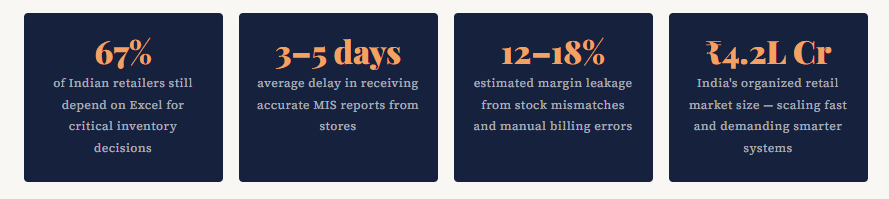
The truth is, most growing businesses in India rely on a patchwork of tools. Tally for accounts, Excel for inventory, WhatsApp for coordination, a billing app for invoices, and a CA who pulls everything together at month-end. For a single-store setup, this works barely. For a business with 3, 10, or 25 locations? It becomes an operational liability.
"We were profitable, but we never really knew why or when we might stop being so. Every report came a week late. Every decision was a guess."
- Owner, multi-store apparel chain, Ahmedabad
In 2025-26, the retail ERP conversation in India has fundamentally shifted. It is no longer about whether your business needs an integrated system. It is about which one, at what cost, and when. This guide cuts through the noise and gives you honest, practical answers, whether you run a single distribution warehouse or a 30-outlet franchise.
The Real Operational Problems Indian Retailers Actually Face
Before we talk software, let us talk about pain. Real, day-to-day operational pain that business owners and managers deal with usually without naming it as a "systems problem."
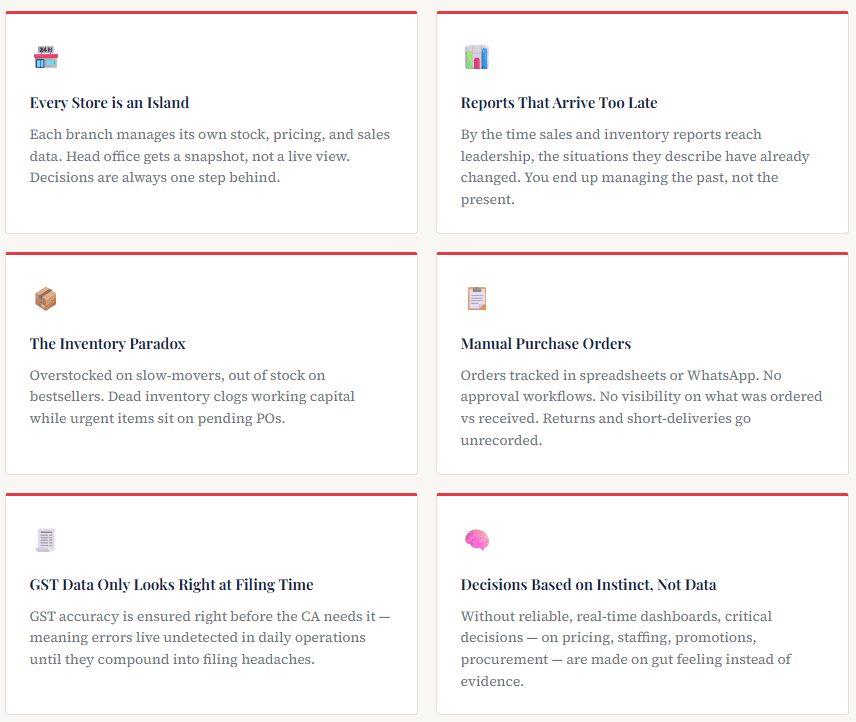
The Silent Leakage Problem
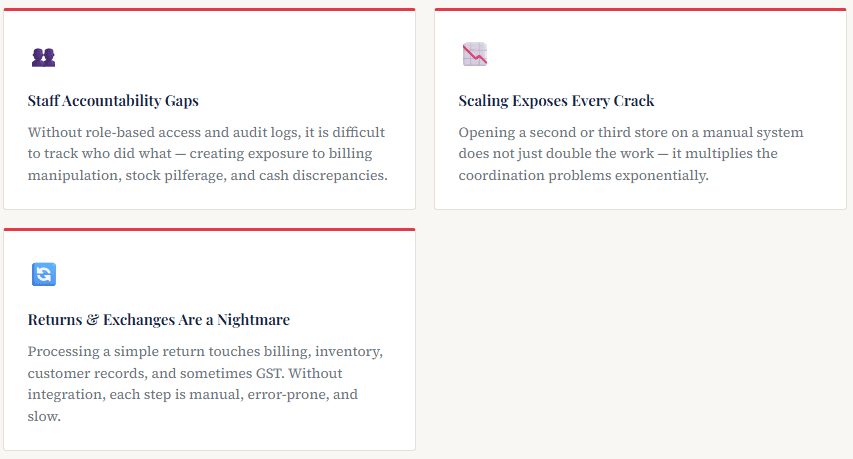
These problems do not announce themselves dramatically. They show up as margin erosion, cash flow stress, missed opportunities, and leadership fatigue. By the time they become visible, they have often been bleeding the business for months.
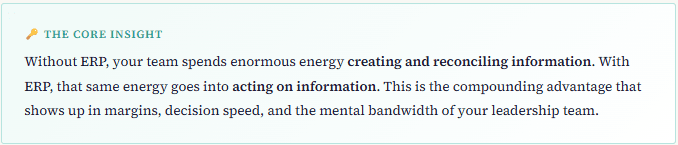
None of this is a failure of effort or intent. These challenges are a natural consequence of using tools that were built for a simpler era of retail. ERP does not solve for effort, it solves for the architecture of how your business captures, connects, and uses information.
What Is Retail ERP? And How Does It Actually Work Day-to-Day?
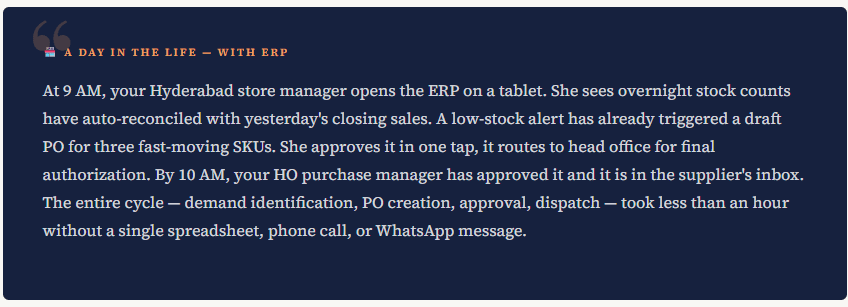
The term "ERP" Enterprise Resource Planning sounds more complex than it needs to. In plain language: it is a single system that connects all the moving parts of your business so that everyone from the store floor to the head office is working from the same accurate, real-time data.
Think of it this way. Right now, your business probably uses separate tools for billing, a different one for inventory, spreadsheets for purchase tracking, and Tally for accounts. Each of these tools creates its own version of the truth. ERP replaces that patchwork with one system of record.
What a Retail ERP Manages - In Plain Terms
Billing & Point of Sale
GST-compliant invoicing across walk-in customers, wholesale buyers, and online orders all from the same interface. Sales data updates inventory in real time the moment a transaction occurs.
Inventory Management
Live stock visibility across every store and warehouse. Batch-wise, expiry-wise, and variant-wise tracking. Automated low-stock alerts. Dead stock identification. Reorder point suggestions based on sales velocity.
Purchase & Supplier Management
Centralized purchase order creation with defined approval workflows store manager requests, head office approves, supplier receives. Track delivery status, partial fulfillments, and returns seamlessly.
GST & Compliance
Automated GST calculation across all transaction types. Clean, structured GSTR-1, GSTR-3B, and GSTR-2A reconciliation data. Fewer CA surprises at filing time because compliance is handled at the point of transaction, not retrospectively.
Head Office Control & Reporting
Real-time dashboards for sales performance, store-wise comparisons, category performance, staff productivity, and margin analysis. Leadership teams manage the business not the data extraction process.
Customer & Loyalty Management
Customer purchase history, loyalty point tracking, and targeted offer management across all stores. Build relationships that keep customers coming back and give you data on who they are and what they buy.
User Access & Audit Controls
Role-based access ensures store staff see only what they need. Management sees everything. Every action is logged, creating full audit trails for stock movements, discounts, voids, and cash transactions.
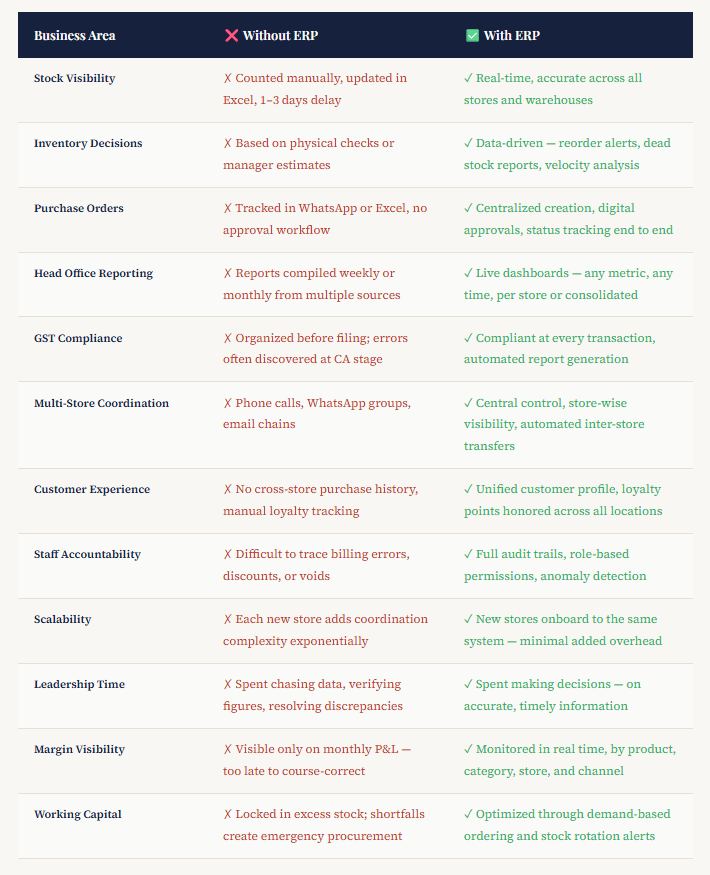
With ERP vs Without ERP: The Honest Side-by-Side
This is the comparison most ERP vendors avoid being explicit about, because the "without ERP" column is uncomfortable. But it is the most important thing to see clearly before making a decision.
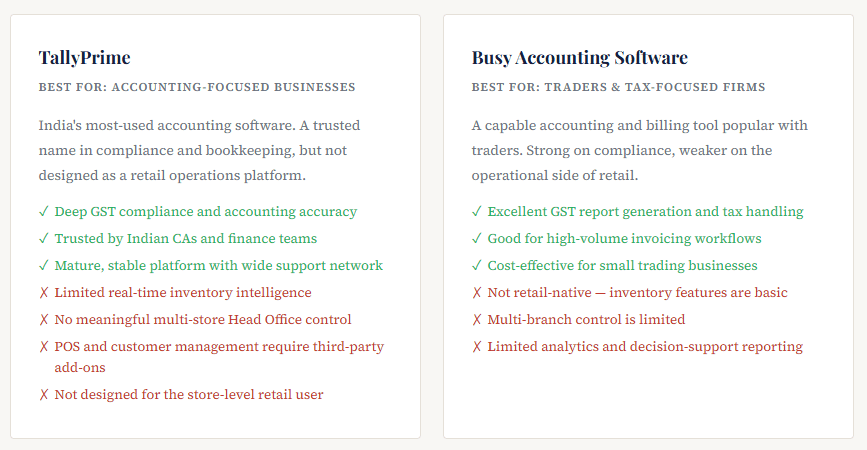
Retail ERP Software in India: Use-Case-Based Comparison (2026)
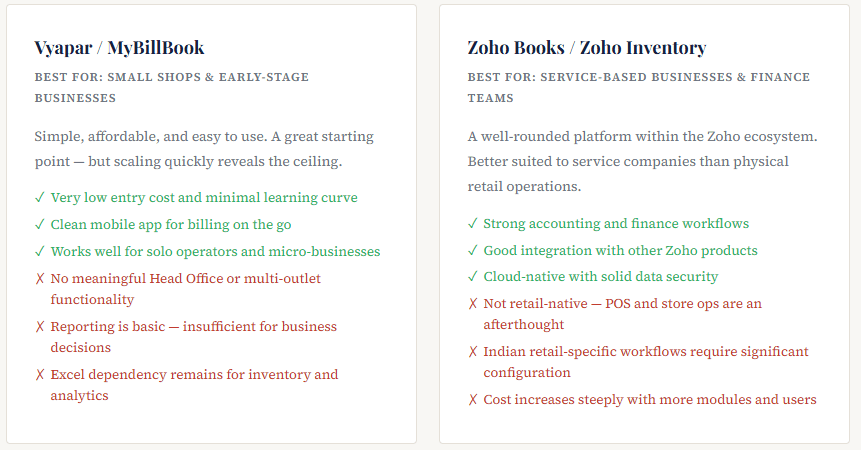
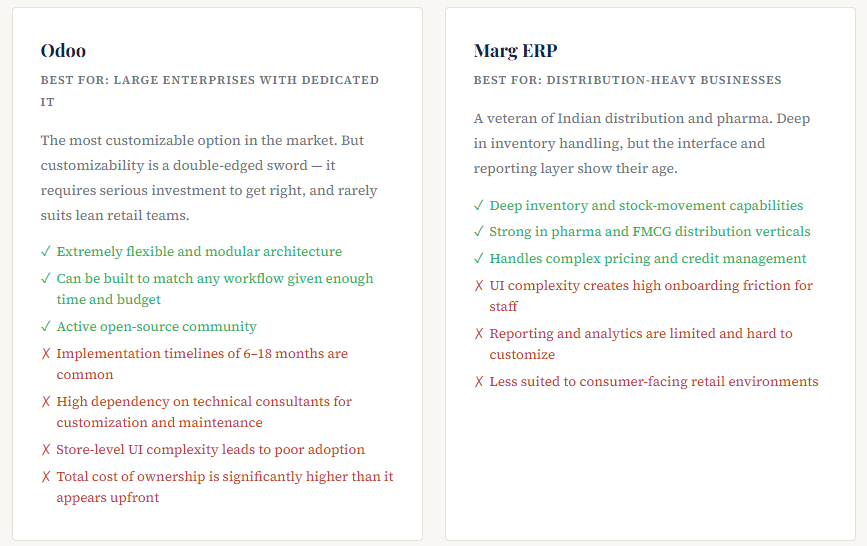
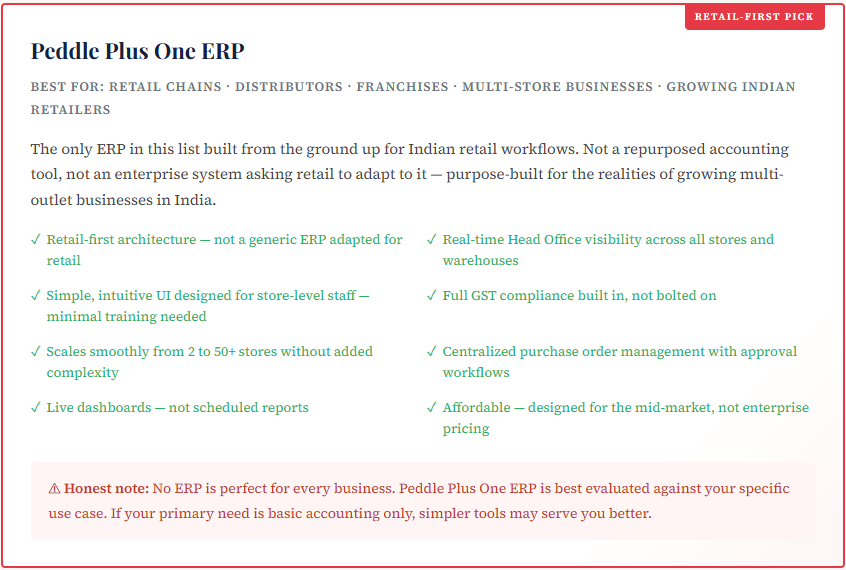
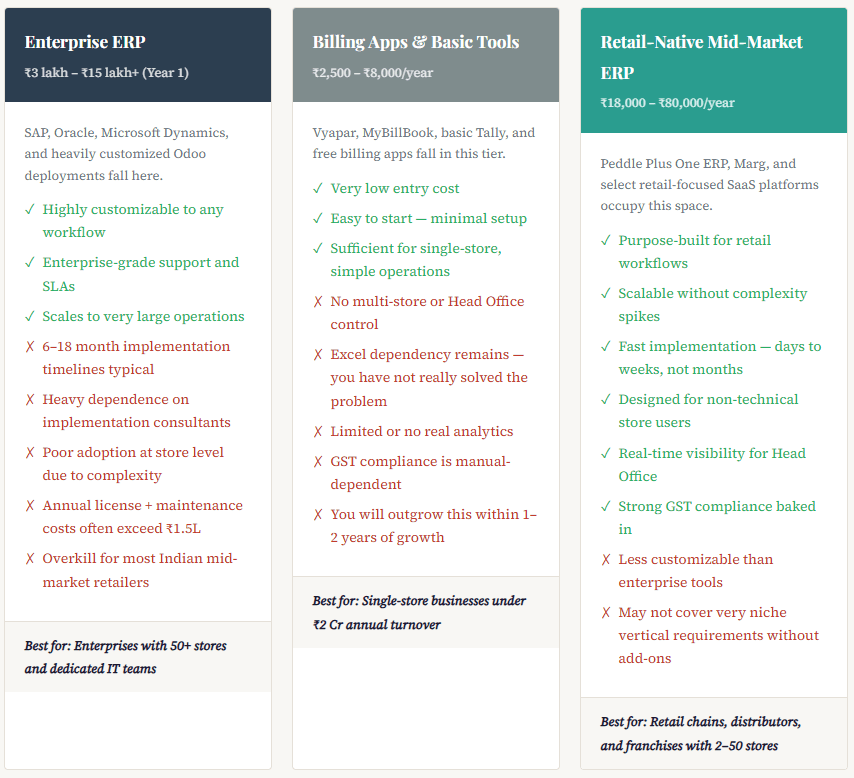
Let us be clear: this is not a ranking. No single ERP is universally the "best." The right choice depends entirely on your business model, scale, team capability, and what you are primarily trying to solve for. What follows is an honest assessment of where each product fits and where it falls short.
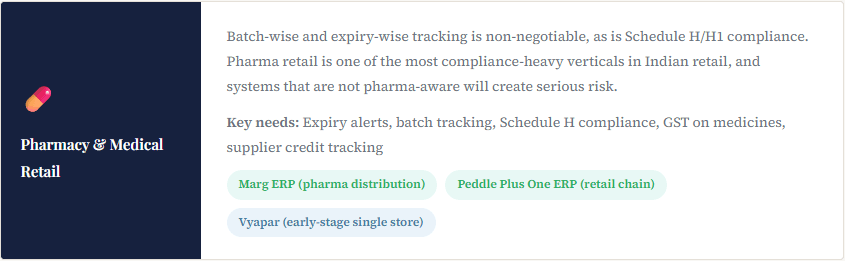
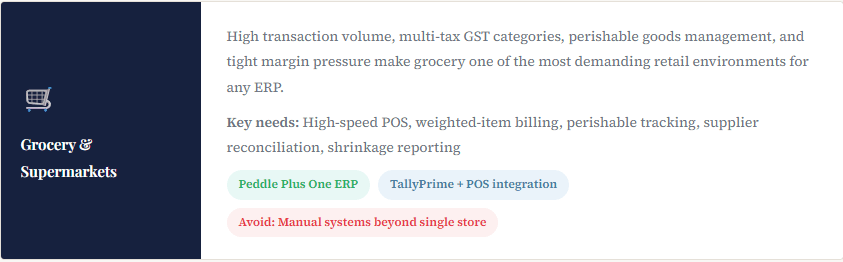
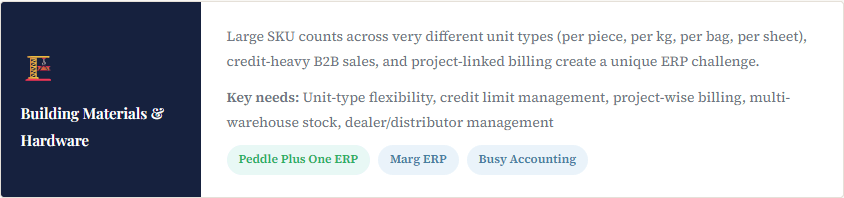
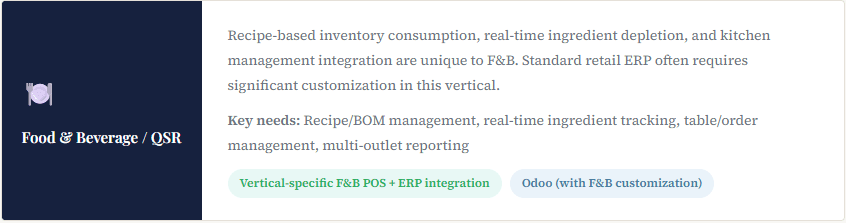
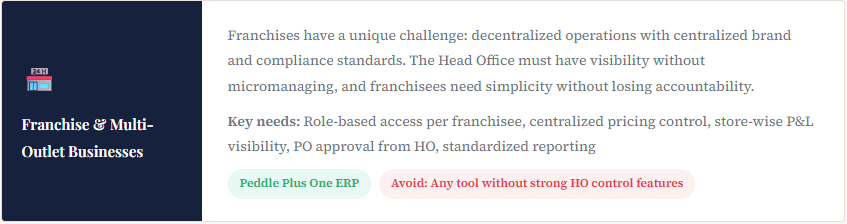
Industry-Specific Use Cases: Which ERP Fits Where
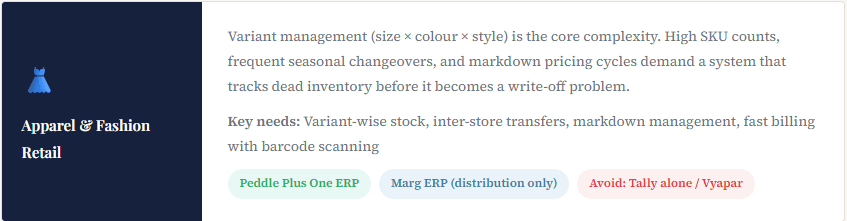
The "best ERP" question cannot be answered without knowing what industry you operate in. A pharmacy's compliance requirements are completely different from an apparel retailer's inventory challenges. Here is how ERP maps to specific Indian retail verticals.
ERP Cost Reality in India: What You Actually Pay in 2026
Cost is often the first question asked and the last thing fully understood. ERP pricing in India spans a very wide range from a few thousand rupees per year to multi-lakh enterprise investments. What matters is not just the sticker price, but the total cost of ownership and whether the system actually delivers value relative to what you pay.
Understanding Total Cost of Ownership (TCO)
The annual license fee is only part of the story. When evaluating cost, factor in:
💡 Full Cost Checklist
One-time costs: Setup fee, data migration, hardware (barcode scanners, POS terminals), initial training.
Ongoing costs: Annual license/SaaS subscription, support and maintenance, add-on modules, per-user fees (common in SaaS ERP).
Hidden costs: Staff time spent on implementation, productivity dip during transition, consultant fees for customization, cost of not switching (the ongoing leakage from your current system).
The cost of a good ERP is fixed and predictable. The cost of not having one in margin leakage, bad decisions, and wasted management time compounds silently every month.
How to Choose the Right Retail ERP for Your Business
The wrong ERP is worse than no ERP. A system that your store staff refuse to use, or that requires constant consultant intervention, will drain resources without delivering results. Here is a structured framework to make the right decision.
Step 1: Define Your Primary Problem Statement
Before evaluating any software, be ruthlessly specific about what you are trying to fix. Are you struggling with inventory accuracy? Multi-store coordination? GST filing chaos? Staff accountability? The answer shapes everything.
Step 2: Map Your Non-Negotiables
How many stores or locations do you operate across?
Do you need Head Office-level visibility and control or just store-level billing?
What is your GST filing complexity (number of GSTINs, HSN codes, return types)?
Do you manage perishables, batches, or expiry-tracked inventory?
Do you need purchase order approval workflows between store and HO?
What is the technical capability of your store-level staff?
Do you operate franchise locations with brand-standardized workflows?
Is mobile/tablet access needed at the POS level?
Do you need offline functionality for stores with unstable internet?
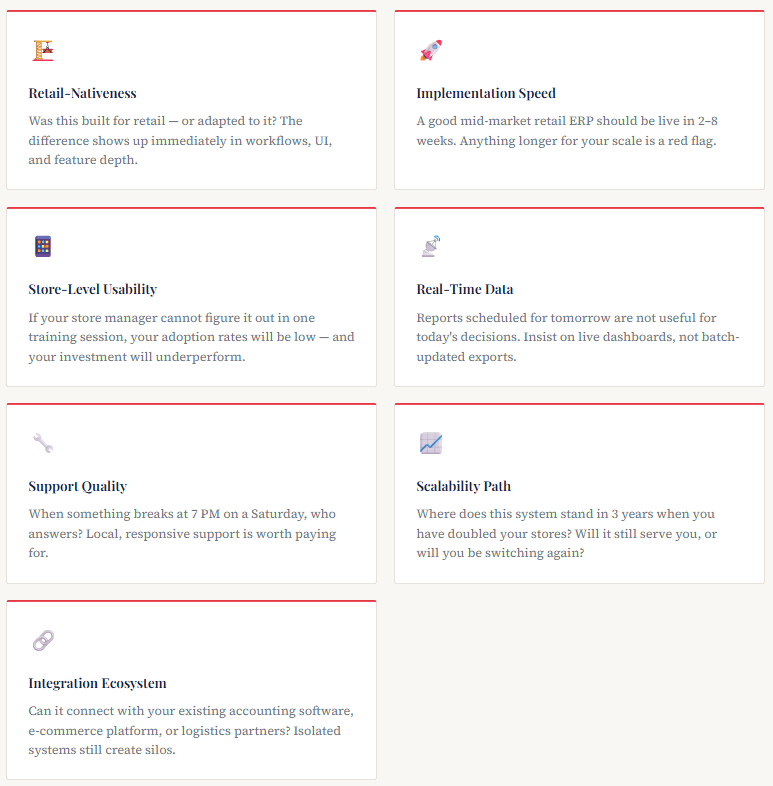
Step 3: Evaluate Vendors on These 7 Criteria
Step 4: Always Demand a Live Demo on Your Own Scenarios
Do not accept a scripted product walkthrough. Come to a demo with 3-5 specific scenarios from your actual business, a multi-store stock transfer, a credit note with GST, a franchise-wise sales comparison report. If the vendor cannot handle your actual use cases fluently in a live environment, that tells you everything.
ERP Implementation: What to Realistically Expect
ERP implementation has a reputation for being painful, over-budget, and under-delivered. That reputation is not entirely undeserved enterprise ERP projects, in particular, have a long history of delay and disappointment. But retail-native mid-market ERPs, when chosen well, follow a very different trajectory.
Typical Implementation Phases for a Mid-Market Retail ERP
Discovery & Configuration (Week 1-2)
The vendor maps your workflows, sets up your master data (products, suppliers, stores, user roles), and configures tax structures and GST settings. A good vendor does most of the heavy lifting here so your team does not need to.
Data Migration (Week 2-3)
Migrating existing inventory data, customer records, and supplier information from Excel or legacy systems. This phase requires your team's involvement to validate data accuracy. Do not skip it or rush it bad data in means bad reports out.
User Training (Week 3-4)
Role-specific training for store staff, store managers, purchase managers, and HO users. A good retail ERP requires 1-2 days of training per user group, not weeks. Insist on hands-on training with your own data, not generic examples.
Pilot Launch (Week 4-6)
Go live on one store or one workflow first. Identify real-world issues in a controlled way before rolling out to all locations. A phased rollout is almost always smarter than a big-bang go-live.
Full Rollout & Stabilization (Week 6-12)
Expand to all stores. Most businesses need 30–60 days post-go-live to settle into new workflows and see the full data-quality benefits of centralization. Set realistic expectations internally it gets better, not worse, after week six.
⚠ What Causes ERP Implementations to Fail
The most common reasons retail ERP projects fail in India:
(1) Selecting a tool based on price alone, not fit.
(2) Rushing data migration without validation.
(3) Inadequate staff buy-in especially at store manager level.
(4) No internal champion someone who owns the implementation and drives adoption.
(5) Over-customizing the tool before going live, delaying the launch indefinitely.
Red Flags to Watch for When Evaluating ERP Vendors
The ERP sales process in India can be aggressive. Vendors know that once a business signs and migrates data, switching costs are high. Here is what to watch for before you commit.
Vague pricing: If a vendor cannot give you a clear, all-inclusive quote in writing including setup, training, and annual renewals negotiate or walk away.
Demo on demo data only: A vendor who refuses to show their product working with your real SKUs and scenarios is hiding limitations.
No reference customers in your vertical: Ask for 2-3 reference customers in a similar business type and actually call them.
"Everything is customizable": This is a warning sign, not a feature. It usually means the base product does not handle your use cases out of the box and customization will delay and cost you.
Long implementation timelines for your scale: If a vendor proposes a 6-month implementation for a 5-store retail chain, it signals the product is not retail-ready.
No clarity on post-go-live support: Who do you call when something breaks? What are the SLA commitments? Is support in English and Hindi? Get this in writing.
Lock-in on data export: Confirm you can export your own data at any time in a readable format. Vendors who restrict this are creating dependency not value.
No mobile or tablet access: In 2026, any retail ERP that is desktop-only is already behind the curve.
ROI: What a Good Retail ERP Actually Saves You
Return on investment from ERP is not just about revenue growth, it is also about leakage reduction, time savings, and decision quality. Here is how the math typically works for a growing Indian retail business.
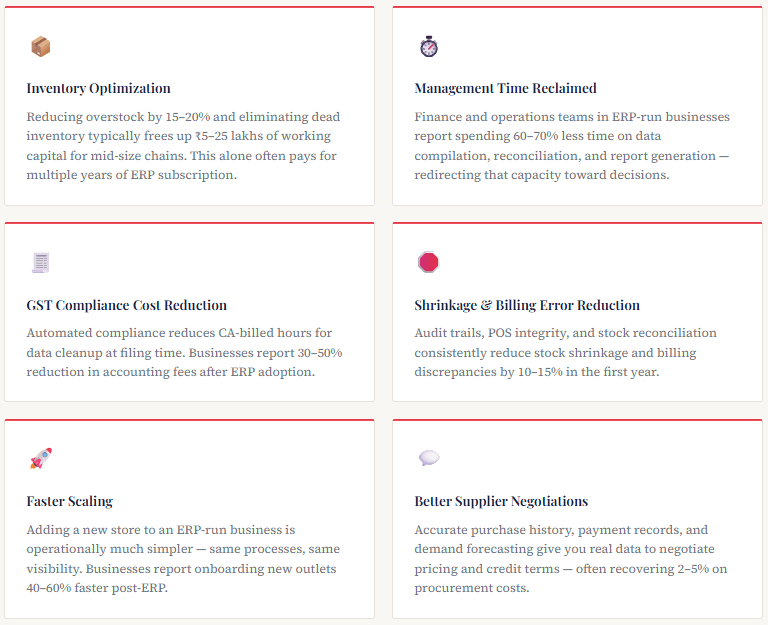
Most mid-market retail businesses that implement the right ERP recover their full Year 1 investment within 4-8 months not through a single dramatic improvement, but through the compounding of many small operational gains.
Closing Thoughts
The goal of this guide is not to sell you any particular software. It is to change how you think about this decision. ERP is not a technology purchase, it is a structural change to how your business captures, processes, and acts on information. Done right, it is one of the highest-ROI investments a growing Indian retail business can make. Done wrong, it wastes money, frustrates staff, and sets your scaling back by 12-18 months.
The businesses that make this transition well share a few characteristics: they define the problem clearly before evaluating solutions, they involve their operations team in the selection process, they invest in training, and they choose a system designed for people like them not a system that asks them to adapt to enterprise-level complexity.
If you are reading this because something in your current setup is not working trust that instinct. The right time to upgrade your systems is usually 6 months before you feel you absolutely have to.
"The best time to implement ERP was before you had the problem. The second best time is now."
Frequently Asked Questions
What is the best retail ERP software in India in 2026?
There is no single "best" only the best fit for your specific business. For accounting-focused needs, TallyPrime remains the standard. For distribution, Marg ERP has depth. For growing retail chains, multi-outlet businesses, and franchises, Peddle Plus One ERP is designed specifically for that segment. Start by defining your primary operational problem, then evaluate options against that problem not against general feature lists.
How much does retail ERP software cost in India?
Costs range from ₹2,500/year for basic billing apps to ₹15 lakh+ for enterprise implementations. The practical sweet spot for a growing retail chain or distributor (2–20 stores) is typically ₹20,000–₹80,000 per year for a retail-native SaaS ERP. Always factor in setup fees, training, and hardware when calculating the real cost.
Can ERP replace Tally for accounting?
Retail ERP complements Tally rather than replacing it in most cases. ERP handles daily retail operations billing, inventory, POs, staff management while Tally continues to serve as the statutory accounting and audit tool. Many businesses run both, with ERP feeding clean data into Tally. Some businesses do transition fully to ERP-based accounting once they are comfortable, but this is a business decision to make after go-live not a day-one requirement.
How long does ERP implementation take for a retail chain?
For a retail-native mid-market ERP, a 3–10 store chain should expect 3–8 weeks from kickoff to full go-live. Enterprise ERPs can take 6–18 months for the same scale. If a vendor is quoting longer than 8 weeks for a straightforward retail setup, ask them specifically what is driving the timeline and whether it is complexity in their product or in your requirements.
Is retail ERP difficult for store staff to use?
This depends entirely on the product. Modern retail-native ERPs are designed for non-technical users with simple POS interfaces, guided workflows, and minimal data entry. Enterprise ERPs like Odoo, when poorly configured, can be genuinely difficult for store staff. Before selecting, always have a store-level employee sit down with the demo system and try to complete 2–3 basic tasks without guidance.
Does ERP help reduce dead stock and inventory losses?
Significantly. Real-time stock visibility, sales velocity reporting, and automatic reorder point alerts directly address the two biggest inventory problems in Indian retail: overstocking slow-movers and understocking fast-movers. Most businesses see meaningful inventory optimization within the first 60–90 days of live ERP use.
Which ERP is best for a franchise business?
Franchise businesses specifically need role-based access control, centralized pricing management, standardized reporting across franchisees, and PO approval workflows from the franchisor side. Any ERP that does not have these features built in not as customization, but as standard capabilities will be inadequate for franchise management at scale.
Can retail ERP work without internet connectivity?
This is a critical question for businesses in Tier 2 and Tier 3 cities where internet reliability varies. Some ERPs offer offline modes where the POS continues to function and syncs to the cloud when connectivity is restored. Confirm this capability explicitly with your vendor, and test it do not just accept a verbal confirmation.

Tamanna Bhardwaj
EditorContent Strategist at Peddle Plus with 4+ years of experience in brand growth and marketing, specializing in retail technology, ERP adoption, and business operations for Indian SMEs.