Best ERP Software for Small Businesses in India (2026)
There's a version of this story that plays out in thousands of Indian small businesses every year.
The owner started with a billing app simple, fast, affordable. Then came a second store, so they added a separate Tally instance for accounts. Inventory started being tracked in Excel. Operations ran on WhatsApp. GST filing happened once a quarter in a blur of reconciliation and panic.
For a while, it holds together. Just about.
But at some point usually when the third location opens, or when SKUs cross a few hundred, or when a key employee leaves and takes their Excel muscle memory with them the patchwork starts to unravel. Stock figures don't match. Purchase decisions are made on instinct. The accountant spends three days every month just cleaning up data before they can start the actual work.
This is not a story about software failure. It's a story about outgrowing systems that were never designed to scale.
In 2026, ERP software for small businesses in India has matured to a point where "it's too expensive" or "it's too complex for our size" are no longer valid reasons to delay. The real question isn't whether you need an ERP it's which one is actually built for how your business works, at the stage you're at right now.
This guide is written to answer exactly that.
Table of Contents
Why Small Businesses in India Need ERP in 2026
What Genuinely Good ERP Software Looks Like
The Real Cost of Not Having an ERP
Top ERP Options for Indian Small Businesses - A Use-Case Comparison
How to Choose the Right ERP for Your Business
Implementation: What to Expect and How to Prepare
Not Sure Where Your Business Actually Fits?
Final Thoughts for Business Decision-Makers
Why Small Businesses in India Need ERP in 2026
The Indian small business landscape has changed more in the last three years than in the decade before it.
GST compliance has raised the bar for record-keeping accuracy. Consumers now expect inventory accuracy across online and offline channels. Margins in retail and distribution have tightened, which means operational leakage dead stock, over-purchasing, billing errors has a direct and visible impact on profitability. And the labour market for skilled back-office staff has made it harder to rely on people-dependent manual processes.
Most small businesses today run on what could charitably be called a "multi-tool stack":
Excel for inventory management
A billing app (Vyapar, MyBillBook, or similar) for sales
Tally for accounts and GST
WhatsApp for inter-store and vendor communication
One trusted employee who holds all of this together in their head
This setup has a ceiling, and it's lower than most owners realize. The problems it creates aren't always dramatic — they accumulate slowly, invisibly, until they're impossible to ignore:
Stock figures across locations that never quite match
Purchase orders placed based on gut feel rather than demand data
GST mismatches that take days to trace and correct
Business decisions made on reports that are always a few days out of date
Dependence on individuals rather than systems, creating fragility
ERP doesn't eliminate all of this overnight. But it creates a single, connected operational foundation — one version of the truth across billing, inventory, purchasing, and finance that makes scaling possible without the chaos multiplying in parallel.
In 2026, ERP is not a luxury for Indian small businesses. It's the infrastructure that separates businesses that scale cleanly from those that scale messily.
What Genuinely Good ERP Software Looks Like
Not every tool marketed as an "ERP" actually delivers ERP functionality. There's a significant difference between a billing app with an inventory module and a genuine enterprise resource planning system.
Here's what separates the two and what you should be evaluating when you assess any ERP for your business.
Non-Negotiables (Must-Have From Day One)
Unified billing and POS sync Sales data from your counter, your website, and your marketplace channels should flow into one system automatically. Manual re-entry is where errors begin. GST-ready invoicing with correct HSN codes, tax rates, and invoice formats must be built in, not bolted on.
Real-time inventory across all locations This is perhaps the single most valuable capability an ERP offers a multi-location Indian retail or distribution business. The system should show you live stock at each store, each warehouse, and in transit and update the moment a sale, transfer, or receipt is processed.
Purchase order workflow and approval Good ERP replaces the WhatsApp-to-vendor pipeline with a structured purchase order system: reorder triggers, vendor comparison, approval chains, and GRN (Goods Receipt Note) processing. This alone can cut purchasing errors significantly.
Reports and dashboards without Excel A business owner should be able to open a screen and see store-wise sales, fast-moving vs. dead stock, margins by category, and pending payables without waiting for someone to prepare a report. Real-time dashboards are a standard expectation in 2026, not a premium feature.
GST and compliance readiness Auto-populated GSTR-1 and GSTR-3B data, input tax credit reconciliation, and audit-ready transaction records are baseline requirements for any Indian business. An ERP that doesn't handle this natively creates more compliance work, not less.
Worth Having (Valuable as You Grow)
CRM and customer loyalty management
Mobile app access for store managers and owners on the move
Demand forecasting and replenishment automation
E-commerce and marketplace integrations (Amazon, Flipkart, Meesho)
Role-based access control and audit logs
Vendor performance tracking
The important discipline here is to not let the "nice to have" list drive your decision. Choose an ERP that does the non-negotiables exceptionally well for your current business, and that has a credible roadmap for the features you'll need in 12-24 months.
The Real Cost of Not Having an ERP
This section doesn't appear in most ERP buying guides. It should.
When businesses delay ERP adoption usually citing cost or implementation effort they rarely account for the cost of not having it. These costs are real, measurable, and ongoing. They're just harder to see than a software invoice.
Dead stock and working capital blockage Without demand-driven purchasing, overstocking is almost inevitable. Industry estimates suggest that retail businesses without inventory management systems carry 20-30% more dead stock than those with proper ERP. At an average product margin of 25-35%, that's a significant drag on return on capital.
Stockout losses The other side of the same problem: fast-moving items run out because nobody caught the signal early enough. Customers leave empty-handed or worse find what they want at a competitor.
GST penalties and interest Incorrect or incomplete GST filings, mismatches in input tax credit, and delayed reconciliation carry penalties that compound over time. An ERP that automates GST compliance isn't a convenience, it's risk mitigation.
People cost and knowledge dependency When operations depend on individuals who hold institutional knowledge in their heads (or their personal spreadsheets), the business is one resignation or extended leave away from disruption. ERP systematizes that knowledge.
Slow decision-making When the data you need to make a good decision takes three days to gather and clean, decisions get made on yesterday's information or they get deferred entirely. In a competitive market, this is a structural disadvantage.
The total cost of these inefficiencies, for a typical 3-5 store Indian retail or distribution business, often exceeds the annual cost of a good ERP by a multiple of two or three. The ROI case for ERP is typically not "will we get our money back", it's "how long will it take."
Top ERP Options for Indian Small Businesses - A Use-Case Comparison
This is not a ranked list. Software rankings are almost always misleading because they decontextualize tools from the businesses using them. A system that works brilliantly for a 15-store fashion chain will be overkill for a single-location electronics shop, and vice versa.
What follows is an honest, use-case-based comparison designed to help you match the right tool to your actual situation.
1. Vyapar / MyBillBook
Best for: Early-stage retail shops moving beyond manual billing
These tools occupy the entry level of the market, and they do that job well. For a business owner who has been managing everything in a register or a basic spreadsheet, Vyapar or MyBillBook represents a meaningful step forward: GST-compliant invoicing, basic stock tracking, payment recording, and simple reports — all at a price point that almost any business can afford.
Strengths:
Very affordable (often under ₹5,000/year)
Fast to set up most businesses are running within a day
Clean, simple interface that doesn't require training
Good for single-location businesses with limited SKUs
Honest Limitations:
Multi-outlet support is either absent or very limited
No meaningful warehouse or transfer management
Reports are basic enough to see what happened, not enough to plan what to do next
No head office consolidation or centralized visibility
The verdict: An excellent starting point, but most businesses will outgrow it within 12–18 months of meaningful growth. The risk is staying on it too long and building operational habits that an ERP will later have to undo.
2. TallyPrime
Best for: Small businesses where accounting accuracy and GST compliance are the primary concern
TallyPrime is the most widely adopted accounting software in India, and its reputation is well-earned. For businesses whose primary pain point is clean books and reliable GST filing, Tally is genuinely excellent. It's familiar to virtually every CA and accountant in the country, which matters for practical implementation.
Strengths:
Best-in-class GST compliance and return filing support
Deep accounting functionality journals, ledgers, reconciliation
Familiar to accountants, reducing adoption friction
Strong audit trail and financial reporting
Honest Limitations:
Not designed for retail inventory workflows real-time multi-location stock management requires significant customization or add-ons
No native POS integration; sales data must be manually entered or synced via third-party tools
Warehouse management is rudimentary without additional modules
Reporting is financial-first; operational dashboards require add-ons or workarounds
The verdict: If your primary need is accounting and compliance, and your operations are relatively simple, TallyPrime is a solid choice. For businesses that need operational control alongside financial management, it's a partial solution excellent for one half of the problem.
3. Zoho Books / Zoho ERP Stack
Best for: Service businesses and non-retail SMEs with strong finance and workflow needs
Zoho has built a remarkably comprehensive suite of business applications, and Zoho Books is among the better accounting tools available to Indian SMEs. The Zoho One stack - combining Books, Inventory, CRM, and other modules can serve as a reasonable ERP for certain business profiles.
Strengths:
Strong accounting and finance automation
Good integration across the Zoho suite (CRM, HR, Projects)
Clean UI and cloud-native architecture
Reasonable pricing for the breadth of functionality
Honest Limitations:
Inventory management, while functional, lacks the depth that retail and distribution businesses need
POS integration is more limited compared to retail-native platforms
Customization for Indian retail workflows (batch tracking, SKU variants, kirana-style operations) requires effort
Support quality can vary; implementation partners are important
The verdict: A strong option for service companies, B2B businesses, and non-retail SMEs. Less ideal as the primary system for businesses where inventory movement and POS are core operational realities.
4. Marg ERP
Best for: Distribution-heavy businesses, pharma distributors, FMCG wholesalers
Marg has a long history in the Indian market and has built genuine depth in the distribution and wholesale segment. If your business involves complex inventory management batch tracking, expiry dates, scheme management, multi-warehouse operations Marg is worth evaluating seriously.
Strengths:
Deep inventory modules with batch, serial number, and expiry tracking
SKU-level visibility with movement history
Strong for pharma, FMCG, and distribution workflows
Good vendor management and purchase workflows
Honest Limitations:
The interface reflects its legacy architecture functional, but not intuitive for store-level staff
POS workflows for retail counter operations are weaker than retail-native systems
Dashboard and reporting capabilities feel dated compared to newer platforms
Onboarding requires dedicated time and often hands-on support
The verdict: A strong option for distribution-centric businesses willing to invest in proper implementation. Less suitable as the primary system for businesses where the retail counter experience and store-level dashboards matter.
5. Odoo
Best for: Businesses with dedicated IT capability and appetite for a highly customized solution
Odoo is one of the most powerful modular ERP platforms available globally, and it has a growing presence in the Indian market. Its open-source foundation means it can, in principle, be configured to handle almost any business workflow. In practice, that flexibility comes with significant implementation complexity and cost.
Strengths:
Exceptionally broad functionality manufacturing, retail, distribution, HR, CRM, accounting and more
Modular architecture allows you to start small and add capabilities
Large global ecosystem of implementation partners and modules
Strong for businesses with non-standard or complex workflows
Honest Limitations:
Implementation timelines are significant 3-9 months is common for mid-size businesses
Cost of customization escalates quickly; what looks affordable at the license level often costs multiples more in implementation
Requires dedicated internal ownership to manage and maintain
Not plug-and-play businesses without technical capacity often struggle to realize the value
The verdict: Odoo is genuinely powerful and can deliver excellent results for the right business with the right implementation partner. For most small Indian retail or distribution businesses, it's overbuilt at this stage and the implementation investment will outweigh the operational benefit. Worth reconsidering as the business scales.
6. Peddle Plus One ERP
Best for: Scaling Indian retailers, small retail chains, and distribution businesses looking for a retail-first ERP
Peddle Plus One ERP is built specifically for the Indian retail and distribution context which is a meaningful differentiator in a market where most ERP platforms were originally designed for Western or enterprise-scale businesses and adapted for India as an afterthought.
Strengths:
Designed around Indian retail workflows from the ground up not a generic ERP with a retail skin
GST-ready billing with deep POS integration; counter staff can operate it with minimal training
Real-time inventory across stores and warehouses, with head office visibility into all locations
Structured purchase order workflows with demand-based replenishment signals
Onboarding designed for businesses that don't have dedicated IT teams implementation is measured in days, not months
Built by people with direct retail operating experience, which shows in how the workflows are structured
Honest Limitations:
Currently focused on retail and distribution; businesses in manufacturing, services, or other segments will find the scope narrower
As a newer platform, the ecosystem of third-party integrations is still developing compared to more established names
The verdict: For scaling Indian retailers and distributors who want an ERP that works the way their business actually works without a multi-month implementation project or a large IT budget Peddle Plus One ERP is worth serious consideration. It occupies an important gap in the Indian market between entry-level billing tools and full-scale enterprise systems.
How to Choose the Right ERP for Your Business
With the options above in mind, here's a practical decision framework. The right ERP is never the most powerful one or the most affordable one in isolation it's the one that fits your current operational reality and has room to grow with you.
Step 1: Be Honest About Your Current Pain Points
Before evaluating any software, spend 30 minutes listing the specific problems your current setup is creating. Not general frustrations specific ones. "We don't know which store has stock without calling the manager" is specific. "Our system isn't good enough" isn't.
The more precisely you can articulate your pain points, the more clearly you can evaluate whether a given ERP actually addresses them.
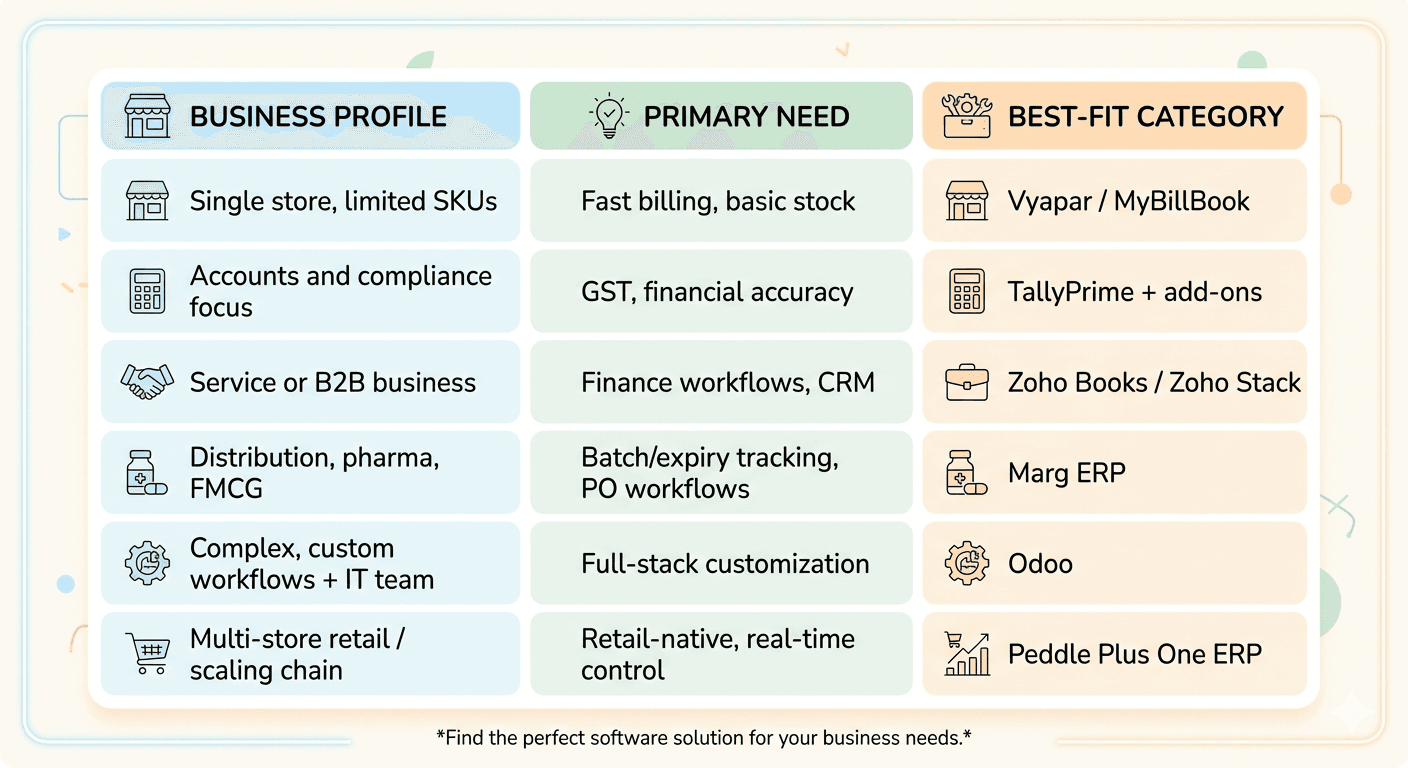
Step 2: Match Your Business Profile to the Right Category
Step 3: Evaluate Implementation Honestly
A common mistake is buying an ERP based on its feature list without accounting for the implementation reality. Ask every vendor these questions before signing:
What does a typical implementation for a business like ours look like?
How long does it take from contract to fully live?
Who owns data migration, and what does that process look like?
What training is provided for store-level staff?
What does ongoing support look like who do we call when something breaks?
Step 4: Factor in Total Cost of Ownership
License cost is usually the most visible number and often the least representative of true cost. The more important calculation includes: implementation cost, data migration effort, training time, ongoing support, and the cost of any customization you'll need over the first 12 months.
For most small businesses, a platform that costs slightly more per month but has a dramatically simpler implementation will deliver better ROI than a cheaper platform with a long, complex setup.
Step 5: Run a Realistic Pilot Before Full Commitment
If the vendor allows it (and reputable ones usually do), pilot the system at one store or one department before a full rollout. Real-world use will surface operational gaps that no demo can reveal. Pay particular attention to how the system performs at the counter under realistic transaction volumes, and how quickly your actual staff not a tech-savvy champion user can get comfortable with it.
Implementation: What to Expect and How to Prepare
ERP implementation is where most small business technology projects succeed or fail not in the software selection phase. A few principles that matter regardless of which platform you choose:
Data preparation is the most underestimated task. Clean product master data (accurate SKUs, correct HSN codes, opening stock figures) before go-live is essential. Businesses that rush this step almost always pay for it with a chaotic first month.
Start with core workflows, not every feature. The instinct to configure every module at launch is natural but counterproductive. Implement billing, inventory, and basic reporting first. Add purchasing workflows once the team is comfortable. Add advanced analytics and forecasting later. Phased adoption has a much higher success rate than big-bang rollouts.
Designate a champion, not just a user. Every successful ERP implementation has one person internally who owns it not just as a user, but as the person responsible for making it work. This doesn't need to be a technical role, but it does need to be someone with enough authority and interest to drive adoption.
Budget for training, not just software. The biggest determinant of ERP success is user adoption, and adoption is a training problem as much as a software problem. Counter staff who understand why the system matters are more likely to use it correctly than staff who were told they have to.
Expect 4–6 weeks of parallel running. Running the old system alongside the new one for a period is standard practice and prudent risk management. It adds complexity temporarily but provides a safety net during the most vulnerable phase of the transition.
Not Sure Where Your Business Actually Fits?
Reading through six ERP options is one thing. Knowing which one matches your specific business — your store count, your SKU complexity, your team's comfort with technology, your growth plans — is another.
If you'd like an honest, no-pressure assessment of where your business stands and what kind of ERP genuinely fits, the team at Peddle Plus One is happy to have that conversation. Not a product demo. A diagnosis first.
[Talk to Us →]
Final Thoughts for Business Decision-Makers
Here's something worth sitting with: most Indian small businesses don't struggle because of low sales. They struggle because their operations have quietly outgrown the systems holding them together.
The business that grew from one store to four in three years is now being managed with tools that were designed for the one-store version. The decision that worked then handle it manually, reconcile at month end, trust the team to keep it in their heads is now the decision that's silently limiting growth.
ERP doesn't solve every problem. It doesn't replace good judgment or strong relationships with vendors and customers. What it does is give you a foundation of operational clarity real numbers, in real time, across the whole business that makes every other decision sharper.
The businesses that are winning in Indian retail and distribution in 2026 are not necessarily the ones with the most stores or the biggest budgets. They're the ones that know exactly what they have, where it is, what it cost, and what to do next.
The right ERP is how you get there.
Looking to evaluate ERP options for your specific retail or distribution setup? The best starting point is a structured conversation about your current operations not a software demo. Understanding your pain points precisely is what makes the difference between buying software and buying control.
Frequently Asked Questions
Can small businesses genuinely afford ERP in 2026?
Yes and the more useful question is whether they can afford not to have one. Cloud-based SaaS ERP pricing has come down significantly, with credible retail-focused platforms available in the ₹15,000-₹50,000 per month range for a 3-10 store operation. When measured against the operational losses from stock mismatches, purchasing inefficiencies, and GST errors, the ROI case is usually compelling within the first year.
Do single-store businesses need ERP?
Not necessarily. A single-store business with a limited SKU count, simple purchasing, and an owner who is directly involved in operations can usually manage with a good billing app and Tally. The signal to consider ERP is when you're experiencing the specific pain points described earlier not as a matter of scale alone, but as a matter of operational complexity. but it's also good to be in system from starting, which help you in scaling easily, if you want a systematic approach and you are visionary you can have ERP for single store .
Should we replace Tally or integrate with ERP?
This depends on your accounting team's comfort level and your CA's requirements. Many businesses integrate their operational ERP with Tally using the ERP for inventory, POS, and purchasing, and pushing financial data to Tally for final accounts and returns. Others move fully onto an ERP that includes accounting. There's no universal right answer, but the integration route is lower-risk for businesses where the CA relationship is central to compliance.
How secure is cloud ERP for Indian business data?
Modern cloud ERP platforms use enterprise-grade security: encrypted data at rest and in transit, role-based access controls, automated backups, and compliance with Indian data protection requirements. Cloud storage is generally more secure than data stored on an on-premise server maintained by a small business's internal IT. The appropriate question is not "is cloud safe?" but "does this specific vendor have credible security certifications and a clear data policy?"
How long does ERP implementation realistically take for a small business?
For retail-native, cloud-based platforms designed for SMEs: 2-6 weeks from contract to go-live is realistic, assuming data is clean and the business is committed. For more complex platforms like Odoo or SAP Business One: 3-6 months is a more honest expectation. The variance is large because implementation speed depends as much on the business's readiness as on the software. but in case of Peddle Plus One ERP , this issue does not exist, as it is very simple and easy to understand that from day one some of the works can be done from 2-3 hours training , need less than a week to integrate in your business.
What happens if the ERP vendor shuts down or pivots?
This is a legitimate concern with newer platforms. Ask vendors directly about their data export policies you should be able to export your complete transaction history in a standard format at any time. For businesses where continuity risk is a serious concern, established platforms with a long track record offer more certainty, even if newer platforms may offer better features for your current needs.

Tamanna Bhardwaj
EditorContent Strategist at Peddle Plus with 4+ years of experience in brand growth and marketing, specializing in retail technology, ERP adoption, and business operations for Indian SMEs.