Peddle Plus Team • January 30, 2026
Are you a working professional managing a retail business in India? If so, you're probably juggling inventory, billing, customers, and suppliers—sometimes all at once. As 2026 approaches, the march of technology is impossible to ignore. Whether you own a thriving fashion store, a cozy electronics shop, or a sprawling departmental outlet, you’ve likely heard about Retail ERP Software India but might still rely on traditional billing solutions. That brings us to the burning question that’s on every retailer’s mind: ERP vs Traditional Billing Software—what should you choose to set your store up for success in 2026?
Why ERP vs Traditional Billing Software Matters for Indian Retailers
Retail in India isn’t what it used to be. Customer expectations are rising, businesses expand fast, and competition is fierce—even at the neighborhood level. Whether you run a family-owned shop or a growing chain, the tools you use play a direct role in how smoothly you operate and scale.
Many shopkeepers start with basic billing software because it’s simple, cost-effective, and gets the job done. But as the business grows, they hit limits—manual errors, separate systems for inventory and billing, and challenges in gaining insights from scattered data.
This is where ERP (Enterprise Resource Planning) steps in—offering integrated, end-to-end Retail Management Software 2026 promises to be smarter, more user-friendly, and absolutely essential for making strategic decisions. Let’s break down how these two solutions stack up, making your choice less daunting and way more informed.
1. Key Features: What Do You Really Get?
Traditional Billing Software:
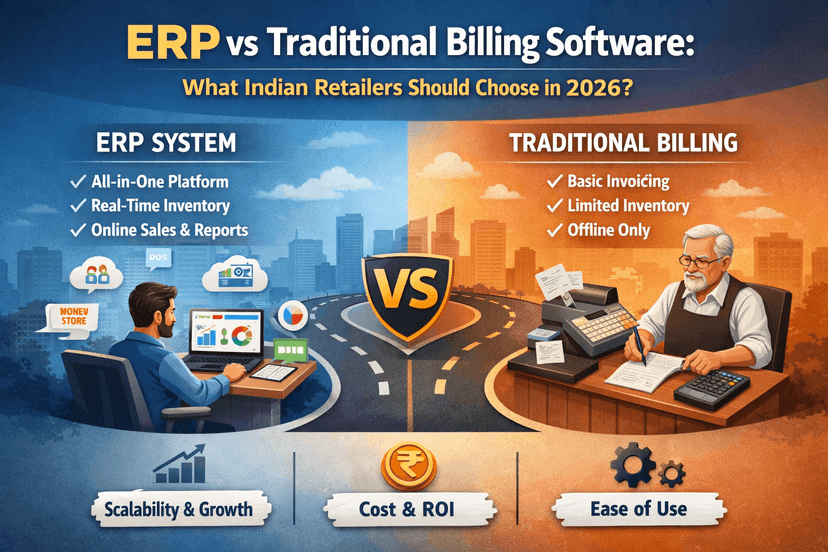
This is the classic system many Indian retailers know well. It focuses on generating invoices, keeping track of daily sales, and managing basic inventory counts. It often runs offline, is easy to use, and requires minimal training.
ERP for Retailers:
An ERP does everything your billing software does—and a lot more. With Retail ERP Software India, you can handle accounts, advanced inventory, supplier management, analytics, HR, and even customer loyalty programs—all within a single dashboard. Plus, many of the best ERP for small businesses now offer cloud access, mobile apps, and real-time reporting.
2. Usability: Keeping It Simple vs. Thinking Big
If you manage a small shop and rarely need more than basic invoicing, billing software for retailers is hard to beat for simplicity. You can start using it almost immediately, with barely any learning curve.
But once your business starts expanding—with multiple locations, diverse products, or online sales—an ERP becomes key. These systems automate repetitive tasks and bring everything (billing, stock, finances, HR) under one roof, saving you dozens of hours every week.
3. Adaptability and Growth: Planning for 2026
Retail in 2026 will keep evolving with new customer demands, government regulations (like GST updates), and tools for digital payments. The best ERP for small businesses often update automatically to stay compliant and secure—traditional billing systems, meanwhile, might require manual interventions or pricey upgrades.
- If you plan to open new stores or launch online sales, an ERP scales with you easily.
- Bigger operations are easier to manage with a centralized system that ties everything together.
4. Cost and ROI: What’s the Real Investment?
Let’s face it: budgets matter. Traditional billing software is cheaper upfront, making it attractive for new or micro retailers. ERPs, on the other hand, usually cost more but deliver value by saving time, reducing errors, and supporting business growth.
- Traditional billing can be a quick fix; ideal for shops with stable processes and less complexity.
- ERP systems are a long-term investment—paying off as you automate, optimize, and gain deep insights into your business.
How to Decide: Practical Tips for Indian Retailers
Now comes the tricky part—choosing what’s right for your specific shop. Here’s what to consider:
- Business size and plans: Still a single location? A small, robust billing software might be enough. But if you're eyeing expansion, Retail Management Software 2026 (an ERP) can save future headaches.
- Complexity of operations: Need HR, supply chain, or analytics in the same system? Go for an ERP.
- Tech support: High-quality support is crucial. Check if the vendor provides local assistance and regular software updates.
Buying Guide: What to Check Before You Choose
No matter which side you lean toward in the ERP vs Traditional Billing Software debate, always do your homework. Ask yourself and your vendor:
- Does the solution support GST and digital payment integrations required in India?
- Can it grow with my business—supporting online sales, multiple stores, or new product lines?
- Is customer support responsive and knowledgeable, especially in your local context?
Also, consider user-friendliness, security features, and data backup options. Sustainable, scalable systems can keep you competitive well beyond 2026.
Conclusion: Making the Right Choice for Your Retail Success
Choosing between ERP vs Traditional Billing Software is about more than just ticking boxes—it’s about your business vision for 2026 and beyond. If you run a small, steady retail shop, sticking with your tried-and-true billing software could make sense. But if you dream big, aim for growth, or want to overhaul your efficiency, investing in Retail ERP Software India can be a game changer.
Take the time to honestly evaluate where your business stands and where you want it to go. If you’re not sure, start by consulting with reputed vendors or talking to other Indian retailers who’ve transitioned recently. The technology choices you make now will set the stage for smoother operations, satisfied customers, and—most important—a business that thrives, no matter what the future brings.
Ready to future-proof your retail store? Explore your options, ask hard questions, and don't be afraid to think bigger. Your shop’s next chapter could be its best yet.