AI Exposes ₹70,000 Cr Tax Frauds Is Your ERP Audit-Ready?
AI Tax Raids Just Caught ₹70,000 Cr of Hidden Sales. Would Your Billing Software Protect You? (2026)
India's Income Tax Department used AI and Generative AI tools to analyze 60 terabytes of billing data across 1.77 lakh restaurant IDs and found an estimated ₹70,000 crore in suppressed sales. The AI didn't raid every outlet. It simply compared what the billing software recorded with what was filed in GST returns. The mismatch was enormous. The investigation is now expanding nationally to other sectors, other platforms, other businesses. The single question every retailer, distributor, and multi-location brand owner must answer today: if that AI looked at your billing data right now, what would it find?
Table of Contents
- The Story That Every Indian Retailer Needs to Read
- What Exactly Happened: Explained Simply
- Why AI Tax Enforcement Is Growing in 2026 and Won't Stop
- What Audit-Ready Billing Software Actually Looks Like
- Peddle Plus One ERP vs Basic Billing Software: Feature Comparison
- Which Businesses Does Peddle Plus One ERP Serves?
- What This Looks Like in Practice: Before and After Peddle Plus One ERP
- Signs Your Current Software Has Put You at Risk
- The Cost of Doing Nothing
- The Business Case for Getting This Right
- How to Evaluate Your ERP for Compliance in 2026
- Where This Is Heading: Industry Trends for 2026 and Beyond
- Common Mistakes Retailers Make, and Why They're Dangerous Now
- The Next 5 Years: What Indian Retailers Should Prepare For
- Conclusion: Honest Businesses Deserve Software That Protects Them
The Story That Every Indian Retailer Needs to Read
It started with a biryani restaurant in Hyderabad in late 2024. Officers noticed something small: the footfall didn't match the billing. A closer look revealed that cash transactions were being recorded and then deleted from the system before GST filing. What followed was India's largest billing-software investigation. The Income Tax Department's digital forensics lab accessed the backend servers of a major billing software company in Ahmedabad. Using AI tools, they processed 60 terabytes of data, six years of transactions across 1.77 lakh restaurant IDs spanning Tamil Nadu, Karnataka, Telangana, Maharashtra, Gujarat, and more.
The result: an estimated ₹70,000 crore in suppressed restaurant sales. And the CBDT has already announced it is expanding the investigation to other billing platforms and sectors.
This is not just a restaurant story. It's a story about what happens when your billing software (the software you trust to run your business) doesn't have the controls that protect you.
The AI didn't knock on doors. It read data logs. And what it found changed everything.
What Exactly Happened: Explained Simply
Here's a plain-English breakdown of how this investigation worked and why it matters for your business.
The Billing Software Had a Fatal Flaw
The software used by thousands of restaurants had a feature that turned out to be catastrophic: it allowed invoices to be deleted or 'corrected' after payment. This was probably built to handle genuine mistakes. But it was misused to erase cash transactions before filing GST returns. The software had another problem: it kept no honest record of these deletions. There was no audit trail showing who deleted what, when, or why.
AI Found What Manual Audits Never Could
Even though invoices were deleted from the user interface, the backend server logs retained digital traces timestamps, entry records, session data. AI tools reconstructed deleted transaction flows and compared them at scale against GST filings, UPI records, and delivery app data. The numbers that emerged were staggering: ₹13,317 crore in post-billing deletions, ₹19,400 crore in post-generation bill modifications, and 231 businesses that reported zero GST turnover despite active billing records.
Why Honest Businesses Are Still at Risk
This is the part that most coverage misses: many businesses did not intend to evade taxes. Their software gave them the ability to delete invoices, and their staff used that feature for genuine corrections, for managing returns, for fixing errors. Without an audit trail, those corrections look identical to deliberate suppression.
If your software allows it, your team will use it. And if there's no audit trail, there's no way to prove innocent intent even when it exists.
Why AI Tax Enforcement Is Growing in 2026 and Won't Stop
The New Income Tax Act Expands Digital Powers
Starting April 1, 2026, the new Income Tax Act gives officers the power to enter any premises where electronic data is stored and demand access to server logs, ERP databases, and billing software backends. Your software's data is now officially within scope of tax investigation. If authorities have reason to search, they can compel access codes, passwords, and technical assistance and override them if you don't cooperate. The law also requires all electronic books to remain accessible on Indian servers with daily backups. For business owners, the question has shifted from "does my software work for me?" to "can my software prove itself when authorities come looking?"
GST Infrastructure Is Getting Smarter Every Year
India's GST system now routes e-invoices through the Invoice Registration Portal (IRP) in real time. GSTR-3B liability fields are auto-populated and locked from April 2025. GSTN's AI tools BIFA and ADVAIT already run continuous pattern detection across the system. Every UPI transaction, every Swiggy or Amazon order, feeds a data universe that cross-references your returns automatically.
Every Digital Payment Creates a Cross-Reference Point
Think about everything that gets logged when you do business digitally. A customer pays by UPI, that transaction is recorded with NPCI. They order through Zomato, the aggregator has that sale. They use a card, the bank logs it.
Now here's what matters. When you file your GST returns, AI systems cross-check your numbers against all these data points. If your declared sales don't match what NPCI, Zomato, or the banks have on record, the system flags it. The more digital your business becomes the more data trails you leave behind. And the more eyes watching to make sure it all adds up.
What Audit-Ready Billing Software Actually Looks Like
The features that protect you from AI-driven enforcement are the same features that make your business run better. Here's what matters.
Immutable Invoice Logs- No 'Vanish After Payment'
Every sale, edit, and cancellation must be permanently recorded. Deletions after payment must be impossible. Genuine corrections should be logged with the user's identity, the timestamp, and the reason. This is your most important protection, it transforms your data from a liability into evidence of honest dealing.
Controlled ERP: All transactions are logged at the system level. GSTR-I, GSTR-II, and GSTR-III are generated automatically from billing data, no separate preparation, no double entry, no room for undocumented edits.
GST E-Invoicing and E-Way Bills at the Point of Billing
Your invoices should be routed through the IRP automatically when the bill is raised ,not uploaded in a batch at month-end. This creates a government-verified record of every transaction in real time.
Controlled ERP: E-invoices and e-way bills are auto-generated at the point of billing for B2B, B2C, and D2C transactions. The government has a record before the customer has even left your store.
Central, Chain-Wide Visibility for Multi-Location Businesses
If you have more than one outlet, you need a single dashboard that shows all sales, all edits, and all cancellations across every location in real time. Local workarounds at individual branches are impossible to catch without this.
Controlled ERP: Multi-store, multi-user architecture gives headquarters live visibility across every branch on a single screen, from any device, anywhere.
Role-Based Access With Maker-Checker Controls
Not every staff member should be able to edit, cancel, or void a transaction. Granular access control creates accountability. Sensitive actions require approval.
Controlled ERP: Role-based permissions are configurable per user and per branch. You decide who can do what and the system enforces it.
Real-Time Shrinkage and Stock Discrepancy Detection
You should not be discovering inventory mismatches at quarter-end or year-end. A modern system flags discrepancies the day they occur.
Controlled ERP: Live inventory tracking across all SKUs and locations, with automated supplier order placement and real-time stock alerts.
Direct Integration With Your CA's Tools
Your CA should pull reports from the system not from a spreadsheet you've prepared. A system-generated report is evidence; a manually prepared spreadsheet is a representation.
Controlled ERP: Direct data push to Tally 9 ERP and Zoho Books. No manual export, no double entry, no divergence between your billing records and your accounting records
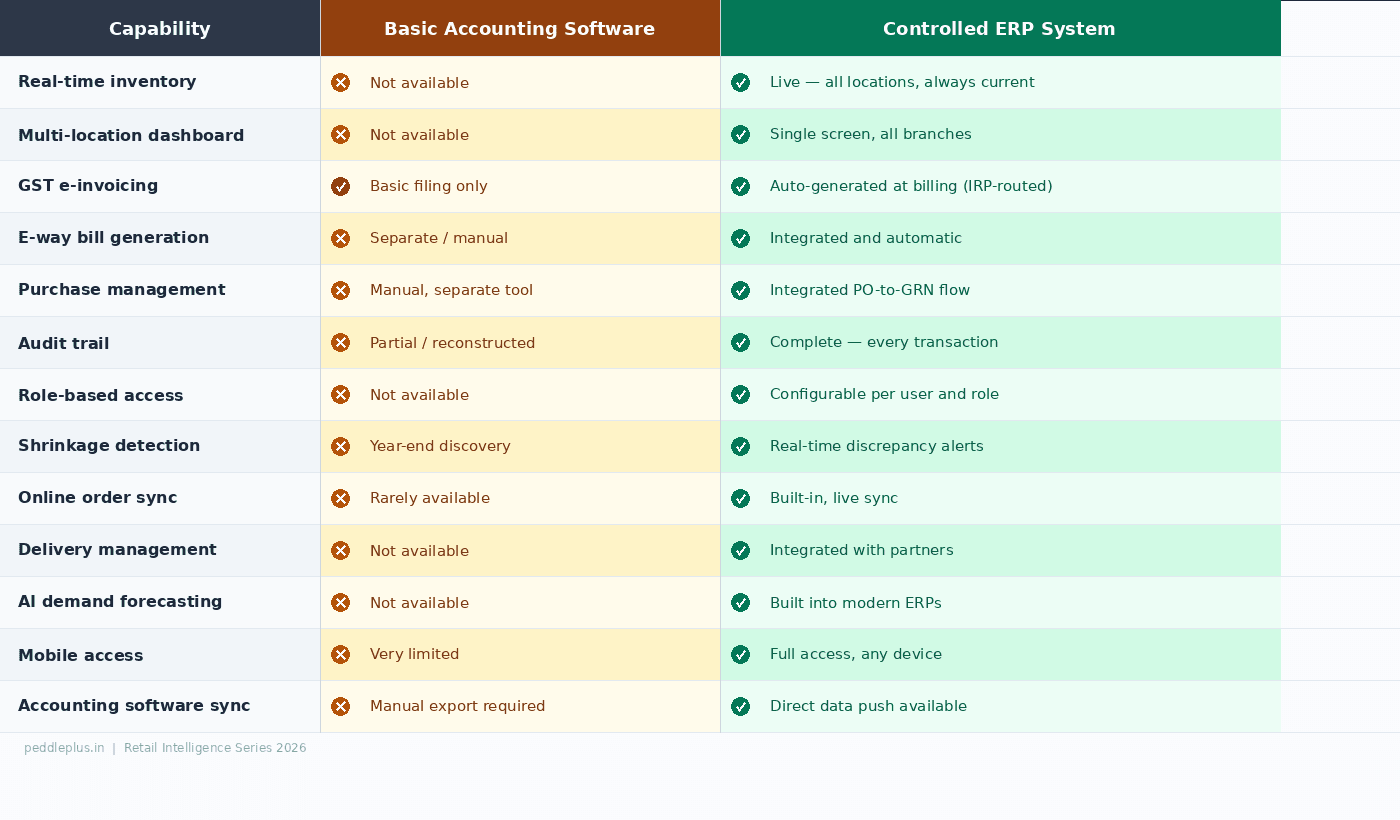
Peddle Plus One ERP vs Basic Billing Software: Feature Comparison
Here's a side-by-side look at how it compares to basic billing software on the features that matter most in the current compliance environment:
Which Businesses Does Peddle Plus One ERP Serves?
It is built by retailers, for retailers. It serves businesses across a wide range of sectors, all of which face the same compliance landscape in 2026:
- Grocery & Supermarkets- fast billing, stock management, supplier orders, and daily transaction reports
- Clothing & Garments -SKU management across styles and sizes, exchange POS, and seasonal stock management
- Auto Parts & Accessories- part number cataloguing, supplier tracking, and GST-compliant invoicing
- Consumer Electronics- serial number tracking, warranty management, and compliant billing
- Pharmacies - batch and expiry tracking, GST compliance, and supplier management
- Cosmetics & Personal Care, Gifting & Stationery, Pet Shops- fast POS, inventory control, and online ordering
- Spas, Salons & Gyms- appointment-based billing, membership management, and service-level POS
- Restaurants & Cafes- table billing, takeaway, delivery integration, and GSTR compliance
Peddle Plus One ERP currently serves retailers across India, the UAE, and Africa, and the compliance challenges described in this post are relevant to all of them.
What This Looks Like in Practice: Before and After Peddle Plus One ERP
Consider a garment retailer with 3 outlets in two cities, processing approximately ₹80 lakh in monthly sales across cash, UPI, and card.
Before Peddle Plus One ERP: The Typical Situation
- Each outlet manager has full system access & can edit and void bills after payment
- Daily cash reconciliation is done manually by the manager and sent to HQ by WhatsApp
- GST returns are prepared from exported spreadsheets at month-end by the CA
- Headquarters has no live view of what's happening at each branch
- Stock discrepancies are discovered at quarterly stock-takes typically 3–4 months after the fact
The Risk: Even if every manager is honest, the system cannot prove it. There is no audit trail distinguishing genuine corrections from manipulation. If an AI tool cross-references the billing server logs with GST filings, every undocumented deletion is a red flag.
After Peddle Plus One ERP: The Audit-Ready State
- Every invoice is immutable after confirmation, corrections are logged with user ID, timestamp, and reason
- GSTR-I, II, III are generated automatically from live billing data ,no separate preparation, no spreadsheet
- Owner dashboard shows live sales, edits, and stock across all 3 outlets on one screen, from the Owner App on mobile
- E-invoices are auto-generated at billing and verified by IRP in real time
- Tally data push keeps the CA's records in sync with the billing system automatically
- Stock discrepancies trigger alerts the day they happen not 3 months later
The Result: If the same AI audit cross-references this retailer's data, the billing records and GST filings match perfectly. Not because everything has been done manually but because the system makes honest data the only possible output.
Signs Your Current Software Has Put You at Risk
You may already be carrying compliance risk without knowing it. These are the warning signs:
- Your billing software allows invoices to be deleted or edited after payment with no log of the change
- Your GST returns are prepared from spreadsheets rather than directly from system data
- You have no real-time view of what each branch or outlet is billing
- Your inventory discrepancies show up at month-end or quarter-end, not the day they happen
- Different staff members can access and modify the same transaction records without approval
- Your CA asks you for manual reconciliation files each month
- Your e-invoices are uploaded in batches, not generated at the point of sale
If even two of these apply, your current software is a compliance liability, not a compliance asset.
The Cost of Doing Nothing
Some business owners hear about a ₹70,000 crore investigation and think: 'That's restaurants. That's not my sector. I'm too small.'
Here's what the data actually says:
- 1.77 lakh restaurant IDs were covered the vast majority small and mid-size businesses, not large chains
- 231 businesses reported zero GST turnover despite active billing records all caught by the AI
- CBDT officials have stated the findings are 'only the tip of the iceberg' and expansion to other sectors is underway
- The new Income Tax Act from April 2026 explicitly extends digital enforcement powers across all sectors
- •Penalties can include reassessments covering 6 prior financial years, plus penalties up to 300% of evaded tax, plus interest
The cost of upgrading your software is a known, manageable number. The cost of being caught in an AI audit is open-ended and it includes your working capital, your reputation, and potentially your freedom.
The Business Case for Getting This Right
Here's a simplified ROI for a mid-size Indian retailer with ₹3–5 crore annual turnover, moving from basic billing software to a proper ERP:
- ERP software investment: Affordable subscription, typically far less than one month's CA reconciliation cost
- Shrinkage reduction (conservative 1%): ₹3–5 lakh annually recovered through real-time stock alerts
- CA reconciliation time saved: ₹50,000–1 lakh in reduced accounting fees through direct Tally/Zoho push
- Avoided penalty exposure: Penalties on a ₹25 lakh undeclared amount can reach ₹7.5–25 lakh, audit-ready software eliminates the possibility
- Online sales incremental revenue: Peddle Plus One ERP's online ordering feature can add 15–30% incremental revenue from local customers
- Employee accountability: Commission tracking and role-based access reduce internal fraud and billing errors
Conclusion: Peddle Plus pays for itself within months in most cases and provides risk protection that is structurally impossible with basic billing software.
How to Evaluate Your ERP for Compliance in 2026
If you're comparing software options, here are the six questions that matter most right now:
1. Can invoices be deleted after payment?
If yes and without an audit trail that is your single biggest compliance risk. Stop the evaluation and prioritize this first.
2. Is GST e-invoicing generated automatically at the point of billing?
Batch uploads are not enough. Real-time IRP routing means the government has a record the moment the invoice is raised.
3. Do you have a single view across all locations?
If each branch operates independently with no live central visibility, you have no way to catch local discrepancies before they become audit problems.
4. Does it push data directly to your accounting software?
Manual export creates a gap. Direct push to Tally or Zoho means your CA always has system-verified data.
5. Is it genuinely easy to use for your staff?
The best compliance software is the software your team actually uses correctly every day and is built for Indian retailers easy billing in Hindi and English, on PC, tablet, or mobile.
6. Does the vendor support you in your city?
It should be build to be genuinely easy for Indian retailers with support in Hindi and English, and staff training included.
Where This Is Heading: Industry Trends for 2026 and Beyond
- AI enforcement will expand beyond restaurants. CBDT has confirmed investigations into additional billing platforms and sectors. Indian retail grocery, garments, electronics is in scope.
- Real-time GST reporting is becoming the standard. India is moving toward continuous transaction reporting. E-invoicing mandates will extend further down the turnover threshold in the next 1-2 years.
- Cloud ERP is becoming the baseline, not the premium. Peddle Plus One ERP is already cloud-based available on PC, tablet, and mobile from anywhere, for any size of business.
- Omnichannel compliance is the new normal. With Amazon, Flipkart, Swiggy, and Zomato integrations, Peddle Plus One ERP ensures that online and offline sales are unified in a single, compliant inventory and billing system.
- ERP-to-government API integration will become mandatory. Direct IRP routing and Tally push (both already available in Peddle Plus One ERP) will become compliance baselines within this decade.
Common Mistakes Retailers Make, and Why They're Dangerous Now
- 'We use Tally / a CA / a spreadsheet- we're fine.' None of these create real-time audit trails at the point of billing. They are tools for recording, not for compliance protection.
- 'Compliance is a year-end activity.' AI can reconstruct six years of transactions in weeks. Your compliance posture must be continuous - every day, every transaction.
- 'My staff are honest, I don't need access controls.' Access controls protect honest staff as much as they deter bad actors. They create a verifiable record that innocent corrections were innocent.
- 'I'm too small for this to apply to me.' The investigation found non-compliance at businesses of every size. The AI does not sort by turnover before it flags mismatches.
- 'I'll upgrade when I get a notice.' By the time you receive a scrutiny notice, historical data has already been analyzed. Upgrading after the fact cannot undo six years of undocumented corrections.
The Next 5 Years: What Indian Retailers Should Prepare For
- 2026-2027: AI enforcement expands to retail, pharma, and distribution. E-invoicing mandates extend further. CBDT risk-scoring becomes routine.
- 2027-2029: Continuous transaction reporting pilots for GST. Real-time reconciliation between ERP and GSTN becomes expected standard practice.
- 2029-2032: Automated risk scores for all GST-registered businesses. Retailers with clean ERP data enjoy frictionless compliance; those without face persistent scrutiny.
- 2032 and beyond: Near-real-time tax settlement. Compliance happens inside the transaction not at month-end or year-end.
Retailers who invest in honest, integrated, audit-ready systems today are not just protecting themselves from the current wave of enforcement. They are building the data infrastructure that will define Indian retail for the next decade.
Conclusion: Honest Businesses Deserve Software That Protects Them
The ₹70,000 crore investigation is fundamentally a story about data architecture. The billing software at the center of the investigation was not designed for honest business, it was designed for convenience. It allowed deletions, it skipped audit trails, and it gave local managers more power than any centralized system should.
The result was that honest businesses and dishonest ones looked identical from the outside. Both had clean GST filings. Neither had a verifiable audit trail. When the AI arrived, it couldn't tell the difference and that was the problem. Peddle Plus One ERP was built for exactly this world. It is a 360° retail solution built by retailers, for retailers designed so that honest business owners don't get caught in the crossfire of enforcement aimed at those who aren't. Immutable logs, real-time e-invoicing, central multi-location visibility, direct CA integration, and a system that runs cleanly on PC, tablet, or mobile, these are not advanced features. They are the minimum standard for doing business safely in India in 2026.