Cloud ERP vs On-Premise ERP: Which Is Better for India in 2026?
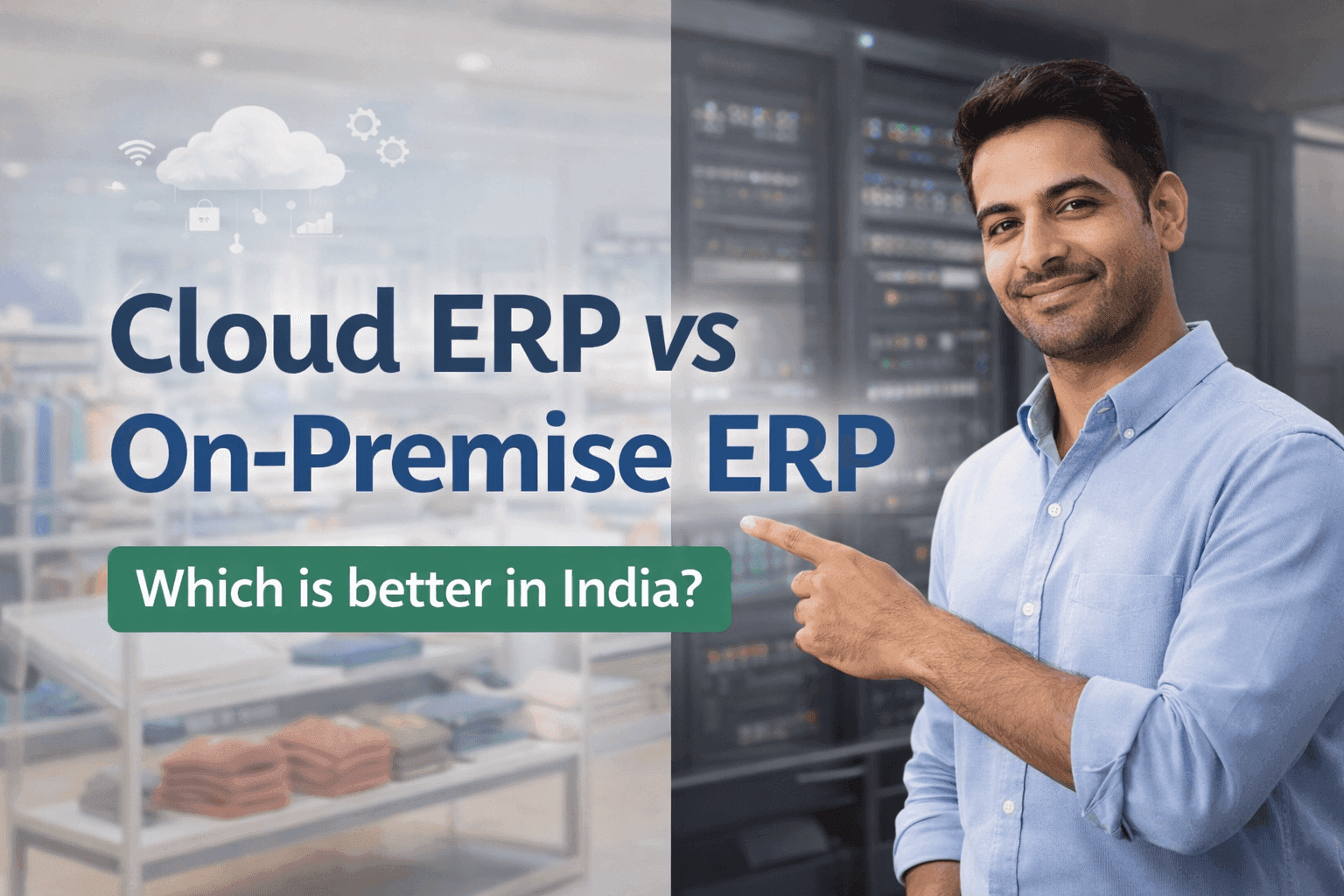
Cloud ERP vs. On-Premise ERP: Which Is Better for Indian Businesses in 2026?
A practical, experience-backed guide for Indian businesses choosing between flexibility, centralized control, and real operational efficiency based on how your business actually runs, not on industry trends.
Key Takeaways
Cloud ERP is ideal for multi-location retail, franchise networks, distributors, and fast-scaling businesses that need real-time, centralized visibility
On-Premise ERP remains valid for single-location or standalone operations with limited complexity and strong internal IT infrastructure
Cloud ERP enables Head Office-level 360° control across all stores, outlets, and warehouses simultaneously
Centralized pricing, promotional schemes, and live stock visibility are decisive advantages that only cloud ERP delivers at scale
The right ERP choice is determined by operational structure and business complexity not by cost alone or popular opinion
Table Of Contents
Why This Decision Matters More Than You Think
What ERP Actually Does In Practical Terms
Understanding On-Premise ERP: The Traditional Control Model
Understanding Cloud ERP: The Modern Centralized Model
Centralized Head Office Visibility Across All Stores
Centralized Pricing, Offers, and Promotional Schemes
Centralized Inventory: Eliminating the Data Silo Problem
When On-Premise ERP Still Makes Operational Sense
Head-to-Head Comparison: Cloud ERP vs. On-Premise ERP
Cost Reality for Indian Businesses in 2026
Internet Dependency: An Honest Assessment
The Biggest Mistake Businesses Make When Choosing ERP
A Practical Decision Framework
If Cloud ERP Is the Right Fit, Here's What to Look For
The Final Conclusion: Not Better Technology Better Fit
Why This Decision Matters More Than You Think
Indian businesses today don't struggle to find ERP software. The market is saturated with options. What they genuinely struggle with and often get wrong is understanding how ERP should run within their specific operational context.
Cloud or on-premise. That single architectural decision quietly determines the trajectory of your business. It shapes how your team works, how your leadership sees the business, how fast you can scale, and ultimately how competitive you remain over the next five to ten years.
Yet most businesses approach this choice by asking the wrong questions entirely. They ask which solution is cheaper this year, which brand is more popular, or which one their competitor recently adopted. The result is a system that was never designed for how they actually operate leading to workarounds, frustration, and eventually, another migration.
This guide cuts through the noise. It will help you understand the real-world implications of each model, see through concrete use cases where each genuinely excels, and arrive at a decision rooted in your actual operational structure.
What ERP Actually Does In Practical Terms
Before comparing deployment models, it is worth establishing what ERP actually is not in technical terms, but in the terms of how a business experiences it daily.
ERP is not simply accounting software with extra features. It is a unified operational backbone that connects every moving part of your business into a single, coherent system. Instead of sales data living in one app, inventory tracked on a spreadsheet, purchase orders managed via email, and GST reconciled manually at month end, an ERP brings all of these into one real-time source of truth.
In practical terms, a well-implemented ERP means that when a sale is made in one of your outlets, it automatically updates inventory, triggers a replenishment alert if stock falls below threshold, posts the accounting entry, updates the GST ledger, and makes the data available on your management dashboard all in the same moment, without anyone manually moving information between systems.
The question, then, is not whether your business needs this level of integration. For any business that has grown beyond the simplest single-location model, the answer is almost certainly yes. The real question is: should this integrated system live on your own servers, or on a cloud infrastructure managed by your provider?
Understanding On-Premise ERP: The Traditional Control Model
On-premise ERP is the older, more traditional model. The software is installed directly on servers that your business owns, manages, and maintains within your own infrastructure. All data storage, security protocols, backup routines, system upgrades, and ongoing IT management are your responsibility.
This model was the industry standard for decades and for good reason. When businesses operated from single locations, had dedicated IT departments, and required deeply customized workflows, on-premise ERP delivered exactly what they needed: complete ownership, deep configurability, and zero dependency on external connectivity.
For certain types of businesses, this model still holds genuine merit today. A large standalone manufacturing facility with proprietary processes, a single-location wholesale operation with a full IT team, or a business operating in a region with unreliable connectivity may find that on-premise ERP continues to serve them well. The critical requirement is that operations are centralized in one location, complexity is contained, and the technical resources exist to support the infrastructure long-term.
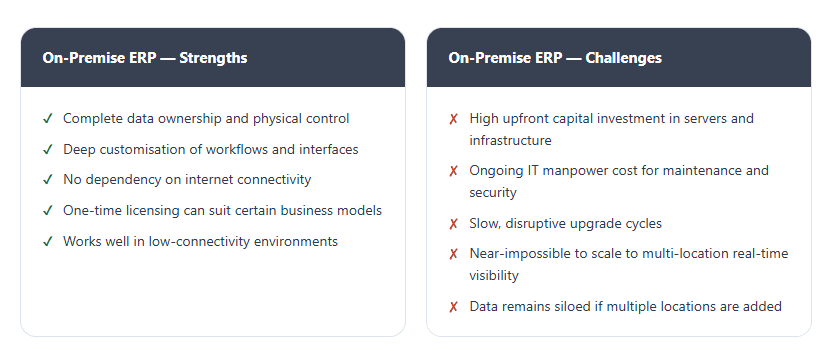
The challenges become particularly acute when a business begins to grow beyond one location. The fundamental architecture of on-premise ERP is built around a single, centralised server. Attempting to extend real-time visibility and control to multiple outlets each operating from that same server over a network introduces latency, reliability risks, and security vulnerabilities that quickly erode the model's advantages.
Understanding Cloud ERP: The Modern Centralized Model
Cloud ERP operates on secure, high-availability servers managed entirely by the ERP provider. Your business accesses the system through the internet from any device, at any location, at any time without managing any underlying infrastructure. The provider handles servers, uptime, security, backups, and software updates. Your team simply logs in and operates.
The architectural difference between cloud and on-premise ERP is not merely technical. It represents a fundamentally different philosophy about where business intelligence should live and how operational control should be exercised. In a cloud model, the system is always current, always accessible, and always synchronized meaning that every location, every warehouse, and every team member is working from the same live version of reality at any given moment.
For India's rapidly growing retail chains, franchise networks, distribution businesses, and e-commerce-integrated operations, this architecture is not just convenient. It is operationally transformative.
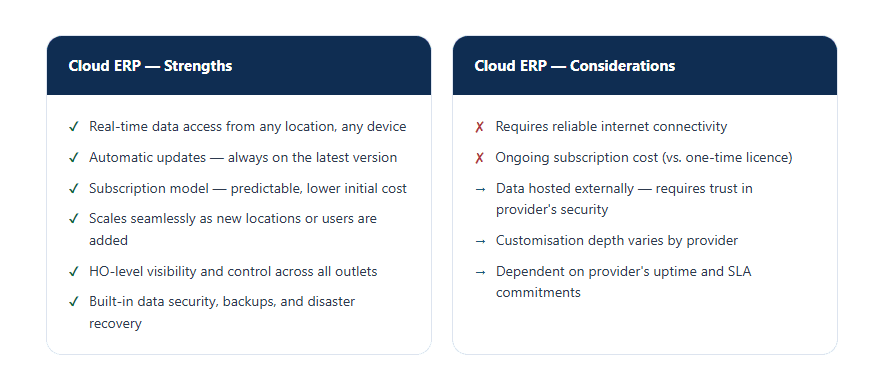
Where Cloud ERP Becomes a Game Changer for Indian Businesses
The theoretical advantages of cloud ERP are well-documented. What is less often discussed is exactly how those advantages manifest in the day-to-day operational reality of Indian retail, wholesale, and distribution businesses. The following three scenarios represent the most significant, practical transformations that cloud ERP delivers.
Centralized Head Office Visibility Across All Stores
In any multi-location business whether a regional retail chain, a franchise network, or a distributor managing multiple depots the Head Office has one fundamental need: to know exactly what is happening across the entire operation, right now. Not yesterday's summary. Not a compiled report that arrives three days after month end. The live picture, in real time.
With on-premise or disconnected systems, this visibility is simply not achievable without significant manual effort. Store managers compile daily reports, send them via WhatsApp or email, and someone at HO manually aggregates the data a process that is slow, error-prone, and always a step behind reality.
Cloud ERP eliminates this entirely. Senior management at HQ can see live sales performance across every outlet, real-time stock movement at every location, instant branch-level profit and loss figures, and operational exceptions all from a single dashboard. The result is not just better data. It is faster, more confident decision-making at every level of the organization.
360° live visibility Faster decisions Eliminates manual aggregation Real-time branch P&L
Centralized Pricing, Offers, and Promotional Schemes
Pricing inconsistency is one of the most damaging and most common problems in multi-location Indian businesses. Without a centralized system, different outlets inevitably drift: one store is still running an expired scheme, another has applied the wrong discount bracket, a third never received the updated price list. Each inconsistency creates revenue leakage, customer confusion, and brand damage.
Cloud ERP gives the Head Office complete authority over pricing and promotional management. A new scheme can be activated across all fifty outlets simultaneously, with the correct discount logic, validity period, and product applicability enforced automatically by the system. A price change can be made once at HQ and take effect everywhere in real time. There is no room for drift, no risk of outdated rates persisting in the field.
For franchise models and EBO networks in particular, this capability is not a convenience it is operationally critical. The brand's integrity and financial accuracy depend on every outlet operating from the same price and scheme definitions at every moment.
Instant scheme deployment Zero pricing inconsistency Revenue leakage eliminated Brand uniformity
Centralized Inventory: Eliminating the Data Silo Problem
Without a unified cloud system, each store or warehouse in a multi-location business becomes a data island. Stock information is local, manual, and delayed. The central warehouse doesn't know what the stores need until requisitions arrive. Stores don't know what the warehouse holds until they call. Replenishment decisions are based on incomplete information. The result is a chronic combination of stockouts in high-demand locations and overstock accumulating where it isn't needed.
Cloud ERP connects every store, depot, and warehouse into one live inventory network. At any moment, the Head Office or warehouse manager can see exactly what is held at every location, track movement in real time, identify which outlets are approaching stock-out thresholds, and trigger replenishment proactively before a customer walks in to find empty shelves.
For fast-moving consumer goods distributors and retail chains managing hundreds of SKUs across dozens of locations, this centralised inventory intelligence is not merely efficient it is the difference between a business that scales smoothly and one that stumbles under the weight of its own growth.
Live cross-location stock visibility Fewer stockouts Smarter replenishment Reduced overstock
When On-Premise ERP Still Makes Operational Sense
A balanced assessment requires acknowledging that on-premise ERP is not obsolete. For the right type of business, it remains a perfectly valid and sometimes preferable choice. The key is being honest about what "the right type of business" actually looks like.
On-premise ERP is most appropriate for businesses that operate from a single, well-defined location, have no plans for multi-outlet expansion, possess an internal IT team capable of managing server infrastructure, and require deeply customized workflows that cloud platforms cannot easily accommodate. A large standalone showroom managing a complex, proprietary sales process, a local wholesaler with one well-equipped warehouse, or a manufacturer with highly specific production workflows may find that on-premise ERP gives them exactly the control and customization depth they require.
The On-Premise Sweet Spot
If your business operates from a single location, has no Head Office visibility requirements, manages a modest number of SKUs from one warehouse, and has no near-term plans for expansion on-premise ERP can serve you well. The cloud's advantages are most decisive precisely when multi-location coordination is required. Where it isn't, the calculus shifts.
The critical caution, however, is this: if there is any genuine possibility that your business will add locations, expand into new channels, or grow its operational complexity within the next three to five years, building on an on-premise foundation means you will almost certainly face a costly and disruptive migration earlier than anticipated. The architecture that fits a single-location business today is rarely the architecture that serves a ten-location business tomorrow.
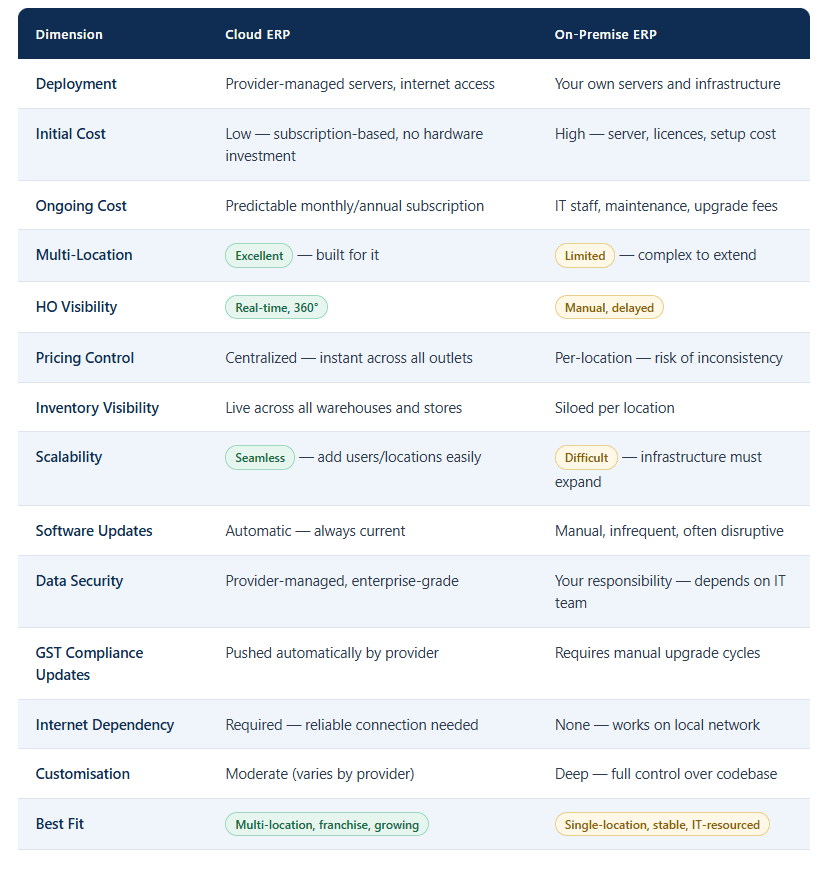
Head-to-Head Comparison: Cloud ERP vs. On-Premise ERP
The table below provides a structured, neutral comparison across the dimensions that matter most for Indian businesses evaluating ERP deployment models.
Cost Reality for Indian Businesses in 2026
Cost is consistently cited as the primary factor in ERP deployment decisions for Indian SMEs. It is also the dimension most commonly misunderstood, because the comparison is rarely made on a like-for-like basis.
The on-premise ERP cost equation typically begins with a substantial capital expenditure: server hardware, software licences, professional implementation fees, and staff training. These upfront costs are visible and often significant. What is less visible but equally significant over time is the ongoing cost of IT manpower to maintain the system, the cost of periodic hardware refresh cycles, the cost of manual upgrade implementations, and the cost of downtime when issues arise.
Cloud ERP operates on a subscription model. The monthly or annual fee covers software access, infrastructure, security, updates, and support. There is no server to buy, no IT team to maintain it, and no hidden upgrade costs. For most growing Indian businesses, particularly those in the ₹5 crore to ₹500 crore revenue range, the total cost of cloud ERP ownership over a three-to-five year period is considerably lower than the equivalent on-premise deployment especially when the full cost of IT infrastructure and manpower is factored in.
The more important financial consideration, however, is not the direct cost of the ERP itself. It is the cost of the operational capability it enables. The real-time visibility, centralized control, and faster decision-making that cloud ERP provides for multi-location businesses generates measurable value through reduced stock-holding costs, fewer pricing errors, better cash flow management, and faster scaling value that significantly outweighs the subscription cost for businesses at the right growth stage.
Internet Dependency: An Honest Assessment
The most common objection to cloud ERP adoption among Indian businesses is internet dependency. It is a legitimate concern and one that deserves a direct, honest response rather than a dismissive one.
Yes, cloud ERP requires a reliable internet connection. In 2026, however, the connectivity landscape in India has changed dramatically from even five years ago. Broadband penetration across urban and semi-urban India is extensive. 4G coverage is near-ubiquitous, and 5G rollout is accelerating rapidly in tier-1 and tier-2 cities. For most commercial premises in established industrial and retail zones, reliable connectivity is the default, not the exception.
For businesses with genuine connectivity concerns, the practical solution is straightforward: a primary broadband connection with a 4G/5G backup SIM as failover. The combined monthly cost of this redundant setup in most Indian cities is modest typically between ₹2,000 and ₹5,000 per month and effectively eliminates downtime risk. Many cloud ERP providers also support offline caching for critical point-of-sale and inventory operations, allowing core business functions to continue uninterrupted during brief connectivity interruptions, with automatic synchronisation when the connection is restored.
The Real Risk Has Shifted
In 2026, the greater operational risk for most multi-location Indian businesses is not internet downtime it is the data fragmentation, reporting delays, and loss of control that come from operating on systems that were never designed for their current scale. Poor systems are a more persistent threat than connectivity gaps.
The Biggest Mistake Businesses Make When Choosing ERP
After years of working with Indian businesses across retail, wholesale, and distribution, one pattern emerges consistently: businesses that make poor ERP deployment decisions almost always ask the wrong questions.
They ask: "Which ERP is cheaper?" as if the tool's price is more important than its fit. They ask: "Which ERP is most popular right now?" as if a competitor's choice is a reliable proxy for their own operational needs. They ask: "Which is the trending technology?" as if modernity is a virtue independent of context.
The questions that actually determine the right ERP choice are these: How many locations do I currently operate, and how many will I operate in three years? Do I require Head Office visibility across all outlets? Do I manage pricing and promotional schemes centrally? Is my inventory split across multiple warehouses, or does it sit in one place? Do I have a dedicated IT team, or do I need the system to manage itself?
ERP should match the business structure not the other way around. The businesses that get the most from their ERP investment are those that began with an honest assessment of their operational reality before they ever evaluated a vendor.
The Right Starting Question
Before evaluating any ERP solution, answer this: "How does my business actually operate today and how will it operate in three years?" Let the answer drive the technology decision, not the other way around.
A Practical Decision Framework
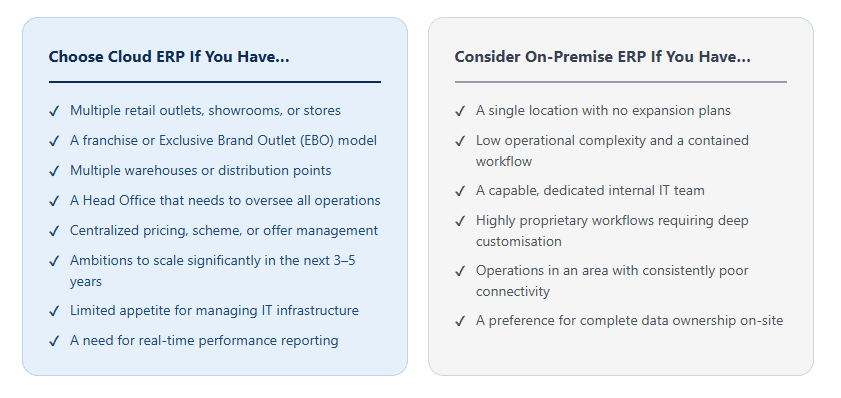
Based on the analysis above, the following framework provides a clear, structure-based guide to making the right deployment choice for your specific situation.
If Cloud ERP Is the Right Fit, Here's What to Look For
Choosing cloud over on-premise is one thing. Choosing the right cloud ERP, which one is built for Indian retail and distribution, not generic enterprise software adapted for India is another thing .
Peddle Plus One ERP is cloud-native, designed from the ground up for multi-location Indian retailers, distributors, and franchise networks. Centralized pricing, live cross-location inventory, real-time HO visibility, all the capabilities this guide describes, built into the core architecture.
If that sounds like the kind of foundation your business needs, let's have a conversation.
The Final Conclusion: Not Better Technology, Better Fit
Cloud ERP is not simply "better technology." On-premise ERP is not "outdated technology." They are fundamentally different architectural models designed for fundamentally different business realities. The question was never which one is superior in the abstract it is which one is superior for how your business actually operates.
For modern Indian retail, wholesale, and distribution businesses operating across multiple locations particularly those with franchise structures, EBO networks, or multi-warehouse operations cloud ERP is almost always the smarter strategic choice. The real-time visibility, centralized control, automatic compliance updates, and seamless scalability that cloud ERP provides create a compounding operational advantage that grows more valuable with every location added and every year that passes.
For simpler, single-location operations with strong internal IT resources and no meaningful expansion plans, on-premise ERP remains a valid and effective choice. The key is intellectual honesty about which category your business genuinely belongs to and the discipline to let that answer drive the technology decision rather than cost comparisons or industry trends.
The businesses that thrive in India's increasingly competitive commercial landscape will be those that build on operational infrastructure designed for the scale they are heading toward not just the scale they are at today.
Frequently Asked Questions
What is the difference between Cloud ERP And On-Premise ERP?
Cloud ERP is hosted on secure servers managed by the provider and accessed over the internet, while On-Premise ERP is installed and runs on the company's own servers. Cloud ERP offers real-time multi-location access and centralized HO-level control. On-Premise ERP offers complete physical data ownership and deeper workflow customization within a single location. The right choice depends entirely on your operational structure.
Is Cloud ERP better for Indian Businesses in 2026?
Cloud ERP is generally the better choice for multi-location retail chains, franchises, EBO networks, and distributors with multiple warehouses businesses that need centralized visibility, real-time data synchronization, and HO-level operational control. On-Premise ERP remains a valid choice for single-location, standalone operations with limited complexity and strong internal IT resources.
Does Cloud ERP require constant internet connectivity in India?
Yes, Cloud ERP requires a reliable internet connection for full functionality. In 2026, however, most Indian cities, industrial zones, and commercial areas have robust broadband, 4G, and 5G connectivity. Most businesses adopt a primary broadband connection with a 4G/5G backup for redundancy an affordable and effective solution. Many cloud ERP platforms also support offline caching for critical operations, synchronising automatically when connectivity is restored.
Which ERP model is more cost-effective for Indian SMEs?
Cloud ERP is typically more cost-effective for Indian SMEs over a three-to-five year horizon. It operates on a subscription model with no large upfront server investment, no dedicated IT infrastructure cost, and predictable ongoing expenses. On-Premise ERP carries high initial capital expenditure for servers and licences, plus ongoing maintenance, IT staffing, and upgrade costs that accumulate significantly over time.
Can Cloud ERP handle GST Compliance in India?
Yes. Modern cloud ERP platforms designed for Indian businesses include integrated GST management, e-invoice generation, GSTR reconciliation, and compliance reporting. Because cloud ERP is updated centrally by the provider, businesses automatically receive the latest GST rule changes without requiring manual software upgrades a significant operational advantage during periods of regulatory change.
What is the right ERP for a franchise or multi-store retail business in India?
Cloud ERP is strongly recommended for franchise and multi-store retail businesses. It enables the Head Office to centrally manage pricing, promotional schemes, live stock visibility, and real-time performance reporting across all outlets simultaneously. This level of operational control including instant scheme deployment and uniform pricing is extremely difficult to achieve with on-premise or disconnected systems, and becomes more valuable with every location added.

Tamanna Bhardwaj
EditorContent Strategist at Peddle Plus with 4+ years of experience in brand growth and marketing, specializing in retail technology, ERP adoption, and business operations for Indian SMEs.