When Your DMS Stops Being Enough: A 2026 Guide for Indian Distributors
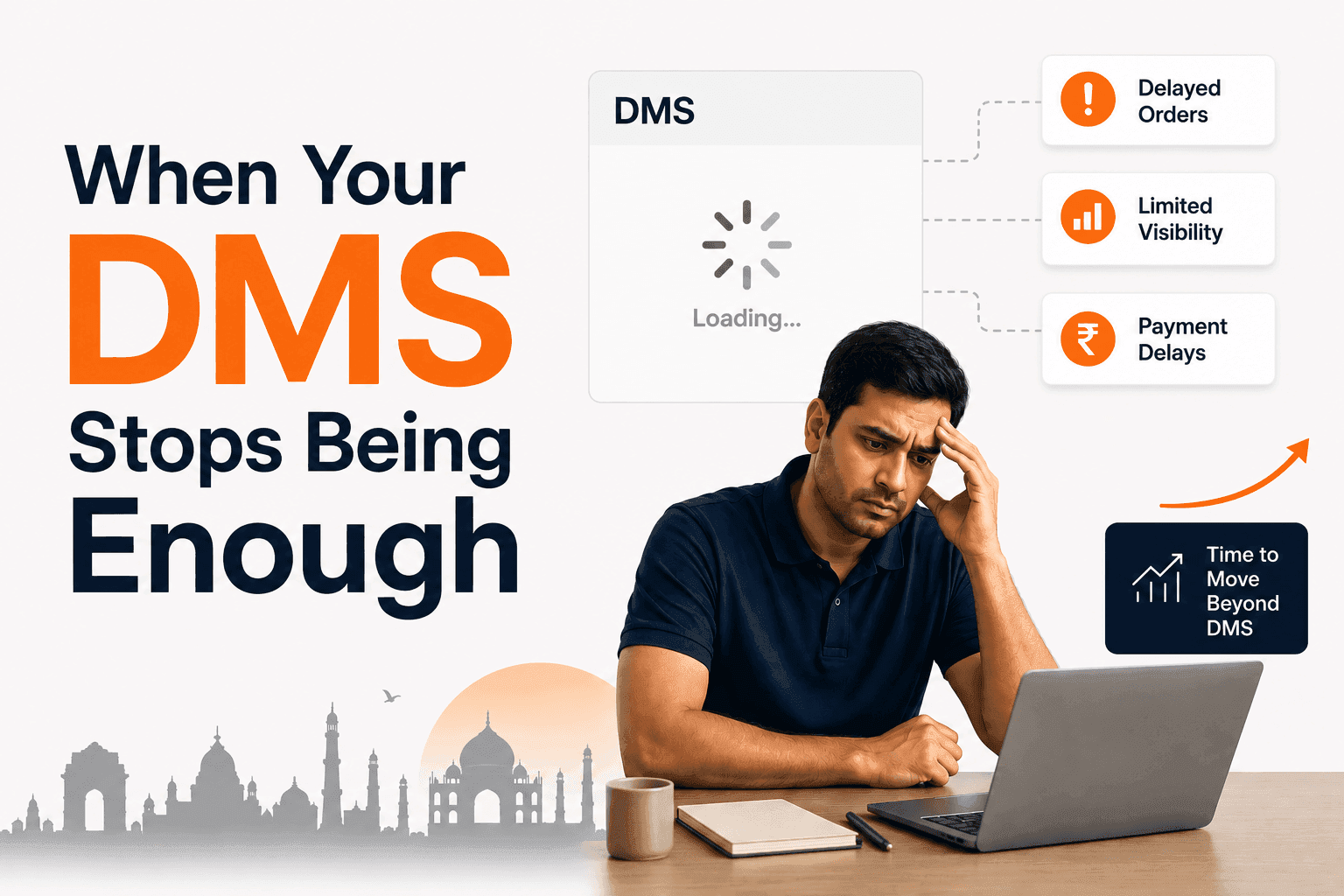
A practical, honest look at when distribution management software hits its ceiling and what to do next.
Table of Contents
What Your DMS Was Actually Built For
5 Signs Your DMS Has Quietly Stopped Being Enough
Why This Is Happening Right Now in 2026
What Changes When You Move to Integrated Retail + Distribution ERP
The Honest Truth About Switching
What to Do Next
TL;DR - Quick Summary
If your distribution business is running multiple disconnected tools (DMS + Tally + Excel + POS + WhatsApp), if your team spends more than 2 days a month reconciling GST, or if you've added retail outlets / e-commerce / multiple brands that your DMS can't see, your DMS hasn't failed. You've outgrown it.
The 5 signs you're at the switch point:
You're running parallel systems for the same data
You've added a retail layer your DMS can't see
GST work that should be automatic is still manual
Multi-store / multi-brand questions take half a day to answer
The hidden cost of "managing the gap" has crossed ₹2-4 lakh per month
The fix: an integrated retail-and-distribution ERP that handles distribution + retail + GST + reporting in one system, typically a 4-6 week phased migration. Most growing Indian SME distributors hit this point at ₹3-5 crore annual turnover or after opening 2-3 retail outlets.
Read on for the full breakdown, or book a 30-min consultation →
It usually starts with one bad Saturday.
A distributor in Surat is on three different screens. Marg ERP for billing. Tally for accounts. WhatsApp for the order from the Vadodara sub-stockist that came in at 11 PM. An Excel sheet to reconcile what the field rep submitted last evening with what's actually moved out of the warehouse. Somewhere in this stack, ₹40,000 worth of Diwali stock has gone missing or been billed twice and nobody is sure which.
The DMS isn't broken. It's doing exactly what it was built to do.
The problem is that the business has quietly grown into something the DMS was never designed for.
If this scene feels familiar, even loosely then this guide is for you.
What Your DMS Was Actually Built For
Distribution Management Software (DMS) does one thing very well: it manages a distribution network.
Inventory at the distributor end, primary sales from manufacturer to distributor, secondary sales from distributor to retailer, scheme and claim processing, beat plans for field reps. If you're running a single-tier FMCG, pharma, or electronics distributorship, products like Marg ERP, Botree, Gofrugal, EazyDMS, Nural, and PepUpSales handle this layer competently. Many Indian SMEs run a profitable business on these tools for years.
That part isn't in question.
What changes is what your business looks like 18 months later.
5 Signs Your DMS Has Quietly Stopped Being Enough
These signs don't show up dramatically. They show up as Saturdays that take longer, reports that come a week late, and decisions that increasingly rely on instinct rather than data.
1. You're running parallel systems for the same data
Stock in DMS. Stock in Tally. Stock in a separate Excel file the warehouse team uses. Three "sources of truth" that disagree with each other by 4-7% on any given week.
When the reconciliation between systems takes more time than running the actual business, the architecture has stopped serving you. It is now consuming you.
2. You've added a retail layer the DMS can't see
The distributor opened two retail outlets last year. Or started selling on Amazon and Flipkart. Or launched a D2C website. The DMS handles the distribution side cleanly, but the retail layer runs on a separate POS, with separate inventory, separate GST filings, and a CA who manually merges everything at month-end.
Pure-play DMS is built for one direction of trade, manufacturer to retailer. The moment you become both a distributor and a retailer, you need a system that sees the entire P&L, not just one side of it.
3. Your GST team is doing manual work that should be automatic
GST 2.0 and the 30-day e-invoicing rule have changed the compliance baseline in 2026. Your CA shouldn't be downloading sales registers from three systems and reconciling GSTR-1 and GSTR-3B in a spreadsheet. If you still file by exporting Excel from the DMS and re-uploading it elsewhere, your tech stack is two years behind your tax obligations.
This is also where audit risk quietly builds.
4. You can't answer multi-store, multi-brand questions in under 5 minutes
"What's our margin on Brand X in the Pune territory this month?" "Which sub-stockist had the worst secondary sales velocity in Q4?" "How much working capital is locked in dead stock across all three warehouses?"
If these questions take an analyst half a day in Excel, that's not a reporting problem, it's an architecture problem. Modern integrated ERP answers questions like these in real time. Pure-play DMS, especially older deployments, simply doesn't store the data in a way that allows it.
5. The cost of "managing the gap" has crossed the cost of upgrading
Add up the time your operations head spends every month reconciling systems, the staff hours lost to manual reporting, the inventory leakage that nobody can fully explain, and the deals you couldn't close in time because the data wasn't there.
For most growing Indian distributors with ₹3-15 crore turnover, this hidden cost crosses ₹2-4 lakh per month by the time they're running 4+ outlets, multiple brands, or any meaningful e-commerce volume. That's the moment switching pays for itself in under a year.
Why This Is Happening Right Now in 2026
Three forces are squeezing distributors at the same time:
Quick commerce expectations. Retailers and end customers expect 24-48 hour fulfillment, even from B2B distributors. Reactive inventory planning isn't fast enough anymore.
Compliance pressure. GST 2.0, RBI 2FA rules from April 2026, and the e-invoicing 30-day window mean that anything manual is now also a risk.
Multi-channel reality. Almost no profitable Indian distributor today is single-channel. They're selling to retailers, end customers, marketplaces, and sometimes their own retail outlets, all simultaneously.
A DMS handles channel one well. It struggles with channels two through four.
What Changes When You Move to Integrated Retail + Distribution ERP
This is where the conversation usually gets vague. Let me make it concrete.
One inventory, one source of truth. The same SKU, the same stock count, visible across distribution, retail, e-commerce, and warehouse. No more Saturday reconciliation.
GST handled at the point of transaction, not retrospectively. GSTR-1, GSTR-3B, and GSTR-2B reconciliation flow from your daily billing data, no Excel exports, no late-night CA panic.
Multi-store and multi-brand visibility. You see which territory is profitable, which sub-stockist is underperforming, which brand has dead stock, in one dashboard, not three.
Real-time secondary sales without a separate SFA tool. Field reps, beat plans, and route execution stay in the same system as your billing and inventory.
A single audit trail. Every transaction, primary, secondary, retail, return, transfer is one searchable record. Compliance becomes structural rather than effortful.
This isn't theoretical. It's what retail-and-distribution ERP, the category Peddle Plus One ERP was built for actually does for SMEs running between ₹3 crore and ₹50 crore turnover.
The Honest Truth About Switching
Migrating off a DMS that's been running your business for years feels risky. That fear is reasonable.
What helps:
A 4-6 week phased migration, not a big-bang go-live
Running parallel systems for the first 3-4 weeks until your team trusts the new data
Keeping Tally for statutory accounting if your CA prefers it, many ERP integrations feed clean data into Tally automatically
Not customizing heavily - pick a system whose default behavior already matches Indian distribution workflows
The businesses that switch successfully share one trait: they stop treating it as a software project and start treating it as an operational upgrade.
Do read our other blog on Why Most ERP implementation Fails in India, you'll get a better insight.
What to Do Next
If three or more of the five signs above describe your business right now, your DMS hasn't failed, it's just been outgrown. That's a good problem. It means the business is bigger than the system that built it.
The next step isn't buying software. It's having a 30-minute conversation about what your specific operations look like, where the gaps are, and whether an integrated ERP genuinely fits your stage.
Talk to us. We'll listen first and tell you honestly whether you're ready to switch or whether your current setup still has another year in it.
📞 WhatsApp / Call: +91 76783 00366 🌐 Book a free 30-min consultation →
We'd rather understand your operations than pitch you a solution.
Frequently Asked Questions
What is the difference between DMS and ERP for Indian distributors?
DMS (Distribution Management Software) handles a distribution network, inventory at the distributor level, secondary sales, schemes, beat plans. ERP (Enterprise Resource Planning) handles the entire business, distribution plus retail, accounting, GST, multi-store operations, and reporting in one system. Indian SMEs running pure distribution may need only a DMS. Indian SMEs running distribution plus retail outlets, e-commerce, or multiple brands typically need integrated ERP.
When should an Indian SME distributor switch from DMS to ERP?
The practical trigger is when you're running parallel systems (DMS + Tally + Excel + POS) for the same data, when GST reconciliation takes more than 2 days a month, when you've added a retail or e-commerce layer the DMS can't see, or when reports take more than half a day to compile. Most distributors hit this point at ₹3-5 crore annual turnover or after opening 2-3 retail outlets
Will switching from DMS to ERP disrupt my business?
A phased migration over 4-6 weeks, with parallel running for 3-4 weeks, minimizes disruption. The riskier path is a rushed "big-bang" go-live, or heavy customization before launch. Pick a retail-and-distribution ERP that handles Indian workflows by default and the disruption is typically limited to the first 30 days.
Can ERP work alongside Tally?
Yes. Most modern Indian ERPs export structured data to Tally automatically, so your CA continues filing on Tally while your operations run on ERP.

Tamanna Bhardwaj
EditorContent Strategist at Peddle Plus with 4+ years of experience in brand growth and marketing, specializing in retail technology, ERP adoption, and business operations for Indian SMEs.