How ERP Helps Indian Retailers Cross ₹10 Crore Revenue and Why Most Don't
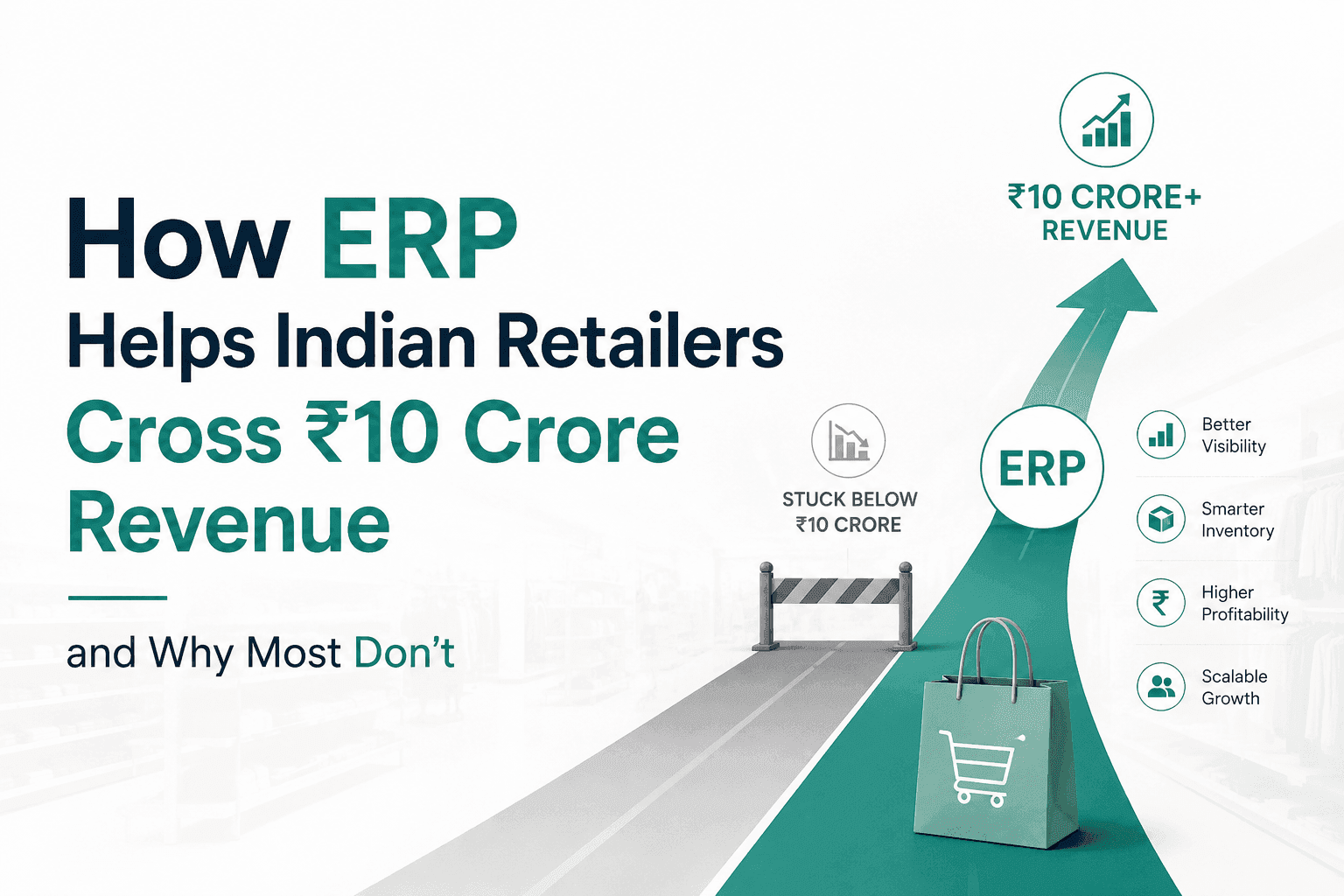
The five operational walls every growing Indian retail business hits between ₹5 and ₹15 crore, and the ERP-led decisions that determine which side of ₹10 crore you end up on.
Table of Contents
The ₹10 crore wall is real
The five operational walls between ₹5 and ₹15 crore
Why most retailers don't cross
How a unified ERP changes the math at each wall
The 18-month playbook for retailers between ₹5 and ₹15 crore
What "ready to scale past ₹10 crore" actually looks like
Where Peddle Plus fits
See what crossing ₹10 crore looks like on Peddle Plus
TL;DR
Most Indian retailers between ₹5 and ₹15 crore in annual revenue are stalled by operational walls, not market conditions. Inventory becomes ungovernable, GST e-invoicing kicks in, multi-channel sync breaks, reporting needs a dedicated function, and the founder runs out of hours. The retailers who cross ₹10 crore consistently have done one thing differently: they replaced their accounting tool with a unified retail ERP before they hit the wall, not after. Crossing this threshold isn't about more marketing or more stores, it's about the operational backbone that lets growth compound instead of consume the founder.
The ₹10 crore wall is real
Walk through any Indian retail conference and you'll hear founders describe the same plateau. They crossed ₹3 crore. Then ₹5. Then growth slowed. Stores opened but margins stayed flat. The founder started spending 60% of their time on operations instead of strategy. Hiring solved some of it, but the new managers needed systems the business didn't have. The curve flattened.
This is the ₹10 crore wall, the operational ceiling most Indian retail SMEs hit between ₹5 and ₹15 crore in annual revenue. It's not a market wall (the market is huge). It's not a product wall (the products are working). It's an operational wall, the point at which the systems that got you to ₹5 crore cannot carry you to ₹15.
The retailers who cross it have made one decision earlier than their peers: they replaced Tally, BUSY, or their bespoke accounting tool with a unified retail ERP. Not because they wanted new software. Because their growth required new infrastructure.
The five operational walls between ₹5 and ₹15 crore
The wall isn't a single point. It's five connected walls, showing up in roughly the same order for nearly every growing Indian retail business.
Wall 1: Inventory becomes ungovernable
At ₹3–5 crore, you can run inventory on spreadsheets and physical counts. At ₹8-12 crore, you cannot.
A retailer at ₹10 crore typically carries 2,000-10,000 SKUs across 3-8 stores, sells through 2-4 channels, and processes 50,000+ transactions a month. At that scale, stockouts on top SKUs and dead stock on slow movers both compound. You start losing 5-10% of potential revenue to invisible stockouts and tying up 15-25% of working capital in dead inventory, both of which are invisible on your P&L until you look for them.
A unified ERP with real-time multi-store inventory, ABC classification, and channel-level sync isn't a luxury at this stage. It's the only way to recover the margin you're already leaking.
Wall 2: Compliance overhead eats founder time
Once you cross ₹5 crore in turnover, GST e-invoicing applies. Cross ₹10 crore and your compliance complexity increases sharply: more vendors, more interstate transactions, e-way bills daily, RBI 2FA on payment flows, IMEI registration through Sanchar Saathi if you're in electronics.
The compliance load that one bookkeeper handled at ₹4 crore now needs a full-time CA plus compliance support at ₹10 crore, unless your ERP automates most of it. The founder who spent 8 hours a week on tax matters at ₹4 crore is spending 20+ hours a week at ₹10 crore. That's 50% of their working week consumed by paperwork that should be running automatically.
Wall 3: Multi-channel sync breaks
At ₹5 crore, you're probably selling through your stores plus one or two online channels. At ₹10 crore, you're selling across 5–8 channels: stores, your website, Amazon, Flipkart, Myntra or Nykaa (depending on category), WhatsApp Business, ONDC, and increasingly a quick-commerce listing.
The instant you cross four channels, manual inventory reconciliation breaks. You start over-selling on Amazon while sitting on stock in-store. You under-list on Flipkart because your team can't keep up with sync. You refund angry customers because three channels showed "in stock" for an item that sold out two hours ago.
This is the wall where a generic ERP or accounting tool finally fails publicly. And once it fails publicly, your customer ratings drop, which depresses revenue further.
Wall 4: Reporting requires a dedicated function
At ₹5 crore, the founder reads the books on Sunday morning. At ₹10 crore, the founder needs a finance manager, and that manager needs reporting infrastructure.
Reporting requirements between these revenue bands change in kind, not just degree. You go from end-of-month P&L review to needing daily store-level dashboards, weekly category-level margin analysis, monthly vendor performance reviews, quarterly investor updates if you've raised, and annual audit preparation. Each of these requires data that lives across systems that don't talk to each other in a Tally + spreadsheets setup.
The retailers who cross ₹10 crore smoothly have reporting infrastructure that produces these views in seconds. The ones who stall are still copying numbers from Tally exports into Excel pivots every Friday night.
Wall 5: Scaling becomes an org problem, not a product problem
This is the most under-discussed wall, and the most expensive.
At ₹3–5 crore, the founder is the operational system. They know every SKU, every customer, every vendor, every issue. At ₹10 crore, no human can hold that information. You either rely on systems to run the business while you focus on strategy, or growth pulls you back into operations and the strategic vacuum kills momentum.
Without a unified ERP, the founder ends up either becoming a permanent operations manager (stalls growth), hiring expensive senior managers who quit because the systems are inadequate (burns capital), or pushing decisions down the org without giving people the data to make them well (creates chaos).
The retailers who cross the wall have built systems that hold the operational truth, so people, not the founder, can run the business.
Why most retailers don't cross
Most retailers know they need better systems before they hit the wall. They just don't act because:
Sunk cost. They've used Tally or BUSY for years. The team knows it. The CA prefers it. Switching feels expensive even when staying is more expensive.
No obvious crisis. The leakage is gradual. You don't lose ₹50 lakh in one day. You lose it over 12 months in 3% increments that look like normal business friction.
Founder fatigue. By the time the founder is ready to acknowledge the operational wall, they're already burning out — and burnt-out founders make poor software decisions, or no decisions.
Implementation fear. Stories of failed SAP rollouts scare every Indian retailer. Most don't realise modern cloud retail ERPs migrate in 4-8 weeks, not 6-18 months.
Retailers who cross the wall do one of two things: they migrate proactively at ₹5-7 crore (the cheap, smart move), or they migrate reactively after a major operational failure at ₹9-12 crore (the painful, expensive move). Both work. The proactive move costs roughly 60% less in lost revenue, founder time, and team churn.
How a unified ERP changes the math at each wall
Wall | What a unified cloud retail ERP does |
1. Inventory ungovernable | Real-time multi-store inventory, ABC classification, dead-stock alerts, movement-driven replenishment. Recovers the 5-10% stockout leak and the 15-25% working-capital lock. |
2. Compliance overhead | GST e-invoicing automated, e-way bills auto-generated, RBI 2FA built into POS, Sanchar Saathi/IMEI integration. Founder compliance time drops from 20 hours/week to 2. |
3. Multi-channel break | Unit-level inventory sync across every sales channel in real time. No double-selling, no under-listing, no refund spiral. |
4. Reporting function | Pre-built dashboards for store, category, vendor, and time-period analysis. Reports that took the finance lead 6 hours load in 6 seconds. |
5. Org-stage scaling | Role-based access, audit logs, multi-store consolidation, exception alerts. The system holds the operational truth, freeing the founder to lead. |
The 18-month playbook for retailers between ₹5 and ₹15 crore
The retailers who cross the wall most cleanly run a similar 18-month sequence.
Months 0-2: Audit current operational gaps. Identify which of the five walls is closest to breaking. Shortlist 2–3 cloud retail ERPs aligned to your business size and category.
Months 2-4: Run parallel demos on real data. Negotiate pricing aligned to mid-market budgets, not enterprise tiers.
Months 4-6: Migrate, with parallel-run mode active for 30-45 days. Train the team especially store managers and finance lead.
Months 6-9: Operate on the new system. Catch reconciliation gaps in months 7-8. By month 9, the system is normal operating environment.
Months 9-18: Compound the advantages. Add channels (Amazon, ONDC, quick-commerce), open new stores, run advanced analytics. Retailers in this window typically grow revenue 30-60% in nine months because growth no longer fights operations.
What "ready to scale past ₹10 crore" actually looks like
Operationally, the retailer ready to break the wall has these markers:
One source of truth for inventory across every store and channel
Compliance running automatically - GST, e-way bills, payment authentication
Founder spending less than 5 hours a week on bookkeeping queries
Daily and weekly reports available on demand, not requested ad-hoc
New stores opening in 4-6 weeks, not 4-6 months
Store managers running operations independently, escalating only exceptions
If you can tick these boxes, ₹10 crore is a stop on the way, not a wall. If you can't tick most of them, the wall is what's coming next.
Where Peddle Plus fits
Peddle Plus One is built specifically for the ₹3-50 crore Indian retail business, the exact revenue band where the operational walls described above bite hardest. Multi-store consolidation, real-time multi-channel sync, automated GST and RBI compliance, ABC and FSN inventory classification, and a migration model that fits a growing retail business's calendar (4-8 weeks, not 6-18 months).
See what crossing ₹10 crore looks like on Peddle Plus
If your retail business is between ₹5 and ₹15 crore or you're approaching that band and don't want to hit the wall the hard way, book a focused 20-minute session with our growth-stage team. We'll cover:
A working Peddle Plus One dashboard built around your category, store count, and channel mix
Where your current setup is quietly leaking margin across the five walls
A specific migration path: timeline, parallel-run plan, training schedule, month-by-month operations through the transition
Pricing aligned to ₹3-50 crore Indian retail businesses, not global-vendor enterprise tiers
Book a growth-stage retail session →
Sources: India Retail Market Size and Forecast,
IMARC Group; Goods and Services Tax Council, e-Invoicing Threshold Notifications; Reserve Bank of India, Authentication Mechanisms for Digital Payment Transactions Directions, 2025; Bizowie, ERP TCO Comparison: Cloud vs On-Premise Over 10 Years; Mordor Intelligence, India Cloud Computing Market 2026.
Frequently Asked Questions
What is the ₹10 crore wall in Indian retail?
The ₹10 crore wall is the operational ceiling most Indian retail SMEs hit between ₹5 and ₹15 crore in annual revenue. It's not a market or product problem, it's an operations problem caused by inventory becoming ungovernable, compliance overhead growing, multi-channel sync breaking, reporting needs increasing, and the founder running out of hours. Crossing it requires unified retail ERP infrastructure, not more marketing or more stores.
Why do most Indian retailers stall between ₹5 and ₹15 crore?
Four main reasons: sunk cost in legacy tools like Tally or BUSY, no obvious crisis (leakage is gradual at 3-5% per month, not visible all at once), founder fatigue from operational overload, and fear of complex ERP implementations. Retailers who cross the wall act proactively at ₹5-7 crore, costing roughly 60% less than the reactive migration that happens after a major failure.
Is Tally enough to scale a retail business past ₹10 crore?
Tally is a strong accounting tool, but it's not a retail ERP. Past ₹5 crore, retailers typically need real-time multi-store inventory sync, multi-channel reconciliation across Amazon, Flipkart, Myntra, ONDC, and quick-commerce, automated GST e-invoicing and e-way bills, and role-based dashboards, features that require unified retail ERP infrastructure built on top of (or replacing) Tally.
How long does retail ERP migration take in India?
Modern cloud retail ERPs migrate in 4-8 weeks for retailers in the ₹5-50 crore band, not the 6–18 months that legacy enterprise ERPs require. The recommended approach is a parallel-run mode for 30-45 days where both systems operate simultaneously, followed by full cutover with reconciliation checks in months 7-8 of the 18-month playbook.
When should an Indian retailer move from Tally or BUSY to a retail ERP?
The smart move is between ₹5 and ₹7 crore, proactively, before operational walls bite. Migrating reactively at ₹9-12 crore after a failure (over-selling on Amazon, GST notice, dead-stock crisis) costs significantly more in lost revenue, founder time, and team churn. The proactive move costs roughly 60% less overall.
What does GST e-invoicing mean for Indian retailers?
GST e-invoicing applies once a retailer crosses ₹5 crore in turnover. It requires every B2B invoice to be uploaded to the government's IRP (Invoice Registration Portal) in real time, with a unique IRN and QR code generated. Manually managing this at scale across multiple stores is impractical, retail ERPs automate the entire flow, including e-way bill generation for interstate transactions.

Tamanna Bhardwaj
EditorContent Strategist at Peddle Plus with 4+ years of experience in brand growth and marketing, specializing in retail technology, ERP adoption, and business operations for Indian SMEs.