Why CAs Recommend Controlled ERP Systems to Retail Businesses in 2026
Why CAs Recommend Controlled ERP Systems
for Retail Decision Makers in 2026
For retailers, distributors, multi-location brands, founders, and CFOs who want real financial control not just year-end compliance.
Table Of Contents
- The Conversation Happening in Every CA's Office in 2026
- Signs Your Business Has Already Outgrown Manual Systems
- Why This Problem Is Growing in 2026
- Key Benefits- Why CAs Specifically Recommend Controlled ERP
- Controlled ERP vs the Alternatives- The Honest Comparison
- What This Looks Like in Practice
- The Cost of Inaction
- Industry Trends and Market Outlook
- Common Mistakes Businesses Make
- How to Choose the Right Controlled ERP
- The Platform Built for This Requirement
- The Future of Controlled ERP Over the Next 5 to 10 Years
- The Leadership Conclusion
The Conversation Happening in Every CA's Office in 2026
It almost always starts the same way. You walk into your CA's office with one of three problems- a GST notice because some buyer rejected your invoice on ITC grounds, a year-end stock count that came up short by a number nobody can explain, or a bank loan application that rejected because 18 months of clean profit and loss statements couldn't be produced quickly enough. Your CA pulls together whatever they can from your billing software, your accounts package, and those Excel sheets you send every month, bills you for the hours, delivers the numbers, and then says what they've been meaning to say for two years: "You need a proper ERP." In 2026, that advice has shifted from being about better organization to being about protecting what's yours. India's GST system has tightened in ways that directly punish disconnected billing, a mismatch that went unnoticed two years ago, now triggers notices, and a supplier's mistake becomes your problem. Inventory losses are compounding invisibly because if you can't see stock movement in real time, you're not just losing products, you're losing margins you worked hard for. And multi-location retail is growing faster than the tools most owners use to run it, what worked for one store breaks at three, and what worked at three collapses at five. A controlled ERP system for retail isn't about better software anymore; it's about protecting the margins you already have, keeping your compliance clean so notices don't show up, and making decisions based on what's actually happening today instead of what happened last month. The business you've built deserves that much.
Signs Your Business Has Already Outgrown Manual Systems
• Your CA asks for reports that take more than 24 hours to produce
• Your physical stock count doesn't match your software at year-end
• You manage more than one location but cannot see them all from one screen
• GST filing requires manual reconciliation between billing and purchase records
• You have received a GST notice or faced ITC rejections from a buyer
• Your margin per product is something your CA estimates, not your system reports
• A key employee leaving creates a data recovery crisis
If three or more of these apply, the sections below are written specifically for your business.
Why This Problem Is Growing in 2026
1. GST Compliance Has Become Structurally Unforgiving
India's e-invoicing rules have tightened steadily since 2020. What started as a requirement for businesses with turnover above ₹500 crore now applies to those above ₹5 crore, and a move to ₹2 crore is expected soon . Then there's the new 30-day deadline. From April 1, 2025, if your business turnover is ₹10 crore or more and you don't upload an e-invoice to the government portal within 30 days of issuing it, that invoice becomes invalid ,meaning your buyer loses their tax credit and you face penalties . For businesses still using basic billing software that isn't connected to the GST system, every single B2B sale above that limit becomes a manual headache. At scale, that's not just extra work, it's a real risk. This is exactly why CAs are now pushing for proper ERP. The only way to handle this without stress is to have e-invoicing happen automatically at the time of billing, with no separate step, no manual upload, and no chance of missing a deadline.
2.Inventory Loss Is a Silent and Compounding Problem
Global retail shrinkage is projected to reach $132 billion in losses in 2025, continuing a steep rise from $112 billion in 2022. Source: NRF Impact of Theft & Violence Report, 2025. Administrative and operational errors receiving discrepancies, mis-scans, bad data entry, and untracked transfers, account for over 25% of all retail shrinkage. Source: NRF / Loss Prevention Research Council, 2025.
For an Indian retailer doing ₹2 crore annually, even a 2% shrinkage rate means ₹4 lakh leaving the business every year with no traceable cause. The problem is not the loss itself, it’s the invisibility. Without real-time integrated inventory tracking, shrinkage accumulates silently until it shows up as a year-end number that nobody can explain.
3. Multi-Location Complexity Has Outgrown Basic Tools
Since 2022, more and more Indian businesses have been opening multiple locations, new branches, franchise outlets, expanded operations. It's been driven by cities growing, delivery networks getting faster, and the franchise model taking off.
But here's the problem. Most accounting software was built back when a business meant one shop, one owner, one set of books. It was never designed to handle what happens when you have multiple branches, real-time stock visibility across all locations, purchase approvals that need to route correctly, stock moving between one store and another, and compliance data that has to stay clean everywhere.
So here's what's happening. CAs who work with multi-location retailers are spending hours every month just piecing together data. They're pulling reports from each branch, matching numbers, chasing managers for information. And here's the hard truth they already know: even after all that work, the numbers are never quite right. Something always slips.
A proper ERP would show them everything in seconds. Instead, they're billing you for time spent reconstructing what should have been visible from day one.
4. Commercial Pressure Is Now Compliance Pressure
B2B buyers in India are checking supplier compliance infrastructure directly because ITC rejection from an invalid invoice affects their own tax liability. A supplier that cannot reliably generate IRP-validated e-invoices is not just non-compliant; they are a commercial liability for the buyers who work with them. CAs are flagging this: ERP adoption is increasingly a commercial competitive requirement, not only a regulatory one.
Market Signal
India's ERP market reached $1.93 billion in 2025 and is projected to reach $3.6 billion by 2033 at a 7.2% CAGR. Source: IMARC Group, 2025. The retail SME segment is among the fastest-growing within this expansion driven by compliance mandates, multi-location growth, and migration away from standalone accounting tools.
What Is a Controlled ERP System?
When your CA or financial advisor uses the term "controlled ERP," they mean something very specific.
Think of it this way. Basic accounting software just records what happened, like a diary that notes down events. Basic ERP might automate your billing and inventory, but without much oversight.
Controlled ERP is different. It's a system where:
- Every single transaction is recorded permanently.
- Every action- who made a sale, who approved a purchase, who adjusted a price, is tagged to a specific user.
- Nothing can be reversed or backdated. If someone tries, the system leaves a visible trail. You can see exactly what changed, when, and by whom.
For your CA, this matters because it makes your business auditable. When numbers need to be verified, there's proof. When a question comes up, there's an answer. When tax authorities ask for clarity, you have a clean trail to show them.This is what your CA means when they say "controlled ERP." Not just software that does the job but software that protects you, gives you visibility, and makes their actual advisory work possible instead of spending time chasing data.
What It Is Not
- Basic billing software with an ERP label
- Accounting software with inventory added as a side module
- Enterprise ERP from global vendors, scaled down in price but not in complexity
- A system requiring a full-time IT team or a six-month implementation
What It Actually Includes
- Real-time inventory across all locations in one live view, always current
- Integrated purchase management- POs, GRNs, and supplier reconciliation in one flow
- GST e-invoicing and e-way bill generation are automatic at the point of billing
- Role-based access controls staff see what they need; owners and CAs see everything
- Automatic ledger entries- every sale, purchase, and payment update the accounts
- Multi-location dashboard- stock, sales, and compliance visible by branch, in real time
- Complete and immutable audit trail- every entry, edit, and approval permanently logged
- Mobile access- full visibility from any device, from anywhere
"A controlled ERP does not just record what happened in your business. It creates a system where nothing happens without being recorded."
Key Benefits- Why CAs Specifically Recommend Controlled ERP
The CA's recommendation is not driven by software preferences. It is driven by what they encounter in client accounts and the specific, recurring problems that cost businesses real money.
1. Operational Visibility: The CA's First Request
Every CA advising a retail business eventually asks: "Show me your actual stock position, purchase history, and outstanding payables, as of today." In businesses on disconnected tools, this triggers a multi-day recovery effort involving three systems and several WhatsApp threads. In a controlled ERP, it takes three minutes.
Operational visibility is not a premium feature. It is the baseline from which every financial advisory conversation about margins, expansion, loans, or compliance must begin. Without it, the CA is advising on incomplete information, and the business owner is making decisions on data that is weeks old.
2. Shrinkage Control: Making the Invisible Loss Visible
Administrative and operational errors account for over 25% of global retail shrinkage, and in Indian retail, the figure is often higher due to manual receiving, cash handling, and informal supplier relationships. Source: NRF / Loss Prevention Research Council, 2025.
Controlled ERP closes this gap through purchase-to-GRN matching (catching short deliveries at the receiving dock), full transaction attribution (every void, return, and discount linked to a user and timestamp), and real-time discrepancy alerts that surface problems within hours, not at year-end when three months of margin have already gone.
3. Compliance Automation: GST Without the Quarterly Scramble
Under India's current e-invoicing regime, every B2B transaction above the ₹5 crore AATO threshold requires a valid, IRP-routed e-invoice at billing. From April 2025, the 30-day upload window makes this a time-sensitive requirement on every qualifying sale. A business using disconnected billing must handle this manually, and every manual step is a potential compliance failure.
Controlled ERP makes this automatic. The invoice is IRN-stamped at billing. The buyer receives a valid e-invoice instantly. The CA's quarterly reconciliation reduces dramatically. And the business has zero exposure to ITC rejection from buyers.
4. Multi-Location Governance: One Set of Numbers
Branch opacity is the CA's recurring problem in multi-location retail accounts: stock transferred without records, sales banked centrally without attribution, and expenses booked at the wrong location. Controlled ERP assigns every transaction to a location, consolidates data in real time, and enables branch-wise P&L without manual aggregation. For businesses planning a second or third location, this is often the single highest-value feature.
5. Data-Driven Decisions: Margin Intelligence as Daily Output
Knowing total revenue is straightforward. Knowing which product, category, or branch is actually profitable after returns, discounts, shrinkage, and purchase costs is what separates intentional growth from accidental growth.
Controlled ERP surfaces this data as a routine daily output. Product-level margin reports, category performance, supplier cost variance, and demand patterns are visible without a custom report request or a CA visit.
6. Audit Readiness: Every Transaction Has a Permanent Trail
A GST audit, statutory audit, or bank due diligence requires transaction-level evidence. In businesses on disconnected tools, this evidence must be reconstructed, a process that is slow, expensive, and never fully accurate. In a controlled ERP, the complete audit trail exists already: every entry, modification, and approval, with user attribution and timestamps permanently attached.
Controlled ERP vs the Alternatives - The Honest Comparison
The table below reflects actual operational differences - no marketing language.
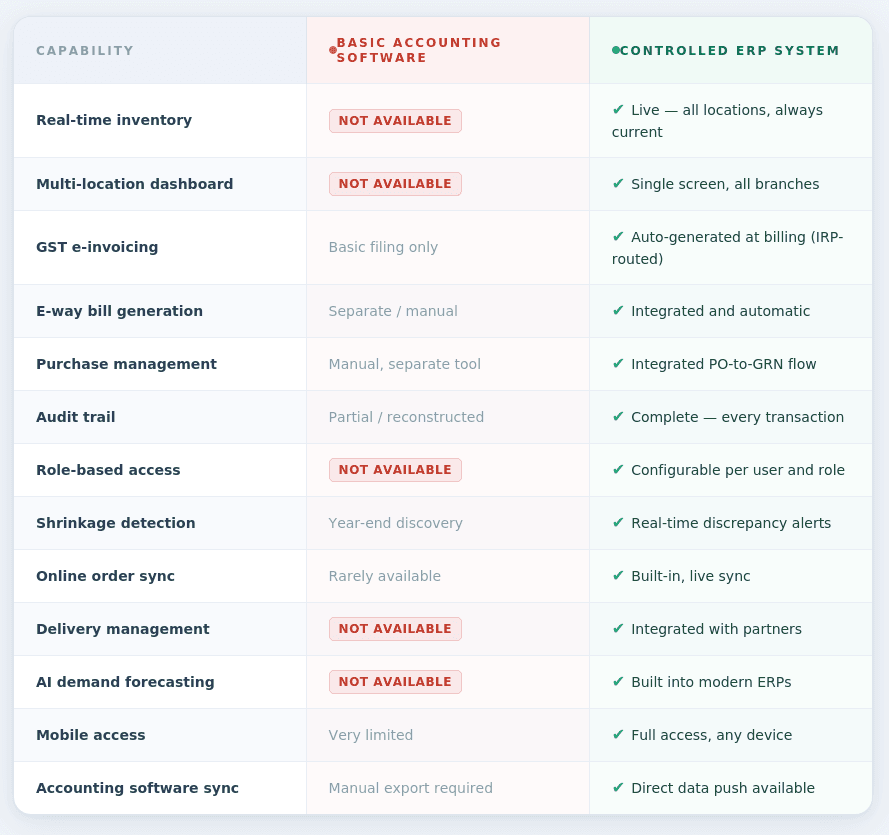
Note: Comparison reflects typical capabilities of standalone accounting software versus purpose-built controlled ERP for Indian retail
What This Looks Like in Practice
Before Controlled ERP
- Business:3-location garments retail chain, annual turnover approximately Rs. 3.1 crore
- Tools: Standalone accounting software for books, WhatsApp for branch stock requests, and a physical ledger for purchases
- GST filing:4 to 6 days per quarter- CA firm reconciling billing and purchase records manually
- Inventory: Year-end physical count reveals Rs. 4.2 lakh discrepancy causes unidentifiable
- Banking: Working capital loan application takes 3 weeks to produce clean financial documents
- Visibility: Branch-level profitability requires a 2-day manual calculation, rarely done
After Controlled ERP- In 90 Days
- All three branches on one ERP; stock visible from one screen, always live
- GST e-invoicing is automatic at billing; every qualifying sale is IRP-routed with no manual step
- Quarterly GST preproduced to a 4-hour review; CA reconciliation time down 65%
- Discrepancy alert surfaces a receiving error at Branch 2 within 48 hours catching a loss running for 7 weeks
- Working capital loan processed in 9 days all documents generated directly from ERP
- Branch P&L available in real time; one branch identified as generating 38% of revenue but only 12% of net margin
ROI Breakdown Example
Shrinkage caught (7-week receiving error): ~Rs. 52,000 | CA reconciliation time saved: ~20 hrs/quarter at Rs. 2,000/hr = Rs.40,000/year | GST penalty exposure avoided: estimated Rs.32,000 | Working capital loan delay avoided: 3 weeks | Total estimated first-year financial benefit: Rs.1.4 to 2.0 lakh. For most mid-segment retailers, this produces a measurable positive return within 60 to 90 days.
The Cost of Inaction
Every month, a retail business operates without a controlled ERP, and specific costs accumulate invisibly.
Compliance exposure: Here's something most business owners don't realize until it starts hurting. Every time you make a B2B sale above the e-invoicing threshold and your system doesn't track it properly, you're not just creating a problem for yourself. You're creating a problem for your buyer. When they go to claim their Input Tax Credit, the system checks your invoice. If it doesn't match perfectly? Rejected. Your buyer loses the credit they were counting on. Now put yourself in their shoes. If one of your suppliers kept causing you tax headaches, how long would you keep buying from them? This is the part nobody talks about. Inadequate systems don't just put you at risk. They make you a liability for customers who are trying to run clean businesses themselves. And in a market where everyone has options, that's not a compliance issue. That's a relationship issue.
Shrinkage accumulation: At a 2% shrinkage rate on Rs. 2 crore annual turnover, Rs. 4 lakh leaves the business every year in losses that cannot be traced or prevented without real-time inventory data.
Data gaps at critical moments: The working capital loan. The GST audit. The investor due diligence. The new location decision. Each requires financial clarity that disconnected tools cannot produce quickly or accurately.
CA time costs: Let's talk about what your CA's time actually costs you. Every hour they spend pulling data from three different systems is an hour you're paying for. Every time they stop to figure out why the stock report doesn't match the sales report, that's billable time. Every time they manually rebuild a P&L because the numbers from your branches don't line up, that's money leaving your pocket. Here's the thing people miss. Your CA isn't charging you extra because they want to. They're charging because reconstructing disconnected data takes real work. Real hours. Real effort. And that cost passes straight back to you. Now think about what they could be doing with those hours instead. Spotting trends. Flagging risks. Helping you plan for growth. That's what you actually pay them for. That's the valuable stuff. But they can't do any of that when they're stuck playing detective with last month's numbers
Opportunity cost: Here's what happens when you make decisions without knowing your margins or understanding what's actually selling. You guess. you look at what sold last month. You trust your gut. You order what feels right. And for a while, that works. You've been in business long enough to have good instincts. But here's the thing about instinct. It doesn't improve over time the way data does. It just stays... instinct. Meanwhile, your competitor down the road isn't guessing. They know exactly which products give them the best margin. They know what's selling this week, not last month. When something stops moving, they catch it early and adjust. When a supplier raises prices, they see the impact on their margins immediately and decide whether to absorb it or pass it on. You? You find out at month-end. Sometimes later. Now multiply that by months. By years. Every week, your competitor makes small, smart decisions based on real numbers. Every week, you make your best guess. Over time, that gap stops being small. It becomes structural. They operate more efficiently. They price more intelligently. They spot problems before they become crises. You're left wondering why you're working just as hard but falling behind. That's not a motivation problem. That's a visibility problem.
Industry Trends and Market Outlook
The data direction is consistent toward integration, compliance automation, and real-time intelligence at every level of the market.
Market Growth
India's ERP market reached $1.93 billion in 2025 and is projected to reach $3.6 billion by 2033 at a 7.2% CAGR. Source: IMARC Group, 2025. The SME retail segment is among the fastest-growing within this expansion.
Retail Loss Detection Investment
The global retail loss detection market is projected to grow from $27.6 billion in 2025 to $51.37 billion by 2033, growing at 8.23% CAGR. India ranks second in Asia Pacific for retail loss detection adoption. Source: Business Research Insights, 2025.
AI Integration in ERP
AI and machine learning are now core ERP components, not add-ons. Early applications of generative AI to ERP implementation have shown up to 40% reduction in deployment time and cost. Source: Accenture Technology Vision, 2025. Demand forecasting, shrinkage anomaly detection, and automated reorder management are moving into mid-market standard features.
Cloud ERP Adoption
The global cloud ERP market is projected to grow from $72.2 billion in 2023 to $130.5 billion by 2028. Source: MarketsandMarkets, 2023. For Indian SMEs, cloud ERP eliminates server infrastructure costs and enables real-time multi-location synchronization, solving the two largest barriers to ERP adoption in the mid-market.
Regulatory Direction
India's compliance trajectory is accelerating: more transactions will be covered by e-invoicing, ITC reconciliation will become increasingly automated, and audit trails will become the regulatory floor rather than a best-practice recommendation. Controlled ERP is not preparation for this trajectory; it is the current rational response to it.
Common Mistakes Businesses Make
Mistake 1: Treating ERP as an IT Project
ERP is not a technology initiative. It is a business decision with operational and financial consequences. Businesses that delegate it entirely to a technical resource without leadership ownership and clear adoption accountability consistently underutilize it. The software works. The data discipline doesn't follow automatically.
Mistake 2: Choosing Based on Features Alone
The right question is not whether a system has the features listed, it is whether those features fit how your specific business actually operates. Indian retail has distinct workflows: GST-first billing, cash-heavy transactions, multi-SKU receiving, and informal supplier relationships. A system built for international or generic B2B businesses will create friction even if the feature list looks complete.
Mistake 3: Running Parallel Systems After Implementation
The most common failure mode in ERP adoption: implementing the system but continuing to use parallel manual processes. A separate stock register, a WhatsApp ordering thread, and a paper purchase ledger alongside the ERP. This produces the cost of ERP with none of the benefits. Full migration is not optional; it is the mechanism through which controlled ERP delivers value.
Mistake 4: Skipping Floor-Level Training
An ERP is only as accurate as the data entered into it. Billing staff who don't follow void procedures, receiving staff who skip GRN entry, and managers who estimate stock transfers rather than recording them are the most common sources of data integrity failures, exactly the failures that controlled ERP is supposed to eliminate.
Mistake 5: Waiting for the Right Time
The most expensive mistake is deferring the decision until the business is larger or more stable. ERP does not just manage scale; it enables it. The businesses growing fastest are often growing because they have data visibility that others don't. The right time to build the foundation is before a critical decision that depends on it.
How to Choose the Right Controlled ERP
Apply these five criteria as non-negotiables before committing to any system.
1. Compliance Readiness
Does it generate GST e-invoices and e-way bills automatically at billing without a separate upload step? Is it updated with current CBIC notifications? Does it push clean data directly to your existing accounting software? If any answer is conditional, the compliance architecture is not genuinely controlled.
2. Integration Ecosystem- Indian Context
Indian retail requires specific integrations: payment gateways (Razorpay, PhonePe, Paytm, UPI), delivery partners (Shiprocket, Delhivery), and marketplaces (Amazon, Flipkart). Any data that flows through manual entry at these integration points is a potential error and a potential data integrity failure.
3. Multi-Location Scalability
Choose a system designed to scale to five or more locations without a platform change. The cost of migrating ERP systems, data transfer, retraining, and operational disruption makes future-proofing the initial selection a financially sensible decision even for single-location businesses today.
4. Access Controls and Audit Trail
Verify these specifically: configurable permissions per user role; every transaction, including voids, discounts, and edits, permanently logged with user attribution; past entries viewable but not modifiable without a traceable override. These are the controls that make an ERP controlled in the professional sense.
5. Support, Context, and Implementation Quality
Ask the vendor directly: What is the realistic timeline to operational go-live? Is there onsite demo and implementation support? Hindi language capability? A team familiar with Indian retail workflows from kirana to chain retail, B2C to B2B? Context-fit matters as much as feature completeness.
Implementation Checklist
GST e-invoicing + e-way bill at billing | Real-time multi-location inventory | Purchase-to-GRN reconciliation | Role-based access controls | Complete immutable audit trail | Payment integrations: Razorpay, PhonePe, UPI, Paytm | Direct sync with your accounting software | Delivery integrations: Shiprocket, Delhivery | Marketplace integrations: Amazon, Flipkart | Mobile access | Hindi support | Onsite implementation support available
The Platform Built for This Requirement
The specific gap described throughout this article between what Indian mid-market retailers need and what existing tools offer is exactly what Peddle Plus One ERP was built to close.
Designed for retail businesses that have outgrown basic billing software but don't need enterprise complexity, Peddle Plus delivers every capability on the controlled ERP checklist built specifically for the Indian retail context, used by thousands of businesses across grocery, garments, auto parts, electronics, cosmetics, pet shops, spas, salons, gyms, and gifting stores.
- GST billing, e-invoicing, and e-way bills are automatic at the point of billing
- Real-time inventory across single and multiple store locations
- Integrated purchase management- PO, GRN, and supplier reconciliation
- Role-based access and full audit trail- every transaction permanently logged
- Multi-device access- full visibility from any device, in real time
- Integrated payments- Razorpay, Paytm, PhonePe, Google Pay, UPI
- Direct sync with your existing accounting software- works alongside your CA's current workflow
- Delivery integrations- Shiprocket and Delhivery
- Marketplace integrations- Amazon and Flipkart
- Warehouse Management- can manage multiple warehouses from one place.
Available across 10+ cities in India, with Hindi support, a free onsite demo, and an implementation team that understands Indian retail from the ground up.
The Future of Controlled ERP Over the Next 5 to 10 Years
The trajectory of India's regulatory and commercial infrastructure is clear. The businesses that position ahead of it will have a compounding advantage over those that react to it.
Invisible Compliance by 2030
GST compliance, ITC reconciliation, and e-invoicing will be expected to operate automatically as a by-product of every transaction no separate compliance workflow. Businesses whose ERP is deeply integrated with the GSTN infrastructure will meet these requirements without conscious effort. Those on disconnected tools will face accelerating penalty exposure.
AI-Driven Retail Intelligence
Demand forecasting, pricing optimization, shrinkage prediction, and supplier benchmarking will shift from quarterly CA-prepared reports to real-time ERP outputs. The first generation of Indian retailers to build five-plus years of clean, structured ERP data will hold an information advantage over later adopters that cannot be easily replicated.
Conversational Access
ERP interaction will move from dashboards to natural language. A store owner will ask their phone what their stock position is across branches, which product categories are underperforming on margin, and which supplier has been short-delivering and receive spoken, accurate answers in real time. This removes the final barrier to adoption: the assumption that ERP requires a trained user to extract value.
Compliance as the Permanent Floor
India's direction under the GST framework is consistent and accelerating. More transactions will be covered. ITC reconciliation will become increasingly automated and unforgiving. Audit trails will be the regulatory baseline, not a best practice. Controlled ERP is not preparation for this future; it is the rational operational response to the present.
The Leadership Conclusion
When a Chartered Accountant recommends a controlled ERP system to a retail business owner, they are not recommending software. They are identifying a structural gap between how the business currently operates and the level of financial control that modern Indian retail, with its compliance requirements, multi-location complexity, and margin pressure, now demands. The businesses that close this gap in 2025 and 2026 will build a compounding foundation: cleaner compliance, sharper margin intelligence, stronger audit readiness, and faster access to growth capital when the business needs it most. The businesses that defer will find the gap wider, more expensive to close, and more costly to ignore with each passing quarter. The CA has already done the analysis. The recommendation is already on the table.
"The question is no longer whether your retail business needs controlled ERP. The question is how much it is already costing you not to have it."
Frequently Asked Questions
What exactly is a "controlled ERP," and how is it different from regular billing or accounting software?
A controlled ERP is a system where every transaction is permanently recorded, every action is attributed to a specific user, and nothing can be reversed or backdated without leaving a visible trail. Unlike basic billing or accounting software, which simply records what happened, a controlled ERP creates an environment where nothing happens without being recorded which makes the business fully auditable and financially transparent at all times.
Why are Chartered Accountants specifically recommending ERP now, in 2025–26?
Two regulatory changes have made the recommendation urgent. First, GST e-invoicing now applies to businesses with turnover above ₹5 crore, with a further reduction to ₹2 crore expected soon. Second, from April 2025, businesses with turnover above ₹10 crore must upload e-invoices to the government portal within 30 days of issuance or the invoice becomes invalid. CAs are recommending controlled ERP because manual compliance at this level of requirement is no longer reliably manageable.
How does controlled ERP help with inventory shrinkage?
Shrinkage in retail is rarely visible in real time, it accumulates silently and typically surfaces only at year-end. A controlled ERP addresses this through purchase-to-GRN matching, which catches receiving discrepancies at the point of delivery, full transaction attribution for every void, return, and discount, and real-time discrepancy alerts that surface irregularities within hours rather than months.
Our business operates across multiple locations. Can a single ERP system manage all of them?
Yes, and for multi-location businesses, this is often the highest-value feature. A purpose-built controlled ERP consolidates stock, sales, purchases, and compliance data across all branches into a single real-time view. It assigns every transaction to a specific location, enables branch-wise P&L without manual aggregation, and eliminates the data reconstruction work that currently consumes significant CA time every month.
Does implementing a controlled ERP replace our CA or change how they work?
No. A controlled ERP does not replace your CA, it allows them to shift from data reconstruction to actual advisory work. When operational and financial data is clean, current, and accessible, your CA can focus on margin analysis, growth planning, compliance strategy, and audit readiness rather than spending billable hours reconciling figures from disconnected systems.
What is the realistic return on investment for a mid-sized retailer?
For a three-location retail business at approximately ₹3 crore annual turnover, documented first-year financial benefits have included shrinkage recovery of around ₹52,000 from a single identified receiving error, CA reconciliation time savings of approximately ₹40,000 per year, and avoided GST penalty exposure of an estimated ₹32,000. Total estimated first-year benefit typically falls between ₹1.4 and ₹2.0 lakh, with measurable positive return within 60 to 90 days of full implementation.
What are the most common reasons ERP implementations fail?
The most frequent failure modes are running parallel manual processes alongside the ERP after go-live, insufficient floor-level training for billing and receiving staff, and treating ERP as an IT project rather than a business decision with ownership at the leadership level. A controlled ERP delivers value only when it becomes the single system of record, not one of several parallel systems.
How should we evaluate whether a controlled ERP is genuinely compliance-ready for India?
Ask the vendor three specific questions: Does the system generate GST e-invoices and e-way bills automatically at the point of billing, without a separate upload step? Is it updated in line with current CBIC notifications? Does it push clean data directly to your existing accounting software? If any answer is conditional or requires a manual workaround, the system's compliance architecture does not meet the standard required for Indian retail in 2025–26.