Why 80% of SMEs Choose Wrong: Truth of Accounting Software VS ERP
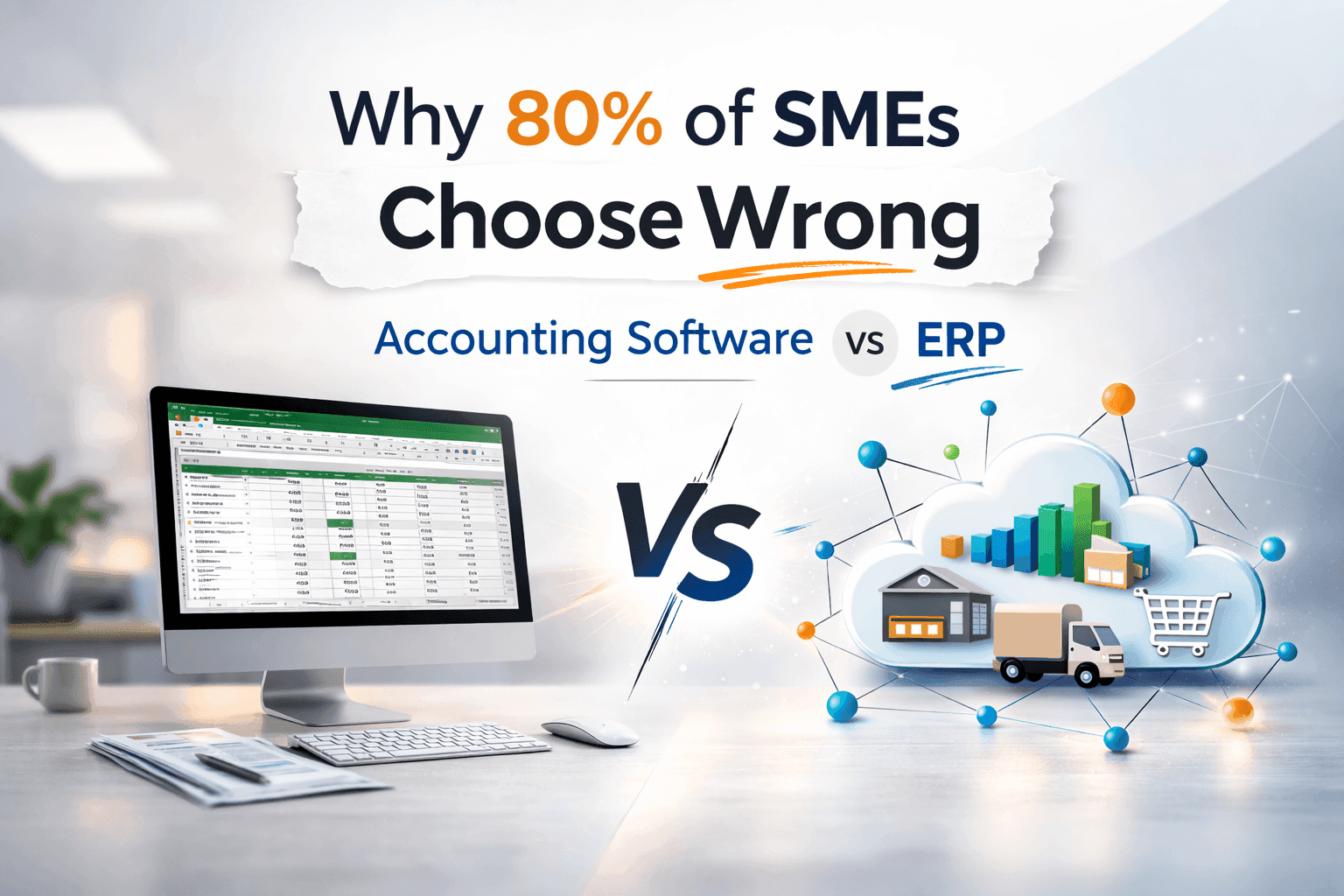
Why 80% of SMEs Choose Wrong: Truth of Accounting Software VS ERP
You already know your accounting software is not enough. You are not reading this because you are confused about the basics. You are reading this because you are stuck in a very specific situation your business has genuinely grown past the point where basic tools work, but every ERP vendor you have spoken to is quoting Rs.30 lakh, Rs.40 lakh, sometimes Rs.50 lakh just to get started.
And that number, for most serious entrepreneurs running real businesses, simply does not make financial sense right now.
So you keep patching things together. A billing tool here. A spreadsheet for stock there. A WhatsApp group between your warehouse manager and store supervisors. It works barely. And every month the cracks get a little wider, the errors get a little more expensive, and the decisions get a little more reactive.
This blog is for you not for a startup with investor money to burn, not for a corporation with an IT department. For the entrepreneur, the warehouse owner, the multi-location retailer who has built something genuinely real and now needs the right systems to take it further, without gambling Rs.40 lakh on software.
Table of Contents
Why 80% of SMEs Choose Wrong: Accounting Software vs ERP Truth
What This Situation Is Actually Costing You
Accounting Software Is Great. Until It Isn't
What ERP Does, In Plain Language
The Honest Comparison
Accounting Software Counts the Loss. ERP Prevents It.
There Is a Third Option. Most People Miss It.
Five Signs You've Already Crossed the Line
This Is Where Peddle Plus One ERP Comes In
What's Coming Next And Why You Should Care
What This Situation Is Actually Costing You
Let's talk about what staying stuck between two inadequate systems is costing you. because most business owners underestimate this badly, and the number is almost always higher than they think. Your operations team spends 8 to 10 hours every single week reconciling data between your billing software, inventory records, and purchase files. That is one full working day, every week, doing something that should be completely automatic. Annualized, that is more than 50 days of productive capacity spent on manual data shuffling that adds zero value to your business.
Your warehouse runs on experience and instinct which works right up until it does not. A stock out happens not because the product was unavailable, but because nobody saw it coming in time. Purchasing decisions are based on last month's numbers, not today's reality. And your CA spends two to three days every quarter pulling together GST filings from systems that were never designed to communicate with each other.
None of this shows up as a single line item on your P&L. But it is costing you in wasted hours, avoidable errors, decisions made on incomplete data, and opportunities you never even see because your information is always running two weeks behind reality.
The Indian ERP software market was valued at $1.8 billion in 2024 and is projected to reach $3.6 billion by 2033 at a CAGR of 7.2%. A significant portion of that growth is mid-scale businesses warehouse operators, retail chains, franchise networks ,who have hit the ceiling of basic tools. (Source: IMARC Group, 2024)
Accounting Software Is Great. Until It Isn't.
Let's be fair. Accounting software does one thing exceptionally well, it records your financial transactions with accuracy. Invoices, ledgers, GST returns, bank reconciliation, balance sheets. For that specific job, on that specific layer of your business, it is clean and reliable.
The problem is not that it fails. The problem is where it stops.
It does not know what is sitting in your warehouse right now. It does not know your Jaipur store has three weeks of stock while your Agra branch ran out two days ago. It does not know that a particular supplier consistently delivers 10 days late and is quietly damaging your customer relationships. It does not know that 60% of your online orders are clustering in one neighborhood where you could open a fulfillment point and cut delivery time in half.
Accounting software records history. Running a business at scale requires managing the present and building the future. For that, the tool you use matters enormously.
What ERP Does, In Plain Language
An ERP connects every department of your business into one system so information flows automatically, decisions happen on real data, and nothing falls through the gaps between tools.
Think of your business as a human body. Purchasing, inventory, billing, sales, delivery, accounts, each one is a separate organ, currently working in isolation. An ERP is the nervous system that connects them all. When a sale happens, inventory updates automatically. When stock crosses a threshold, a reorder alert fires. When an invoice generates, the accounting entry posts. When your warehouse dispatches an order, the delivery partner is notified. All of it, in real time, without anyone manually carrying information from one system to another.
Real Business Scenario
Vikram runs a consumer electronics distribution operation across four cities- Agra, Kanpur, Lucknow, and Varanasi. He carries around 3,000 SKUs and works with 12 suppliers. His team uses accounting software for billing and spreadsheets plus phone calls for everything else.
Every week his operations head drives between locations to physically check stock. Purchasing happens on gut feel. Month-end closing takes four days and always throws up discrepancies nobody can fully explain.
After moving to retail ERP: his operations head stopped those weekly drives. Stock across all four cities is visible from one dashboard in real time. Purchase orders generate automatically when thresholds are crossed. Month-end dropped from four days to one. And Vikram could see a product line sitting dead in Varanasi while selling out in Lucknow and moved the stock before it became a write-off.
That is what ERP actually does which is not in theory, it's for a business exactly like yours.
The Honest Comparison
Here is what separates the two systems side by side with actual differences:
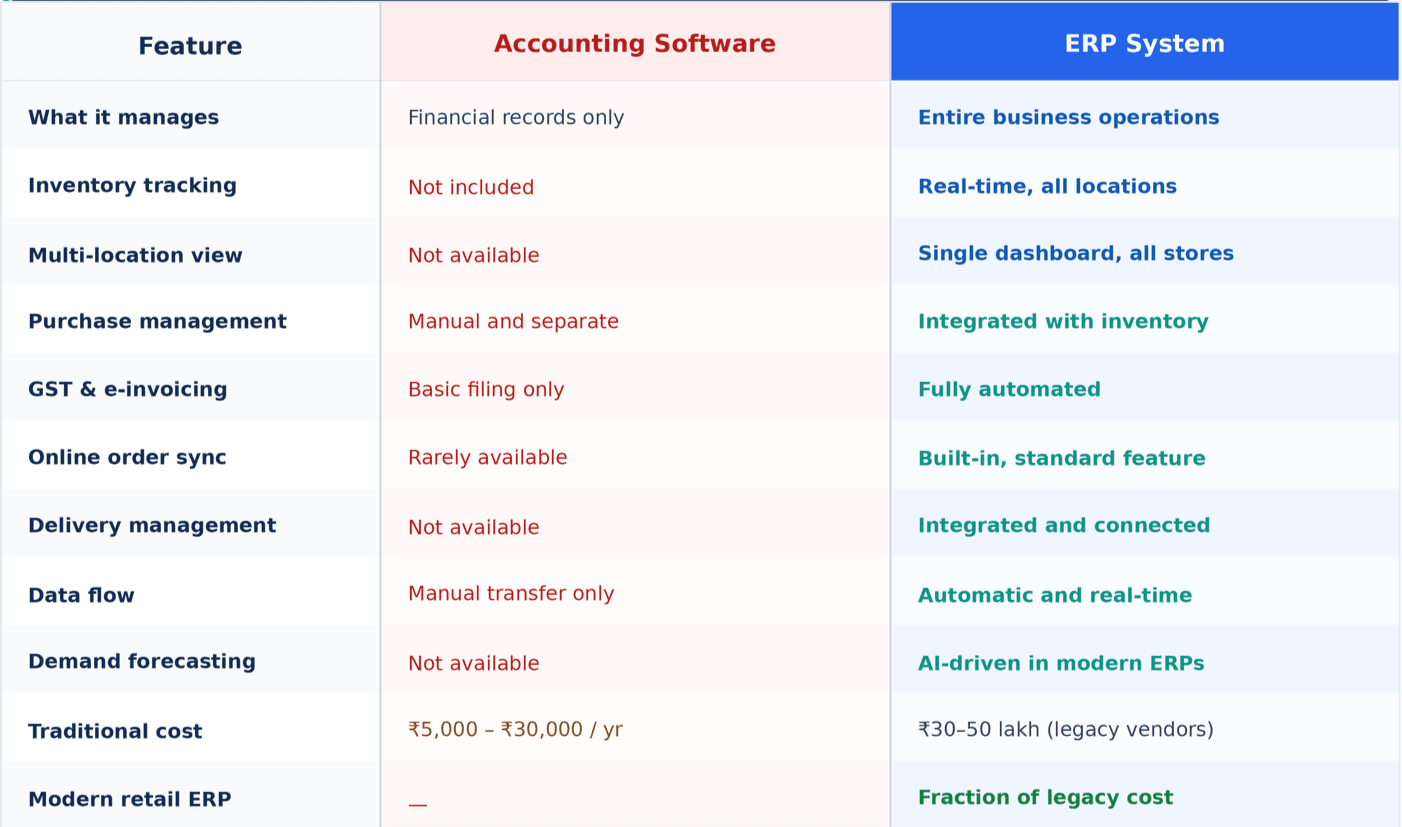 That last row is where the conversation usually ends for most Indian business owners. Legacy ERP vendors quote implementation costs that assume IT departments, months of rollout, and budgets most real entrepreneurs do not have. So the choice has felt like: stay with inadequate tools, or spend money you don't have. That choice is no longer the only one on the table.
Accounting Software Counts the Loss. ERP Prevents It.
Let me show you the real difference between accounting software and ERP. Once you see it, you won't be able to ignore it. Accounting software is like a postmortem report. It tells you what already happened. A sale was made. An invoice was sent. A payment came in. A loss happened. All of it accurate. All of it documented. And all of it too late. By the time your accounting software shows you something went wrong, it already went wrong. The stock ran out three days ago. The supplier overcharged you last month. Your Lucknow branch has been struggling for six weeks. The report confirms it but the customer is already gone, the money is already lost, and there's nothing you can do about it now. ERP is different. It's like ongoing care. It doesn't just record what happened it helps you manage what's happening right now and shape what happens next. When stock at one location runs low, ERP flags it before the shelf goes empty. When a supplier is late with an order, it alerts your team before your customer feels the delay. When one branch is making better margins than another, it shows you today not at quarter end when it's too late to fix.
Accounting software hands you the report after the patient has left. ERP helps keep the patient healthy in the first place. Here's the thing: most Indian business owners running growing operations are making decisions entirely on postmortem data. And then they wonder why everything feels reactive. Why month-end is always a scramble. Why problems keep catching them off guard. The software isn't broken. It's just not built for what you're trying to do with it.
There Is a Third Option. Most People Miss It.
On one side, you have basic accounting software. Does the job for compliance, but leaves you guessing about everything else.
On the other side, there's the big enterprise stuff. The Rs. 40 lakh implementations with consultants, servers, and a six-month timeline. Built for giants, not for you.
But somewhere in the middle and this is where things get interesting there's a new category of cloud-based ERP built specifically for growing Indian businesses.
Think of it as the sweet spot. It gives you everything you actually need: GST that just works (because it was built with it from day one), inventory tracking across multiple locations, seamless integration with your online orders, connections to delivery partners, and real-time reports that actually make sense.
What it doesn't give you: a dedicated IT team, a months-long implementation project, or a finance department to run it.
These aren't watered-down versions of "real" ERP. They're built from the ground up for how Indian retail and distribution businesses actually run. No bloat. No enterprise complexity you'll never use. Just the stuff that moves your business forward.
Finally, ERP that treats you like a business owner not a corporation.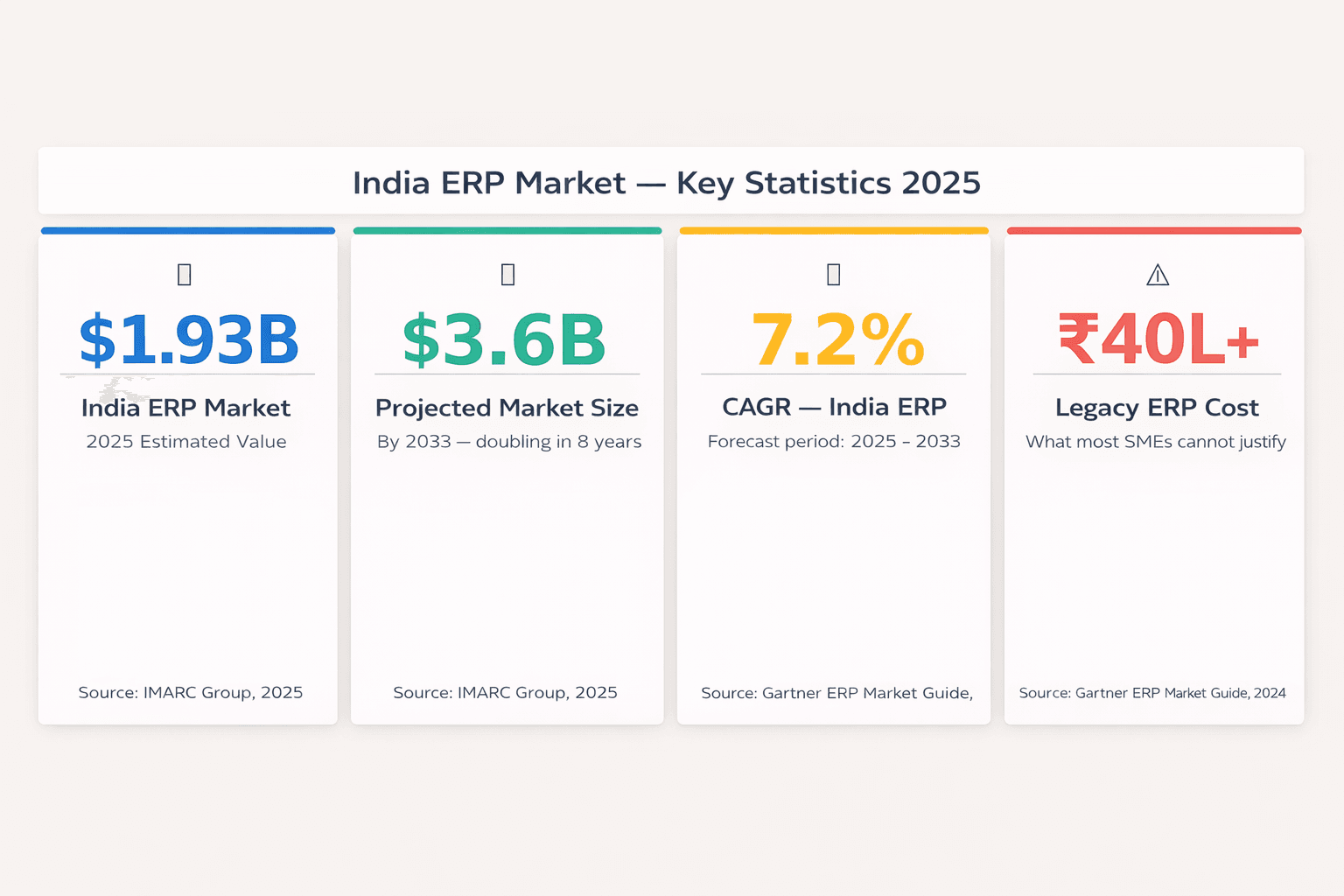
Government Compliance Is Accelerating This GST e-Invoicing Mandates
India's GST e-invoicing thresholds have been progressively tightened since October 2020 and FY 2025-26 marks the most demanding compliance year yet. Businesses with an Aggregate Annual Turnover (AATO) exceeding ₹5 crore are now mandated to generate e-invoices for all B2B transactions (IMARC), and from April 1, 2025, businesses with an AATO of ₹10 crore or more must upload those invoices to the Invoice Registration Portal (IRP) within a strict 30-day window or face outright rejection and loss of Input Tax Credit. (Cargoson) The threshold is further expected to drop to ₹2 crore, bringing a significantly larger pool of SMEs into the mandatory e-invoicing net. (Statista) The Government of India's direction is unambiguous: real-time digital compliance is no longer a choice for growing businesses. Those still operating on disconnected billing tools are not just inefficient they are non-compliant.
The Problems Bleeding Your Business Right Now
Here's what most software conversations never talk about.
When your business is growing, there's damage happening that never shows up in your profit and loss statement. Not directly, anyway. But it's eating into your money every single day. Four silent killers that accounting software simply cannot touch:
Theft and Shrinkage- The Loss Nobody Wants to Talk About
Walk into any warehouse or multi-location retail store and ask the owner a simple question: do you know exactly how much stock disappeared last month?
Most can't answer. Not because they're careless. But because their system simply can't tell them.
In Indian retail, shrinkage that polite word for pilferage, staff theft, supplier short-shipments, and damaged goods, typically runs between 1.5% and 4% of total inventory value every year. Let's put real numbers to that.
If your business moves stock worth Rs. 5 crore annually, we're talking about Rs. 7.5 lakh to Rs. 20 lakh walking out the door quietly. Not in one big chunk. Just... disappearing. A little here, a little there. Your accounting software won't blink. It records the final loss when someone finally does a physical count weeks later. By then, the damage is old news. The trail is cold. This is where ERP changes the game. With real-time inventory tracking, the moment something doesn't add up, the system flags it. Today. Not at quarter-end. Supplier sent 50 units but only 48 hit your shelf? Caught on day one. Something moved from the back room but never reached the billing counter? Flagged immediately. Batch tracking, barcode scanning at every receipt and dispatch, daily stock reports suddenly shrinkage stops being this vague "cost of doing business" you just accept. It becomes a problem you can actually see and fix.
The stock isn't just disappearing anymore. You'd know where.
Dead Stock- Your Money Sitting on a Shelf, Doing Nothing
Here's a question: how much of your inventory hasn't moved in the last three months?
If you don't know the answer, you're not alone. But there's a cost to not knowing.
Dead stock is one of those problems that doesn't make a noise. No one comes to tell you, "Hey, that order of winter jackets from last year is still sitting in the corner." Your accounting software won't send an alert. It just quietly shows the same number month after month, inventory: X rupees. As if that stock is still worth what you paid for it.But here's what's really happening. That product is tying up capital you could be using to buy things that actually sell. It's taking up space. Collecting dust. Maybe even approaching expiry. And because no one is tracking how fast things move, you might even reorder more of the same slow mover without realizing your mistake.
An ERP changes this completely.It tracks every single item's movement. In real time. It shows you what's flying off the shelves and what's been sitting untouched for 30, 60, or 90 days. It flags products trending down before they become dead weight. And it gives your purchasing team the data to stop ordering more of what isn't selling.
For a business with thousands of items across multiple locations, this one feature alone can free up serious working capital. Every quarter.
Here's a real example that stuck with me.
A garment distributor in Kanpur ran an ERP report and discovered that 18% of his total inventory spread across three godowns hadn't moved in over three months. He had no idea. That stock was quietly consuming space, insurance cost, and capital. No one had ever told him.
Within two months of acting on that data, he cleared out the slow movers, freed up Rs. 14 lakh in working capital, and put that money into faster-selling categories.
His accounting software had never once flagged the problem. It just recorded whatever was there.
GST Compliance- Harder, Costlier, Riskier
Here's something nobody tells you about GST. It hasn't stayed still since 2017. And it's not going to.
The government has steadily lowered the e-invoicing threshold year after year from ₹500 crore in 2020 to just ₹5 crore today. E-way bill rules keep expanding. And real-time invoice matching between what you file and what your suppliers file is getting tighter by the month .
For a business with multiple locations, different transaction types, and high daily order volumes, managing all of this manually isn't just inefficient anymore. It's genuinely risky. Here's what that risk looks like on the ground.
Your billing data sits in one place. Your purchases are in another. Inventory lives somewhere else entirely. Every month, your CA spends three to four days just pulling everything together before they can file a single return. In that scramble, errors creep in. Mismatches happen. And a GST notice even for a small discrepancy triggers an expensive, time-consuming process that nobody wants to deal with.
There's a real example that captures this perfectly. A chemical company in Raipur once received a GST notice demanding ₹95 lakh in tax and another ₹1.15 crore in interest. The reason? Their supplier hadn't filed returns. The bitter irony? At the time the liability was assessed, the very form the supplier was supposed to file didn't even exist on the GST portal yet. The business spent two years fighting a liability that shouldn't have existed .
This is the reality of manual compliance today. You're not just managing paperwork. You're exposed to risks you can't control supplier defaults, system gaps, regulatory hard stops. A proper ERP changes this completely. It generates GSTR-1, GSTR-3B, e-invoices, and e-way bills automatically from the same transactions that drive your billing and inventory. No double entry. No manual assembly. No month-end scramble. Your CA stops being a data entry person and starts doing actual financial advisory work. And your compliance risk drops to near zero .
Zero Visibility- You're Running Your Business Blind
This is the problem that makes all the others worse.
Because you can't see stock movement in real time, theft goes unnoticed. Because you don't have a live view of what's selling where, dead stock piles up quietly. Because your data lives in different places that don't talk to each other, GST errors multiply. And by the time someone compiles a report for you, it's already two weeks old. Think about that for a second. You're making decisions about tomorrow based on what happened two weeks ago.
Here's a simple test. Right now, without picking up the phone to call anyone, can you tell me the exact stock position of your top 20 items across all your locations?
If the answer is no and for most business owners, it is you who have a visibility problem. And visibility isn't just a reporting issue. It's an operational issue. It touches every decision you make, every single day. How much to order. What to discount. Which branch needs attention. Where your money is actually stuck. This is where ERP changes everything. Imagine a single screen. Live. Showing you stock levels at every location. Sales velocity by item. Purchase orders that are still on the way. Delivery status. Branch-wise performance. All updating in real time. When your Jaipur store manager marks a product as received, you see it instantly. When your Lucknow warehouse dispatches an order, your delivery partner knows immediately, no phone call needed. When a branch's margin drops unexpectedly, you spot it today, not next month when the damage is done. That's the difference between actually running your business and just guessing at it.
Five Signs You've Already Crossed the Line
You do not need to be a certain size to need an ERP. You need to have certain problems. Be honest with yourself on each of these:
You run more than one location or warehouse.
If your stock exists in more than one physical place and you cannot see it all in real time from one screen, you have an ERP problem -- not an accounting problem.
You sell through more than one channel.
In-store, online, wholesale, delivery apps , if these channels are not connected to the same live inventory, you are either overselling, underselling, or both. Customers pay the price. So do you.
Your purchasing is reactive, not proactive.
If purchase orders happen because someone noticed the shelf was empty, rather than because your system flagged a threshold breach three days earlier -- you are losing money on stockouts and emergency procurement every single month.
Month-end closing takes more than one day.
If your CA needs two to four days to assemble data for GST filing and reporting, your systems are failing your business. That time has a real cost, and it compounds month after month.
You cannot answer one question without making phone calls.
What is my current stock position across all locations right now? If answering that requires calling your store managers, you are managing your business blind. No serious operator should be in that position.
So here's a quick check. Ask yourself:
Do you ever run out of stock on your bestsellers and have no idea it happened until a customer asks?
Is there a corner in your godown or store where products have been sitting for months and you're not sure what's there anymore?
Does your CA spend days every month just pulling together data before they can file your GST returns?
Do you have multiple branches, but no way to see what's selling where without calling each manager at the end of the day?
Have you ever suspected stock is walking out, but you can never quite prove it?
Do you feel like you're always reacting to problems instead of getting ahead of them?
If two or more of these sound familiar and for most people reading this, several will, you are ready for ERP.
Not someday. Not when you get bigger. Now.
The only question left is finding one that doesn't ask you to spend ₹40 lakh before you even get started.
This Is Where Peddle Plus One ERP Comes In
Let's be honest. You didn't read this far because you were bored. You read because something in these pages sounded familiar.
The stock that disappears and you can never quite prove it. The godown corner full of products that haven't moved in months representing lakhs of rupees just sitting there. Your CA spending days every month pulling together data that should be ready in minutes. A branch that's been underperforming, but nobody noticed until the numbers came in too late. A supplier short-shipping you, and you only find out weeks later when you finally do a count.
Every single one of these problems has a name. And Peddle Plus One ERP was built to fix them.
Who Peddle Plus One ERP is really for
Peddle Plus One ERP is not some fancy software built for companies with crore-sized budgets and teams of IT people. It was built for someone like you.
The grocery owner managing four stores across two cities. The garment distributor with three godowns and a headache every time stock moves between them. The franchise operator who wishes they could be in five places at once. The warehouse owner whose entire business runs on instinct, WhatsApp messages, and hoping nothing falls through the cracks.
You're serious about your business. You've just been priced out of serious software. Until now.
What changes the moment you go live
The day you start using Peddle Plus One ERP, something shifts. Your business becomes visible. Not the way a monthly report is visible two weeks late, manually compiled, already outdated. Visible in real time.
Here's what that actually looks like:
A sale happens at any location. Your inventory updates instantly. No one has to tell you. No one has to send a message at the end of the day. You just know.
A delivery comes in from a supplier. It's matched against the purchase order right there. If they sent 48 units instead of 50, the system flags it immediately not during a physical count six weeks from now when everyone's memory is fuzzy.
A product stops moving. The system tracks every item's velocity continuously. So when something hasn't sold in 30 days, your team gets a nudge. Before it becomes dead stock. Before your money gets stuck on a shelf collecting dust.
On theft and shrinkage
Let's talk about the stuff nobody wants to admit is happening. When stock levels don't match what was received, dispatched, or sold, Peddle Plus One ERP flags it. When something goes missing between one branch and another, there's a trail. When a supplier consistently sends less than what you paid for, the data proves it. You stop managing on trust alone. Not because you don't trust your people but because a growing business needs evidence, not hope. That's not suspicion. That's just being serious about protecting what you've built.
On GST compliance
Your CA will notice the difference within the first month. Actually, they'll probably call you to ask what changed.
GSTR-1, GSTR-3B, e-invoices, e-way bills everything generated automatically from the same transactions that drive your billing and inventory. No double entry. No manually matching data from three different systems. No frantic calls at month-end asking where the numbers are.
The data your CA needs is just... there. Accurate. Ready. Because it was never separate in the first place.
The visibility that changes everything
And then there's the part that actually changes how you run your business day to day.
You wake up in the morning, open your phone, and before your first cup of tea- you know. What's selling. What's running low. Which location is performing. What needs your attention today. Not because someone remembered to send you a report. Because the system is live. Connected. Working for you, all the time.
If you've spent years managing by gut feel, phone calls, and hoping for the best, you won't believe how different this feels. It's not just operationally convenient. It changes how confidently you make decisions. How quickly you catch problems. How much of your mental energy goes toward growing the business instead of just holding it together.
What Peddle Plus One ERP actually is
This is what proper ERP does for a growing Indian business. Not just software. Not just compliance. Real visibility, real clarity, real control at a price that actually makes sense for a middle-class entrepreneur.
No Rs. 40 lakh implementation. No months of disruption. No IT team required.
Just a platform that works the way your business actually works. In Hindi or English. On mobile or desktop. Across one location or twenty.
The problems you've been living with? They have names. And finally, there's something built to treat them.
What's Coming Next - And Why You Should Care
Here's what's happening right now in the world of business software.
The gap between basic accounting tools and expensive enterprise ERP is shrinking fast. Not because the big, costly systems are getting cheaper. But because newer, smarter, cloud-based systems built for businesses like yours are getting incredibly good at prices that actually make sense.
Think about what's coming in the next two to three years.
Indian businesses will have access to things that used to cost crores in software implementation:
AI that tells you what to order and when, before you run out
Systems that predict demand based on real data, not gut feel
Real-time profit tracking for every single location you own
Alerts that warn you about stock outs before they happen
This isn't sci-fi. It's coming. And it's coming soon.
Here's the question you need to ask yourself:
Are you building your business on a foundation that can plug into these things when they arrive?
If you put an integrated, scalable system in place now , the one that connects your billing, inventory, compliance, and reporting then you'll be ready. When these AI tools become available, you just switch them on. Your business starts operating at the next level.
But if you're still running on patchwork tools in 2026-27 ,different software for billing, another for accounts, WhatsApp for orders, Excel for stock , you won't be ready. You'll be scrambling to catch up while your competitors are already there.
This is not an IT decision. This is a decision about whether you want to compete or spend the next decade playing catch-up.
The businesses that get their systems right now aren't just being tech-savvy. They're building an advantage that their competitors literally cannot see. Until it's too late.
Frequently Asked Questions
We can't justify Rs.30-50 lakh for ERP. Is there a real alternative?
Yes and it is not a compromise. Modern cloud-based retail ERPs like Peddle Plus One ERP deliver core ERP functionality -- multi-location inventory, automated GST compliance, integrated billing, online orders, delivery management -- without the implementation cost that comes with legacy systems. The Rs.30-50 lakh figure applies to traditional enterprise deployments that assume large IT infrastructure and months of custom development. That is not the only category of ERP available to Indian businesses today.
Our CA is comfortable with our current accounting software. Do we have to change?
No. Peddle Plus One ERP integrates directly with standard accounting tools so your CA continues working in the environment they know. The ERP layer manages operations inventory, billing, orders, delivery and the financial data flows into your existing accounting setup automatically. Your CA gets cleaner data with less manual assembly. Everyone wins.
We have a warehouse plus multiple retail stores. Does one system cover both?
Yes. Peddle Plus One ERP is built specifically for this kind of multi-node operation. Warehouse stock, store inventory, inter-branch transfers, and online fulfilment are all visible and manageable from one dashboard.
How long does implementation actually take?
For a cloud-based retail ERP like Peddle Plus One ERP, the timeline is measured in days, not months. There is no hardware to install, no lengthy customisation project, and onsite support is available across 10+ Indian cities.
Is this only for grocery or retail businesses?
No. Peddle Plus One ERP serves grocery and supermarkets, garment stores, consumer electronics, auto parts, cosmetics, hardware distribution, and more. If you carry inventory, sell across channels, and manage multiple locations the platform is built for your operation.

Tamanna Bhardwaj
EditorContent Strategist at Peddle Plus with 4+ years of experience in brand growth and marketing, specializing in retail technology, ERP adoption, and business operations for Indian SMEs.