Rise Of Dark Stores: What They Are, Why They Matter & 10 Benefits
Dark Stores: 10 Benefits & Profit Strategies for 2026-27
Table of Contents
- What Actually Is a Dark Store?
- Why Are Dark Stores Suddenly Everywhere?
- 10 Benefits of Dark Stores
- The Real Challenge: Making a Dark Store Profitable
- A Real Example: What This Looks Like in Practice
- The Future of Dark Stores
- Is a Dark Store the Right Choice for Your Business?
- How Peddle Plus One ERP Supports Dark Store Operations
- Questions Retailers Actually Ask (FAQ)
- Conclusion
I just wanted to tell you about something I saw last month that completely changed how I think about retail.
I walked into what looked like a regular supermarket from the outside. Inside, shelves were stacked neatly. Aisles were organized. Cold sections hummed at the back. But there was not a single customer. No one is pushing a trolley, no one is at the billing counters. Just people with handheld scanners walking briskly, packing stations humming near the exit, and delivery riders collecting orders every few minutes.
That was my first real encounter with a dark store. And honestly? It felt like watching the future of retail happen in real time.
What Actually Is a Dark Store?
A dark store is exactly what it sounds like, a store that looks normal inside but is closed to walk-in customers. The lights are on. The shelves are stocked. But no one is shopping there.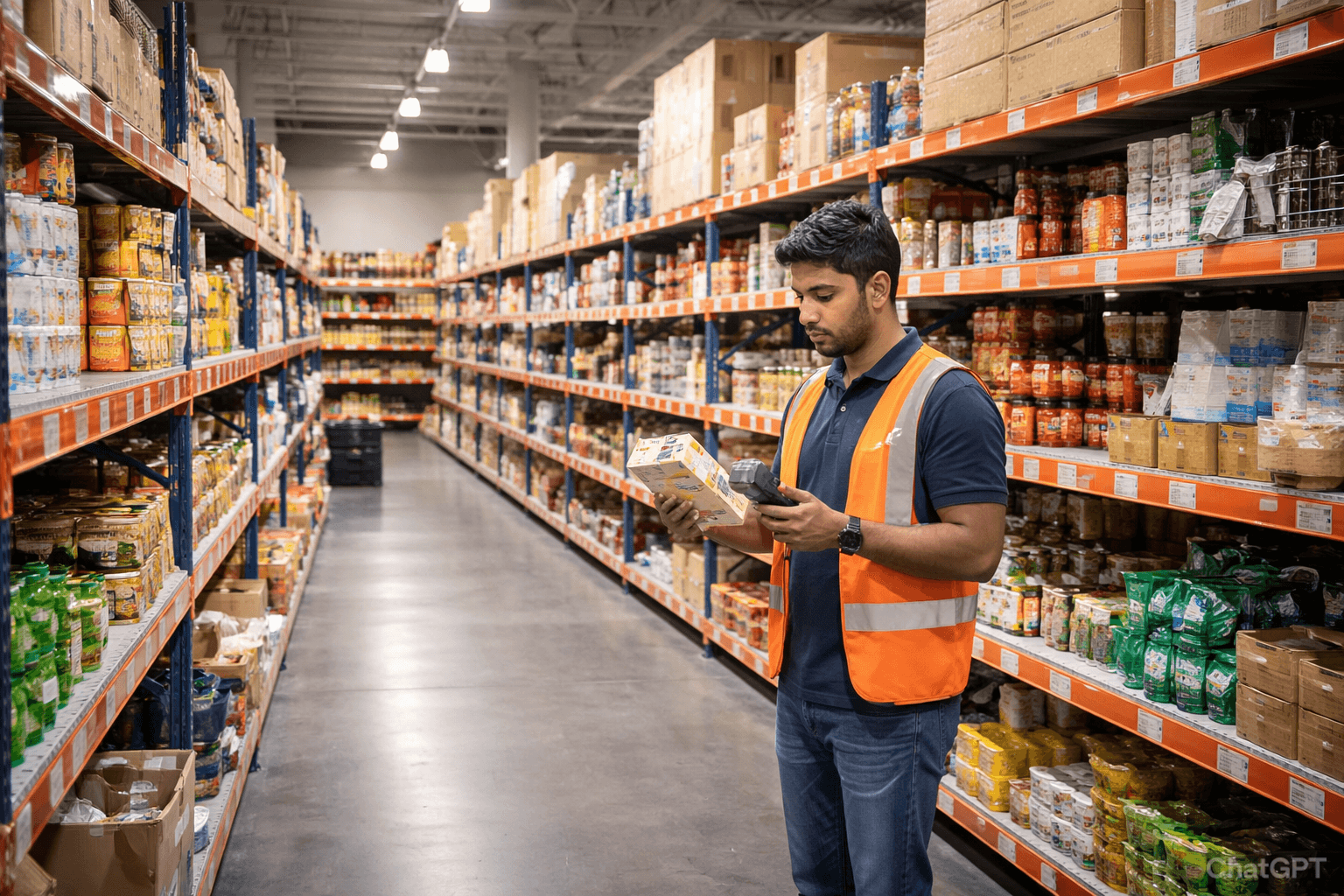
Every item on those shelves exists for one purpose only: to be picked, packed, and delivered to someone's doorstep within minutes.
The name isn't dramatic. It simply means the store is "dark" to customers. No footfall. No browsing. No lost trolleys. Just pure, focused fulfillment.
Think of it like a restaurant kitchen. Customers never enter the kitchen, but everything on the menu comes from there. The kitchen is designed for efficiency, not presentation. A dark store is the kitchen behind your online catalogue.
Dark Stores Didn't Start This Way, Here's How They Evolved
This model didn't come from some fancy strategy meeting. It came from a real problem that every retailer faced after 2020. When online orders exploded, stores tried picking those orders from the same shelves where customers shopped. It was chaos. Customers got frustrated waiting while staff moved through aisles with trolleys. Staff got overwhelmed trying to do two jobs at once. Orders arrived late, substitutions went up, and everyone came out of the experience worse off. Dark stores were the fix, a space designed from the ground up for speed, not for shopping. No grand vision behind it. Just a practical response to an operational headache that was getting harder to ignore.
They began as a workaround, not a plan The earliest dark stores were nothing more than underperforming retail locations that got quietly repurposed. Strip out the customer displays, dedicate the space entirely to fulfillment, and suddenly pickers could actually move. It wasn't elegant. But it worked well enough to prove the concept.
The pandemic fast-tracked everything Consumer behavior was already shifting toward online shopping, but slowly, on its own timeline. The pandemic ripped that timeline apart. People who had never ordered groceries online did it out of necessity, and a large chunk of them never stopped. That permanent shift in habit is what transformed dark stores from a workaround into a serious, long-term business model almost overnight.
Customer expectations kept raising the bar Once people experienced fast delivery, they wanted it faster. First it was next-day. Then same-day. Then two hours. Then thirty minutes. Each time expectations tightened, dark stores had to adapt, better layouts, smarter inventory systems, locations chosen purely for delivery radius rather than visibility or footfall. The model was never allowed to sit still.
The internal operations completely changed Early dark stores were essentially converted stockrooms held together by manual coordination and gut instinct. Today they're purpose-built fulfillment engines, layouts designed around picking paths, real-time inventory tracking, automated replenishment, and route-optimized delivery. The gap between a 2019 dark store and a 2025 dark store is enormous, and most of that gap came from operators being forced to get more disciplined as order volumes scaled.
Data became the real competitive advantage As the model matured, the best operators stopped relying on instinct and started running on numbers. Which SKUs move fastest in which neighborhoods. What time of day order volumes spike. Where substitutions are happening and why. The stores that learned to read their own data pulled ahead of the ones still making decisions on feel. That gap is only widening.
The evolution is still happening By end of 2025, dark store space in Tier 2 and Tier 3 Indian cities alone had reached 4 to 5 million square feet, with Lucknow, Jaipur, Chandigarh, and Kochi growing the fastest. Sub-30-minute delivery is already becoming a baseline expectation in major cities. Automation is entering picking operations. This is no longer a metro experiment or a pandemic-era stopgap, it's a nationwide infrastructure shift that is still accelerating, and the operators who stay ahead of where consumer expectations are going are the ones who will build something that actually lasts.
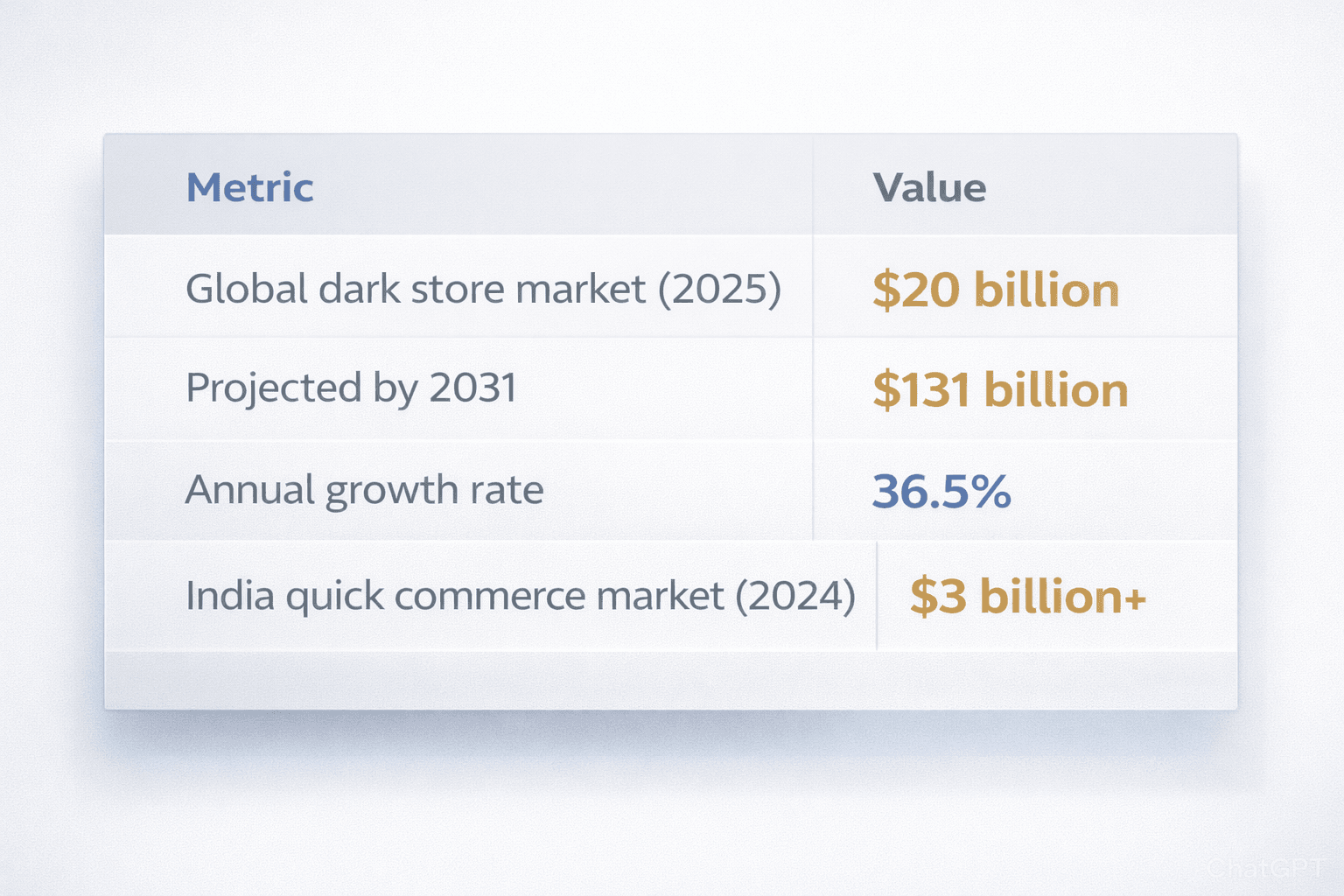
The numbers explain why everyone is paying attention:
How the Dark Store Model Actually Works
A dark store, at its core, is a promise that whatever a customer orders online will be picked, packed, and on its way before they've finished their next cup of chai. But keeping that promise consistently, at scale, requires more than just a dedicated space. It requires a clear fulfillment model that fits both your customers' habits and your own operational reality.
Most dark stores today run on one of 3 fulfillment methods, and the smartest operators don't just pick one. They build around all three.
Curbside Pickup - Fast, Frictionless, Zero Delivery Cost This one is underrated. A customer places an order, drives to the store, and a picker brings it straight to their car. No parking headaches. No waiting in queues. No delivery fee eating into your margins or theirs. During the pandemic this became a necessity, but it stuck around because it's genuinely convenient, especially for working professionals who pass near your location on their daily commute. If you have parking space and a decent order management system, curbside pickup can be one of the most cost-efficient fulfillment options you run.
In-Store Pickup - Give Customers a Reason to Come to You Some customers prefer to walk in, grab their order, and leave. A dedicated pickup counter near the entrance which is separate from any active fulfillment operations which makes this seamless. They're not wandering through the store hunting for their bag. They're in and out in under two minutes. For the retailer, this eliminates delivery cost entirely while still offering the convenience of pre-ordering. It also creates a small but meaningful touchpoint with the customer, where a good experience can quietly build loyalty.
Home Delivery - The Engine That Makes Dark Stores What They Are This is the big one. The reason dark stores exist in the form they do today. Customers order from their phone and expect the order at their door fast. In dense urban areas, that window has shrunk to under thirty minutes for many categories. Home delivery has the widest reach and the highest convenience factor, but it also carries the highest cost. Getting this right means clustering deliveries intelligently, optimizing routes before riders leave the door, and keeping average order values high enough to absorb the last-mile expense.
What If Running Your Own Dark Store Isn’t Feasible Yet?Not every retailer is ready to set up and operate a dedicated fulfillment center from scratch — and that's a perfectly reasonable place to be. Third-party logistics providers, commonly called 3PLs, allow retailers to plug into an existing fulfillment network without the overhead of building one. You hand off the warehousing, picking, and shipping, and focus on what you already do well — sourcing, selling, and managing customer relationships. It's a lower-risk entry point into the dark store model, and for many smaller retailers, it's the smarter first step before investing in owned infrastructure.
The model is flexible by design. What matters is matching the right fulfillment method to the right customer behavior in your market — and then executing it with enough consistency that customers stop thinking about it and just trust it.
10 Benefits of Dark Stores
Let me walk you through what dark stores actually do for a business. These aren't theoretical. Each one solves a real problem that traditional retail was never designed to solve.
Benefit 1: Orders fulfillment goes from hours to minutes
When your inventory sits 2 kilometers from a customer instead of 25, delivery that once took a day can now take under an hour.
BlinkIt built its entire model on this principle. Their stores aren't placed for rent advantages or brand visibility. They're placed for delivery radius. Every location decision answers one question: how many pin codes can we serve within 15 minutes from here?
Benefit 2: More output form the same headcount
Here's something warehouse managers know but retailers rarely discuss: picking in a store full of customers is genuinely inefficient.
You navigate around shoppers. You wait while someone stands in the aisle deciding between two products. You can't move at full pace without creating friction.
In a dark store, none of that exists. Layouts are designed entirely for speed, fast-moving items near dispatch, frequently bought products placed close together, wider aisles for rapid movement. Optimized layouts improve productivity by 20 to 30 percent compared to picking from a live retail floor.
Benefit 3: Inventory Accuracy Becomes Achievable
In a traditional store, a customer picks up a product, carries it around, and leaves it in the wrong section. The system still thinks it's on the right shelf. This phantom inventory causes substitutions, cancellations, and disappointed customers.
Dark stores eliminate this completely. No customers means no misplaced items. With a good inventory system, accuracy above 95 percent is routinely achievable, compared to 85 to 90 percent in a typical store-pick model.
Benefit 4: You Can Stock Far More Variety
Traditional retail shelves are arranged for browsing. Every item needs a facing, a label, and visual accessibility. That limits how many SKUs a store can carry.
Dark store shelves are designed for density, items stacked deep, categorized for picker logic, not customer discovery.
BigBasket's IBBN dark stores carry 40,000 to 50,000 SKUs in spaces around 20,000 square feet. A comparable supermarket might carry 8,000 to 12,000. That range difference is why online orders from dark stores often convert better than in-store shopping.
Benefit 5: Peak Demand Becomes Manageable
Diwali, New Year sales, summer holidays, these peaks are painful for retail. In a standard store, peak demand means overtaxed staff, empty shelves, and frustrated walk-in customers competing with online pickers.
Dark stores decouple the problem. During peaks, you add shifts, bring in temporary staff, and increase fulfillment speed without affecting any physical shopping experience. The machine just runs faster.
Benefit 6: You stop paying for the storefront Nobody asked for
Dark stores don't need prime locations. They don't need attractive facades, display lighting, or branded fitting rooms. They operate out of converted warehouses or secondary commercial spaces where rents are a fraction of high-street retail.
Labor costs are also different. No customer-facing roles, no visual merchandisers, no sales staff. Just pickers, packers, and inventory managers with defined, measurable outputs.
Benefit 7: Unit Economics Traditional Retail Cannot Replicate
Dark stores operate with 30-40% lower operating costs compared to traditional retail formats. The model is fundamentally more efficient.
With lower rental expenses, higher labor productivity, reduced shrinkage, and faster inventory turnover, dark stores eliminate unnecessary cost layers that do not contribute to additional revenue. By shifting to a digital-first fulfillment model, businesses remove overheads tied to physical storefronts while improving operational efficiency and margins.
Benefit 8: Operation that don't depend on footfall , don't collapse when footfall does
Dark stores operate independently of physical footfall. Because revenue is driven by online demand rather than walk-in customers, the business remains stable even during seasonal slowdowns, location disadvantages, or market disruptions that typically impact traditional retail stores.
Benefit 9: Every order is a data point, Retail rarely capture this
Every order through a dark store is digital. You know exactly which products are ordered together, which SKUs spike on which days, how demand changes by pin code, where substitutions happen most.
This data is orders of magnitude richer than what a physical store's POS system produces. It feeds directly back into smarter replenishment and tighter inventory control.
Benefit 10: Delivery reliability becomes your brand promise
This benefit compounds over time and is the hardest to replicate once a competitor has it. When a customer orders and it arrives in 20 minutes, exactly as expected, with no substitutions they don't just feel satisfied. They feel like there's no reason to shop differently next time.
Speed plus accuracy plus reliability creates a purchasing habit. And once that habit forms, it's remarkably sticky.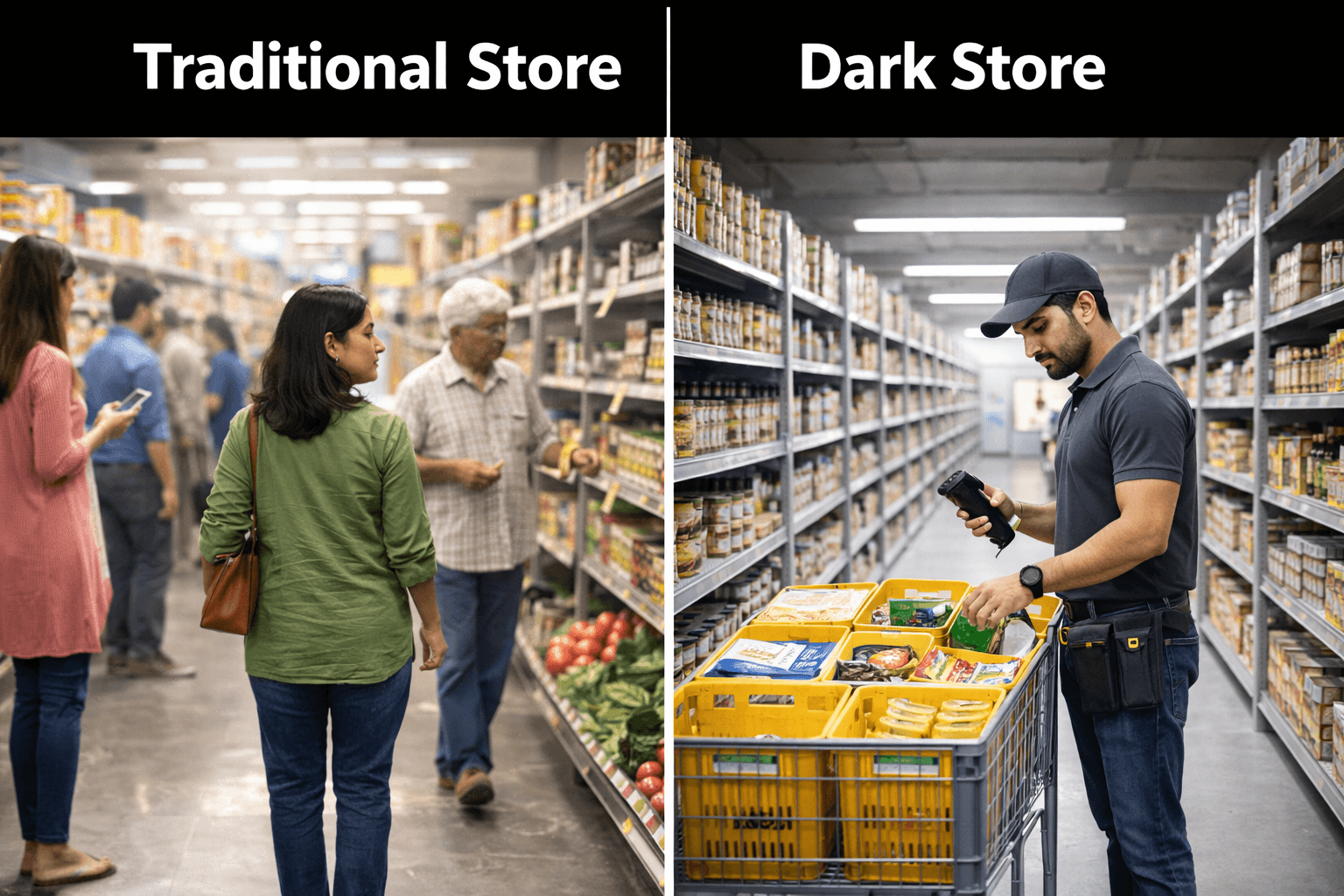
The Real Challenge of Making a Dark Store Profitable
Benefits are real. But they don't materialize automatically. Let me share what the data actually shows about making this work.
Choose Location Based on Order Demand, Not Just Nearby Customers
Most people think dark store location is about being close to customers. That's partly true, but the full picture is more nuanced.
Location is about order density the number of deliverable orders per hour within your service radius relative to rent.
A dark store in central Mumbai might be close to hundreds of potential customers but carry monthly rent of ₹180 per square foot. A dark store on Pune's outskirts might cover fewer pin codes but cost ₹50 per square foot and achieve the same daily orders.
BigBasket categorizes its dark stores into two tiers: those processing around 500 orders daily (still growing toward break-even) and those processing around 1,200 orders daily (already profitable). Know where your location sits on that curve before signing anything.
The Cost Structure Reality
A Bernstein analysis of quick-commerce economics found:
- Delivery costs: About 45% of operating expenses, around ₹50 per delivery at scale
- Staff costs: Another 30% for pickers, packers, and warehouse staff
- Remaining 25%: Covers rent, technology, and margin
The implication is stark. If your average order value is too low, you cannot absorb these costs. Quick-commerce platforms in high-density Indian zones typically see average order values between ₹400 and ₹700, with gross margins on grocery of 15 to 25 percent. The math only works when order volume is high, delivery routes are clustered, and wastage is minimal.
Inventory Discipline Matters More Than Stock Volume
A common mistake in dark store launches is trying to stock everything. More SKUs sounds better but actually means more holding cost, more complexity, and more chances of stock-outs in items that actually sell.
The smarter approach is simple:
- A-category items (fast movers like milk, bread, rice): Always in stock, stocked in depth
- B-category items (moderate sellers): Shelf space but not priority restocking
- C-category items (slow movers): Stock minimally or remove entirely
A dark store with 3,000 tightly managed SKUs will outperform one with 8,000 poorly managed SKUs every single time.
Last-Mile Delivery: Your Biggest Cost and Biggest Opportunity
Delivery cost is the single largest variable you can actually control once your store is operating. Five orders dispatched on five separate routes cost five times as much as five orders batched on a single route.
A useful benchmark: when your cost per delivery falls below ₹35 through efficient batching, the unit economics of most grocery dark stores begin to work at average order values above ₹450.
Technology Is Not Optional Anymore
A dark store run on manual processes is not really a dark store, it's a messy storeroom with pickers.
The minimum technology stack includes:
- A good ERP System which includes - Real-time inventory management & Integrated order management
- Delivery route optimization
- Demand forecasting tools
The 2024 MHI Annual Industry Report found that 55 percent of supply chain leaders planned to increase investment in technology specifically because manual operations cannot scale fast enough.
A Real-World Example
Let me tell you about a grocery retailer in Bengaluru who started this journey last year.
They had one store in a residential area, doing decent business but getting asked daily about home delivery. They couldn't figure out how to make it work without disrupting their store operations.
They started small. Converted a storage room at the back of their store into a dedicated fulfillment zone. Added a basic inventory tracking system. Partnered with a local delivery network. Started taking orders through WhatsApp and a simple website.
Six months in, they're processing 150 orders daily from that back room. The store still runs normally up front. The fulfillment zone operates like a separate business. They're now looking at a dedicated dark store space in a nearby residential pocket to serve that area faster.
The key? They didn't wait for the perfect solution. They started with what they had, learned as they went, and grew into the model.
The Future of Dark Stores
The first wave was loud.
Open fast. Grab pin codes. Stack orders. Beat the competition to the next neighborhood before they get there. Speed was everything- in delivery, in expansion, in ambition. That phase is winding down.
What's coming next is quieter, harder, and honestly more interesting. The dark stores that survive the next five years won't be the ones that grew the fastest. They'll be the ones that figured out how to actually make money doing this.
From Expansion to Execution
For a long time, the metric everyone chased was order count. How many deliveries today? How many new stores this quarter?
Those numbers look great in investor decks. They don't always look great on a P&L.
The conversation is shifting. Operators are starting to ask different questions: What's the contribution margin on this store? What does each delivery actually cost us, end to end? How many inventory turns are we getting per month? These aren't glamorous questions. But they're the ones that separate businesses that scale from businesses that bleed.
Growth without financial control isn't growth. It's just deferred failure.
Data Will Do the Heavy Lifting
Right now, a lot of dark store procurement still runs on experience and gut feel. A store manager decides to stock up on a product because it sold well last Diwali, or because the sales rep pushed hard for shelf space.
That approach is going away.
The next generation of dark stores will plan inventory the way good traders manage positions, based on signals, not instincts. Buying patterns by neighborhood. Order velocity by hour. Which SKUs spike on rainy evenings. Which ones gather dust every third week. This kind of visibility doesn't just reduce waste. It frees up working capital that's currently sitting on shelves doing nothing.
The stores that learn to read their own data will quietly outperform the ones still operating on assumptions.
Operations Have to Grow Up
Here's an uncomfortable truth about a lot of dark stores today: the backend is a mess. WhatsApp groups for reorder alerts. Spreadsheets that no one fully trusts. Delivery assignments made by whoever picks up the phone first.
That works when you're running two stores. It falls apart at ten.
The businesses that will thrive aren't necessarily the ones with the most locations , they're the ones where real-time inventory visibility is standard, replenishment happens before stock-outs (not after), and every delivery route is optimized before the rider leaves the door. Technology stops being a nice-to-have and becomes the actual operating system of the business.
Bigger Network doesn't mean a Better Business
More stores is not the same as more profit. This is a lesson the industry is learning the hard way.
The smarter move going forward is refinement, not just expansion. Tightening service radii so delivery density goes up. Closing the store that never crossed break-even instead of subsidizing it indefinitely. Measuring efficiency per square foot and per delivery, not just aggregate order volume.
Some of the most profitable dark store operators in the next few years will have fewer locations than their competitors and significantly better margins.
That's the shift. From proving the model to running it well.
Is a Dark Store the Right Choice for Your Business?
A dark store is not a solution you adopt because it sounds modern or because your competitors are talking about it. It's a specific operational model that works well under specific conditions and poorly when those conditions aren't met. Before anything else, ask yourself one honest question: do you already have consistent online order volume, or are you hoping a dark store will create it? Because it won't. A dark store amplifies demand that exists. It doesn't manufacture demand that doesn't. If your customers are already ordering online and you're struggling to fulfill fast enough, a dark store solves a real problem. If online orders are still thin, you'd be building expensive infrastructure for a habit your customers haven't formed yet. Beyond demand, think about your margins. Grocery and FMCG can work because of order frequency people buy these things multiple times a week. But if your average order value is low and your delivery radius is wide, the numbers get very difficult very fast. The model rewards density: many orders, close together, fulfilled quickly. The further you are from that reality, the harder profitability becomes.
How Peddle Plus One ERP Supports Dark Store Operations
Running a dark store sounds straightforward until you're actually doing it. Inventory moving across multiple locations. Online orders coming in from different channels simultaneously. Delivery partners asking for updates. Your CA asking for GST reports. And somewhere in the middle of all that, a stockout happens — and nobody caught it in time.
This is the operational reality most dark store operators hit within the first few months. The physical space works. The demand is there. But the backend holding everything together is either missing, fragmented, or simply not built for this kind of complexity. That's the gap PeddlePlus closes.
One Dashboard, Every Location For multi-store owners and franchise operators, visibility is everything. PeddlePlus gives you a single dashboard where every location's inventory, orders, sales, and financials are visible in real time — so you're not calling store managers for updates or discovering stockouts after the customer already complained.
Inventory and Compliance, Handled Together Automated stock tracking, expiry alerts, batch management, and supplier reorder triggers keep your working capital tight and your shelves accurate. For CAs and finance teams, GST returns (GSTR-I, II, and IIIB) are generated automatically from transactions, with direct integration into Tally and Zoho. No double entry, no manual reconciliation.
Your Own App, Your Own Customers Every order placed through a third-party platform is a customer that platform owns. Peddle Plus One ERP lets you launch your own branded app so customers order directly from you building loyalty with your brand and generating data that belongs to your business, not a marketplace.
Analytics Built for Decision-Makers Which locations are underperforming? Which SKUs are bleeding margin? Where are delivery costs too high? Peddle Plus One ERP turns daily operational data into clear answers, the kind a CEO or CFO can act on without digging through five different reports.
Dark stores reward operational discipline above everything else. Peddle Plus One ERP gives you the systems to build that discipline either its one store or twenty.
Questions Retailers Actually Ask (FAQ)
Q: Do I need a dedicated space to start, or can I use part of my existing store?
A: You can absolutely start with a hybrid approach. Convert a section of your existing store into a dedicated fulfillment zone while keeping the rest open to customers. The key requirements: the fulfillment zone should have its own inventory, its own entry point for delivery staff, and minimal crossover with customer areas. Many retailers start this way before moving to a dedicated space as order volumes grow.
Q: What's the minimum order volume needed for a dark store to break even?
A: This varies based on your costs, average order value, and category. For a grocery-focused dark store in an Indian metro, industry data suggests roughly 800 to 1,200 orders daily reaches store-level profitability. Tier 2 cities with lower rentals can break even at 500 to 700 daily orders. The important thing is to model your specific numbers before committing.
Q: How is a dark store different from a regular warehouse?
A: A dark store is designed for last-mile consumer delivery within a 2 to 5 km radius. It carries consumer-facing inventory at retail depth, and orders are processed within minutes. A traditional warehouse handles bulk movements between supply chain nodes, manufacturer to distributor to retailer on timelines measured in days. They serve completely different purposes.
Q: Can a small independent retailer run a dark store profitably, or is this only for large players?
A: Small independent retailers can absolutely run profitable dark store operations. Your advantage is lower overhead ambition. A grocery store processing 200 to 400 orders daily through a connected inventory system, with deliveries through a partner network, can generate meaningful revenue without needing venture capital scale. The key is matching your setup to realistic order volumes.
Q: What categories work best in dark stores beyond grocery?
A: Grocery and FMCG lead the way, but several categories work well: consumer electronics accessories, personal care and cosmetics, over-the-counter pharmacy products, pet supplies, and stationery. These share key traits: high purchase frequency, predictable demand, and manageable storage requirements.
Q: How do I handle delivery without building my own fleet?
A: Partner with existing delivery networks. Platforms like Shiprocket, Delhivery, and local courier services offer last-mile delivery integration. Many dark stores start with partner networks and only consider building their own fleet when volumes cross several hundred orders daily and the economics justify it.
Q: What's the biggest mistake retailers make when starting a dark store?
A: Trying to stock too much too soon. The temptation is to offer everything, but that spreads your inventory thin, increases holding costs, and makes picking more complex. Start with a focused range of high-demand items. Learn what actually sells in your area. Expand gradually based on data, not ambition.
Conclusion
Retail has a new constraint. It used to be location the best sites captured the most footfall. Today, location still matters, but a new variable sits alongside it: speed of fulfillment. The retailer who can put a product at a door in 20 minutes has a structural advantage that a beautiful store with slow delivery simply cannot overcome.
Dark stores are the infrastructure response to that reality. They're not glamorous. No window displays. No ambient lighting. They're operational machines and that's precisely their strength. Whether you're a large retailer evaluating a dedicated dark store network or a neighborhood store wondering whether online ordering could transform your business, the underlying logic is the same: get closer to your customer, manage inventory with precision, and fulfill faster than your competition.
The scale differs. The principle does not.