ERP Today Is What Email Was in 1995 | The Next 10 Years for Indian Retail
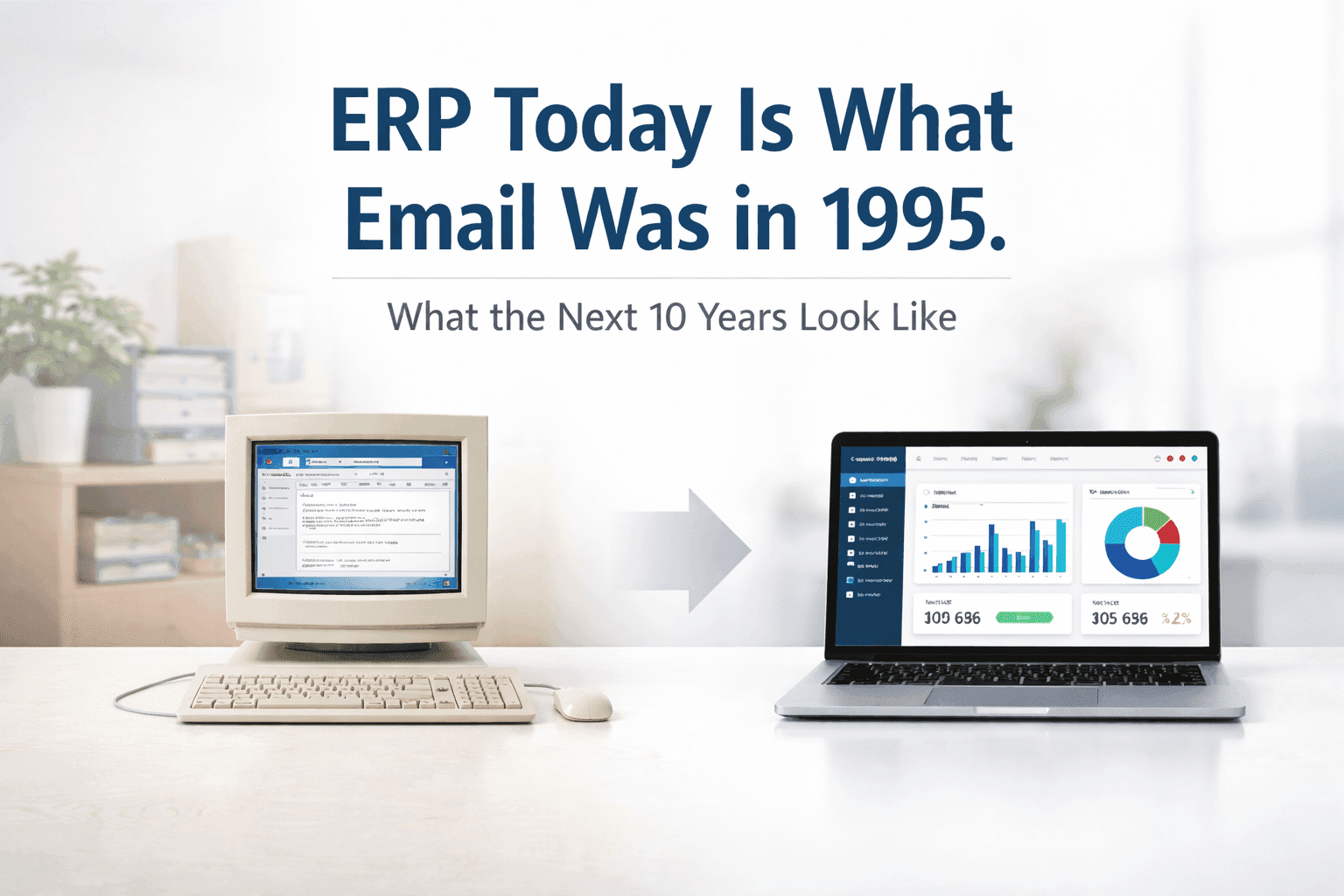
ERP Today Is What Email Was in 1995.
Here's What the Next 10 Years Look Like.
For Indian retailers, SME owners, and entrepreneurs who want real business control without the complexity of enterprise software.
Table Of Contents
The Moment Before Everything Changed
Where ERP Stands in 2026
The 5 Myths Slowing ERP Adoption
8 ERP Trends for 2026 and Beyond
4 ERP Predictions for 2035
What This Means for Indian Retail & SMEs
The Real Cost of Waiting
How to Prepare for the ERP Decade
The Platform Built for This Moment
The Closing Thought
The Moment Before Everything Changed
In 1995, most businesses in India didn't use email. Not because it wasn't available, but because they'd say, "We're a shop, not a software company."
Today, people say the same thing about ERP systems.
But here's what's happening: While some businesses are still managing everything on paper and Excel sheets that only one person understands, others have quietly switched to ERP. They now know their margins in real-time. GST compliance happens automatically. They can track every single item in their inventory without counting. The gap between these two types of businesses is growing every day. And the ones using ERP? They're building advantages their competitors can't even see yet.
"The best time to adopt ERP was five years ago. The second best time is today."
This is for the entrepreneur running a business that's outgrown the notebook but hasn't quite found the right system yet.
Maybe you own a grocery store with two branches and you're still checking both registers personally every evening. Or you run a garments shop and somehow track inventory by memory, which size is in the back, which color needs reordering. Perhaps you have a small salon chain and offer discounts based on gut feel, not actual numbers. If any of this sounds familiar- this one's for you.
What Email Looked Like in 1995
Most businesses still relied on fax machines and handwritten memos. And setting up email back then was a real hassle, you needed special equipment, a modem, a service provider. It felt like too much for a small hardware store or a local clothing shop.
Then something happened. Slowly at first, then all at once, email stopped being optional. By 2000, if you didn't have an email address, you weren't just "old school" you were actually at a disadvantage. Suppliers expected it. Customers asked for it. Business simply moved faster for those who had it.
What once felt like overkill became the bare minimum.
Why ERP Feels the Same Today
Replace "email" with "ERP software" and read that again. The parallel is almost exact.
Modern ERP, the kind that brings together billing, inventory, GST compliance, accounting, and online orders in one place has moved past its early adopter phase. It's not quite mainstream yet, but it's getting there.
Right now, businesses already using it are quietly compounding an advantage. They see their numbers in real time. They don't scramble during tax season. They know what's in stock without a physical count.
The ones holding out? They'll spend the next decade playing catch-up.
The Window Is Open, But It's Closing
Right now, ERP isn't mandatory for small and medium businesses in India. Not yet.
But things are shifting fast. GST compliance keeps getting tighter. Every UPI transaction leaves a digital trail. And customers now expect you to sell across WhatsApp, Instagram, and maybe even a website ,all while keeping stock straight.
These pressures are quietly making ERP less of a choice and more of a requirement.
So the real question is: Do you put a system in place now, on your own terms, when you have time to breathe and figure it out? Or do you wait until the pressure forces your hand, and you're scrambling to fix things on someone else's timeline?
Where ERP Stands in 2026
The global ERP market is projected to hit $183 billion in coming 1-2 years (Source: Panorama Consulting, ERP Report 2024). India's SME ERP market is growing faster than almost anywhere else in the world. GST made it happen. UPI pushed it along. And now, with businesses opening multiple locations, the need is only growing.
But here's the uncomfortable truth hiding behind those numbers.
A lot of Indian SMEs who say they "use ERP" are actually running on billing software from 2010. It prints a GST invoice just fine. But ask it whether you're profitable this month and it stares back blank. It knows what you sold today, but has no clue about last month's pattern.
In plain English: it's digital paperwork, not business intelligence.
The Visibility Gap
Over 60% of Indian retail SMEs still manage inventory through manual methods or basic billing tools with zero integration between sales, stock, accounting, and customer data (Source: MSME Ministry Annual Report & Dun & Bradstreet India SME Survey, 2023). That gap is where the next five years will be decided.
The 5 Myths Slowing ERP Adoption
Before we look forward, let's clear the mental roadblocks that keep mid-market businesses stuck.
Myth 1: "ERP is for big companies."
Look, ERP didn't start with small shops. It was built for massive manufacturing companies with factories and supply chains. But that was then.
Modern cloud ERP- especially the kind built for Indian retail is different. It's designed from the ground up for the owner-operated store. For the guy running two branches and still checking both registers at night. For the small chain that's growing but doesn't want to lose control.
So the question isn't whether your business is big enough for ERP.
The real question is whether your problems are big enough to keep ignoring.
Myth 2: "It's too expensive."
Enterprise ERP from SAP or Oracle can cost ₹10L to ₹1Cr in setup alone. That cost is real. And it's genuinely not built for most Indian SMEs. But the ERP market has a middle tier that most business owners either don't know exists or haven't yet explored. Purpose-built retail ERP for the Indian mid-market brings serious operational capability real-time inventory, GST compliance, multi-location management, online integrations without enterprise complexity or enterprise overheads. The market has matured. The perception hasn't caught up.
Myth 3: "Our current software is good enough."
If your software generates a GST bill but can't tell you your margin per product or show live stock across locations, it isn't good enough. That's not software. That's digital paperwork with a newer label.
Myth 4: "My staff won't be able to use it."
Today's retail ERP is built for teams who've never touched enterprise software before. Touchscreen billing, Hindi-language support, mobile-first interfaces. Training typically takes hours, not weeks.
Myth 5: "We'll do it when we're bigger."
This is the most dangerous one because it sounds logical. Here's the problem: ERP doesn't just manage scale. It creates scale. The businesses growing fastest are growing because they have data visibility that others don't. Waiting until you're bigger to start tracking your business is like waiting until you're successful to start tracking your money.
8 ERP Trends for 2026 and Beyond
Businesses continue to invest heavily in ERP and for good reason. 1.4 million companies are projected to spend $183 billion on ERP over the next two years (Source: Panorama Consulting, ERP Report 2024). Here are the eight forces shaping where that investment is going.
Cloud ERP
Simpler deployment, lower cost, instant scalability the on-premises era is ending
The cloud ERP market is expected to grow from $72.2 billion in 2023 to $130.5 billion by 2028 (Source: MarketsandMarkets, 2023). For Indian SMEs, this is the most important trend: cloud ERP means no dedicated server rooms, no internal IT team, and no ₹5 lakh installation fee. Just software that works, from day one, on any device and scales as the business does.
Two-Tier ERP
HQ runs enterprise ERP; branches and stores run purpose-built cloud solutions
Large companies are learning what mid-market businesses can apply now: different parts of the business need different tools. A head office might run SAP for group financials while every store location runs a lean, purpose-built retail ERP both talking to each other in real time. For a multi-store retailer in India, this means your branches can be autonomous and connected simultaneously.
Digital Transformation (A Continuous Process)
ERP is the spine of every digital transformation initiative
Digital transformation isn't a project that ends. Modern ERP is the connective tissue the system that makes every other technology investment smarter. Your digital payments make more sense when they're inside an ERP. Your e-commerce store performs better when inventory is synced live. Your GST compliance gets simpler when billing and accounting share the same data.
Technology Integration
IoT, e-commerce, delivery, and payment platforms connecting into one system
Manufacturers are integrating ERP with IoT sensors to predict equipment failure before it happens. Retailers are connecting ERP with e-commerce platforms to automate end-to-end order fulfilment. In the Indian context, this means ERP integrating with Razorpay, PhonePe, Shiprocket, Amazon, and Flipkart, so a single sale updates inventory, triggers dispatch, and records the payment simultaneously.
Personalisation & Low-Code Platforms
ERP that adapts to your business, not the other way around
Modern ERP platforms are built for configuration without code. Grocery stores, garment retailers, auto parts distributors, and pet shops all have different workflows and today's ERP adapts to each without expensive custom development. Industry-specific modules mean the software understands your business from day one.
AI-Powered Insights
Machine learning and generative AI embedded into core ERP functions
As of 2025, AI and ML are becoming core components of ERP- not add-ons. The practical impact for a mid-market business: AI scans your sales data and flags that a product is trending before your shelves go empty. It spots a supplier invoice discrepancy before it becomes a dispute. Early applications of generative AI to ERP migration have already shown a 40% reduction in implementation time and cost (Source: Accenture Technology Vision, 2023) removing the biggest barrier to adoption.
Predictive Analytics
Not just what happened but what's about to happen
Predictive analytics inside ERP is moving from enterprise luxury to mid-market standard. Demand forecasting, financial trend prediction, inventory reorder automation, the software surfaces what you need to know before you know you need to know it. For a retailer managing seasonal stock, this single capability can be worth more than all other ERP features combined.
Mobile ERP
Real-time business data anywhere, on any device
Mobile ERP isn't a feature anymore, it's the expectation. An owner who can check live sales, approve a purchase order, or see which branch is understocked from their phone at 10pm is running a fundamentally different kind of business than one who waits for a Monday morning report. Multi-device access, always-on data, and real-time alerts are the new baseline.
4 ERP Predictions for 2035
Trends tell you where things are heading. Predictions tell you where to position yourself. Here's what ERP will look like a decade from now.
1. ERP Becomes Invisible Infrastructure
The best ERP won't feel like software. It'll feel like running your business except your business will be smarter than it's ever been. Just as you don't consciously "use the internet" when you pay via UPI, you won't consciously "use ERP" when you scan a product or review your day-end P&L. The system becomes the invisible layer beneath everything.
2. Autonomous Decision-Making
AI and ML are only advancing. Within the decade, ERP systems will proactively manage operations without human intervention for routine decisions automatically reordering stock, dynamically adjusting pricing based on demand signals, and flagging cash flow risks before they become crises. The owner's role shifts from data entry to strategic oversight.
3. Conversational AI & Voice Interfaces
With the rise of virtual assistants, ERP interaction will shift from dashboards to dialogue. Ask your ERP "What's my margin on garments this month?" and get an instant, spoken answer. This makes real-time business intelligence accessible to every team member not just the owner who knows which report to pull.
4. ERP as Competitive Moat
Here's the insight most people miss: ERP isn't just operational software. Over time, it becomes a moat. A business with five years of clean ERP data purchase patterns, customer behavior, supplier performance, seasonal trends knows things about its own market that no new competitor can replicate quickly. That knowledge compounds every year. The businesses building this data layer today are making an investment that gets more valuable every year it runs.
"The businesses building data intelligence today will be competing against themselves in 2030. Everyone else will be competing against them."
What This Means for Indian Retail & SMEs
India isn't a side character in someone else's story. It's the lead.
With over 63 million registered MSMEs (Source: Ministry of MSME, Government of India, Annual Report 2023–24), India is one of the biggest markets for small-business ERP in the world. And right now, three things are pushing businesses toward a tipping point:
GST means digital billing isn't optional anymore.
UPI has already created a digital trail of every payment data that smart ERP can actually put to use.
Selling on Amazon, Flipkart, or Swiggy isn't a luxury anymore. It's just how business works now.
If you're running a business in Faridabad, Lucknow, Surat, or any tier-2 city, here's what that means: the window to get ahead of this shift is open right now.
Think back to 2018. Remember when digital payments suddenly became a thing? The businesses that figured it out then aren't scrambling today. Same thing is happening now with ERP. The ones who adopt it in 2026–27 won't be the ones playing catch-up in 2032.
But here's the real question for Indian business owners: where do you find ERP that actually gets you? SAP was built for giant corporations, it doesn't know what a kirana ledger looks like. Global software leaves you lost in menus and settings. Tally handles accounts beautifully, but ask it about your inventory, your customers, or your online orders and it goes quiet.
For years, the mid-sized Indian business fell through the cracks. Too big for a notebook, too small for SAP and that's finally changing.
The Real Cost of Waiting
Let's be honest about what "we'll do it later" actually costs every month.
• Stock losses you don't catch until the annual count three months of margin already gone.
• GST errors that accumulate into notices, accountant fees, and lost weekends.
• Slow-moving products blocking shelf space while fast-movers go out of stock because nobody has clean data on the pattern.
• A competitor two streets away who does have this data, pricing aggressively on the exact products you're overpriced on.
• A bank loan that falls through because you can't produce 12 months of clean P&L even though the money was there.
"You are not just losing features by not using ERP. You are losing intelligence, margin, and time compounding every month."
The risk of early adoption is almost always lower than people expect. The risk of late adoption is almost always higher.
How to Prepare for the ERP Decade
You don't need a roadmap the size of a textbook. You need five clear steps.
Step 1 : Audit your visibility gaps.
Can you see exact stock across all locations on your phone right now? Do you know your real margin per product? Which customers haven't returned in 90 days? If any answer is no, that's where you start.
Step 2 : Make the right comparison.
The instinct is to benchmark mid-market retail ERP against enterprise systems. That's the wrong comparison. The real comparison is: purpose-built retail ERP versus your notebook, your Excel file, and your end-of-month chaos. Measured against what it replaces not against what it isn' the value is clear.
Step 3 : Start with billing, inventory, and GST.
These three return the investment fastest. Everything else online orders, customer loyalty, delivery integration builds on this foundation. Get the core right first.
Step 4 : Choose software built for Indian retail.
Generic global ERP will frustrate you within weeks. Indian retail has specific GST and e-invoicing requirements, specific payment integrations (Razorpay, PhonePe, Paytm), and specific delivery partners (Shiprocket, Delhivery). Software that doesn't understand this context becomes a liability, not an asset.
Step 5 : Think in years, not months.
ERP is infrastructure, not a campaign. The businesses that see compounding returns treat it as a long-term investment updating data, expanding modules, training staff. The ones that "implement and ignore" see declining value. The data you build today is the competitive intelligence of 2030.
✅ The 60-Day Test
Most business owners who implement retail ERP and use it consistently report meaningful visibility improvements within 30 days and measurable margin improvements within 60. That's the consistent pattern not a promise, but a pattern worth betting on.
The Platform Built for This Moment
There's a reason this conversation is happening in 2026. The right software for the Indian mid-market affordable, capable, and built for this specific context now genuinely exists.
Peddle Plus One ERP was built around one conviction: a grocery owner in Faridabad, a garments retailer in Lucknow, or a supermarket manager in Bhubaneswar deserves the same business intelligence as a large retail chain at a price that makes sense for where they are today.
It isn't billing software with an ERP label. It's a genuine 360° retail platform that covers:
• GST billing, e-way bills, and e-invoicing directly from the platform
• Real-time inventory management across single and multiple store locations
• Online order management with local delivery and marketplace integrations
• Multi-device access the business runs even when you're not physically present
• Integrated payments: Razorpay, Paytm, PhonePe, Google Pay, UPI
• Direct data push to Tally 9 ERP and Zoho Books works alongside your existing accounting
• Delivery integrations with Shiprocket and Delhivery
• Online selling integrations with Amazon and Flipkart
It serves grocery stores, supermarkets, clothing and apparel, auto parts, cosmetics, pet shops, electronics, spas, salons, gyms, and gifting stores across 10+ cities in India, with support expanding to the Middle East and Africa.
Hindi support. Free onsite demo. A team that actually picks up your call whenever you need.
The Closing Thought
The business owners who adopted email in 1995 weren't visionaries. They were practical people who noticed a shift happening around them and decided to move first rather than react later.
That's all this takes.You don't need to understand AI architectures or cloud infrastructure roadmaps. You need to know one thing: the businesses with real-time visibility into their operations will outcompete the ones without it. Every year, that gap gets wider.
"ERP software is no longer a luxury. It's the same category as a smartphone - something that once felt like an upgrade and is now simply how you run a business."
The email moment is happening again. The only variable is which side of it your business ends up on.
Frequently Asked Questions
How does inventory management software in India benefit small businesses?
Inventory management software in India helps small businesses improve efficiency by automating stock tracking, reducing errors, and enhancing decision-making processes, thus improving overall business growth and operations.
Why should Indian SMEs invest in ERP software by 2025?
Investing in ERP software by 2025 can position Indian SMEs to leverage upcoming ERP trends, optimize business processes, and gain competitive advantage. As ERP software evolves, early adoption ensures smoother transitions and scalability.
What affordable ERP software options are available for SMEs in India?
Affordable ERP software options for SMEs in India include solutions like Marg ERP, which caters specifically to retail, and Gofrugal, which offers flexible pricing models and essential features that support small and medium enterprises.
Is cloud ERP beneficial for retailers in India?
Cloud ERP is highly beneficial for retailers in India as it offers flexibility, real-time data access, and reduced IT expenses. This enables retailers to streamline operations efficiently, adapt to market trends, and maintain a competitive edge.
What are the key ERP trends for 2025 and beyond?
Key ERP trends for 2025 and beyond include increased adoption of AI and machine learning, enhanced data analytics, and a shift towards mobile and cloud-based solutions, which will drive more efficient and flexible business operations.
How can retail ERP software support grocery stores in India?
Retail ERP software can greatly support grocery stores in India by providing robust billing software, inventory management, and data analysis features. These tools help streamline operations, reduce waste, and enhance customer service.
What is ERP software and how is it different from billing software?
Billing software generates invoices. ERP connects billing, inventory, accounting, customer records, and operations into one integrated system. The difference is a cash register versus a brain for your entire business. Billing tells you what you sold. ERP tells you whether you made money doing it, why stock is falling, and what to expect next month.
Can I use ERP for multiple store locations?
Multi-location management is one of ERP's strongest use cases. You get a single view of stock, sales, and performance across all branches from one screen. You can identify inventory imbalances, compare location performance, and manage centrally while each store runs independently.
How is Peddle Plus different from Tally?
Tally is excellent accounting software. What it doesn't offer is an integrated retail operations platform real-time inventory, online orders, customer management, delivery integration, and mobile access. Peddle Plus integrates with Tally 9 ERP and Zoho Books, so you don't choose between them. Peddle Plus handles daily retail operations; the data flows to Tally for accounting and annual filings.
What if I'm already using other software can I switch?
Modern ERP platforms are designed for smooth migration. Most transitions complete within a few days to two weeks, with full data import from common legacy tools. Peddle Plus offers a free onsite demo and onboarding support to make the switch as friction-free as possible.

Tamanna Bhardwaj
EditorContent Strategist at Peddle Plus with 4+ years of experience in brand growth and marketing, specializing in retail technology, ERP adoption, and business operations for Indian SMEs.