Why POS-Only Software Fails In India
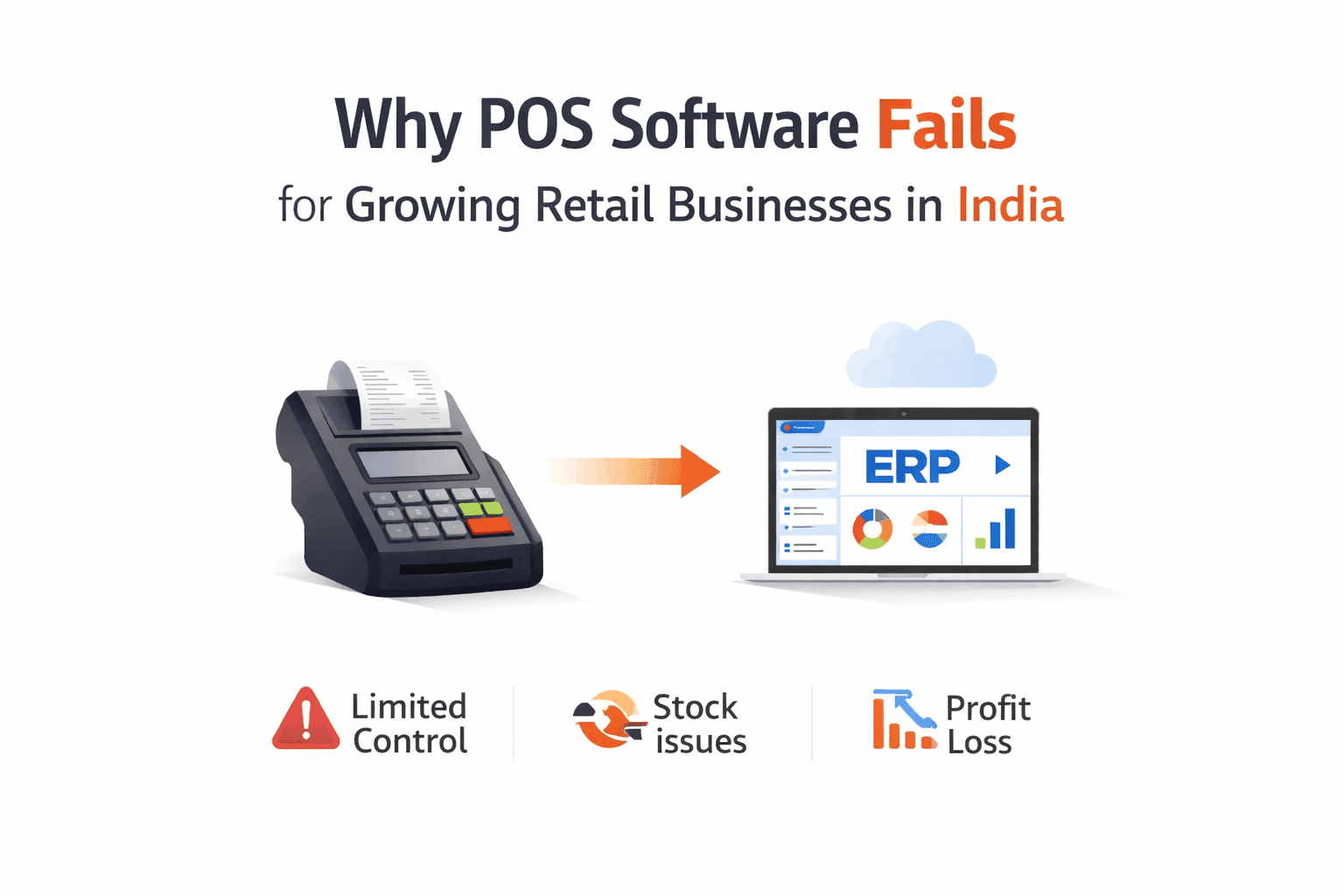
Why POS-Only Software Fails in Growing Retail Businesses in India (2026 Guide)
Table Of Contents
What POS Software Actually Does
The Scalability Problem: Why POS Breaks During Expansion
When Should Indian Retailers Move Beyond POS?
Why Indian Multi-Store Retailers Are Switching to Cloud ERP
A Practical Question for Growing Retailers
How Peddle Plus One ERP Supports Growing Retail Businesses
Final Conclusion
For years, POS billing software has been the backbone of small retail businesses in India. It handles transactions, prints bills, and keeps daily sales running smoothly. But in 2026, retail has changed. Businesses are expanding to multiple locations, managing online and offline sales, handling complex GST compliance, and competing in a fast-moving digital market.
The problem? POS-only software was never built to manage growing retail operations.
As businesses scale, they need real-time inventory tracking, centralized multi-store control, automated accounting, detailed profit analytics, and seamless GST reporting. A basic POS system focuses only on billing, leaving gaps in stock management, financial visibility, and strategic decision-making.
This guide explores why POS-only software fails growing retail businesses in India and how upgrading to a complete retail ERP system can help retailers gain control, improve profitability, and scale confidently in 2026.
Multi-location retail is turning into the new normal for fashion chains and electronics stores, as well as drugstore networks and supermarket chains, and at first, it works.
It handles billing.
It generates GST invoices/receipts.
It tracks store-level inventory.
But the moment you
Open an another outlet
Add a warehouse.
Launch a outlet/branch model
Expand into multiple cities.
Your POS system starts showing limitations.
Because POS is made for deals.
Growing businesses need centralized control.
This is why POS-only software fails to grow retail businesses in India.
What POS Software Actually Does
The utmost retail billing software in India is designed to
Process deals
Print bills
Reduce Stock
induce introductory reports
Handle GST compliance
It works perfectly for:
Single-store retailers
Original standalone businesses
Low functional complexity
But it is not designed for:
But it isn't designed for
Multi-store retail operation
Centralized force visibility
warehouse integration
Head office dashboards
Unified reporting across locales
That’s where retail ERP software in India becomes essential.
The Scalability Problem: Why POS Breaks During Expansion
No consolidated Multi-Store Visibility
In India, growing retailers frequently operate
3-10 stores
1 central warehouse
A head office team
Regional directors
With POS-only systems, each store works singly.
The head office depends on
Excel sheets
WhatsApp updates
manual daily reconciliation
There is no real-time consolidated dashboard. For serious growth, retailers need multi-store retail management software that connects all outlets into one centralized system.
Inventory Mismanagement / Chaos Across Locations
Force mismanagement is one of the biggest financial losses in India.
With POS-only software:
Stock visibility is store-specific
Warehouse data is disconnected
Transfers are manually tracked
Overstock and stockouts increase
Growing retailers need:
✔ Centralized stock visibility
✔ Real-time inter-branch transfers
✔ Warehouse integration
✔ Smart replenishment planning
This is where inventory management software for retail, integrated with ERP, becomes critical.
Pricing & reduction Leakage
In Indian retail, offers change constantly:
festive discounts
End-of-season deals
Ballot schemes
Regional pricing
Without centralized control:
Stores apply inconsistent Discounts
Schemes remain outdated
margins shrink
Multi-location businesses bear centralized pricing governance, which introductory POS software can’t handle efficiently.
That’s why many retailers evaluate cloud ERP for retail chains as they expand.
Reporting Delays = Slow Decisions
Growing retailers need answers continually:
Which store is underperforming?
Which SKU sells fastest across all metropolises?
What's the total profit across India at the moment?
Which scheme is most profitable?
POS systems produce store-position reports.
But expanding businesses need consolidated, real-time intelligence.
A complete retail operation system in India connects:
Deals
force
storages
Finance
Multi-branch reporting
Into one unified dashboard.
The Cost of “Affordable” POS Software
Many Retailers choose POS because it looks cost-effective.
But the real cost includes
Manual data reconciliation
Inventory mismatches
Reporting errors
IT troubleshooting
Profit leakage due to pricing inconsistencies
Cheap billing software frequently leads to precious functional inefficiency.
Still, understanding POS vs ERP for retail business is pivotal before scaling if you are comparing systems.
When Should Indian Retailers Move Beyond POS?
If your business has:
Multiple retail outlets
Franchise or EBO model
A central warehouse
HO-driven operations
Aggressive expansion plans
Also, POS-only software will ultimately limit your growth.
You should evaluate:
Cloud ERP vs On-Premise ERP for Indian Businesses
Best ERP software for retail business in India
How to implement ERP in retail operations
Because growth without centralized systems creates functional chaos.
Why Indian Multi-Store Retailers Are Switching to Cloud ERP
Modern cloud-based retail ERP software in India offers:
Real-time visibility across all stores
Centralized pricing & scheme control
Live warehouse integration
GST-biddable account
Multi-location performance dashboards
Remote access for operation
Rather than 5 stores operating independently, your entire business operates as a single connected system. That's the difference between billing software and business control software.
A Practical Question for Growing Retailers
If you’re running multiple stores today, ask yourself:
How long does it take to get consolidated deals data?
Can you see real-time stock across all locales?
Is pricing controlled centrally?
How important is it that manual reporting happens every week?
Are you confident in your inventory accuracy?
Still, your current system may not be made for your coming growth stage if these answers are unclear.
How Peddle Plus One ERP Supports Growing Retail Businesses
At Peddle Plus, the focus isn't just billing.
It's centralized retail control.
Peddle Plus is designed specifically for Indian retail chains, distributors, and multi-location businesses that bear:
Multi-store retail operation
Centralized force control
Real-time reporting dashboards
HO-driven pricing & scheme control
warehouse integration
Scalable pall ERP armature
Rather than operating in silos, retailers using Peddle Plus manage all locales from one centralized platform.
Still, exploring a structured retail ERP system could bring functional clarity before you gauge further if you’re assessing whether POS-only software is limiting your business.
You can:
Assess your current retail operations structure
Compare POS vs ERP functionality for your business
Explore how centralized retail control works in practice
Visit: https://www.peddleplus.in
No aggressive selling.
Just clarity before expansion.
Final Conclusion
POS-only software does not fail small businesses.
It fails growing businesses.
For single-store operations, POS works perfectly.
But for:
Multi-store retail chains
Franchise networks
Distributors with warehouses
Expansion-focused brands
Billing software is not enough.
In modern Indian retail:
Real-time visibility wins.
Centralized control wins.
Data-driven decisions win.
If growth is your goal, your software must scale with you.
Frequently Asked Questions
What is POS-only software?
POS-only software handles billing, barcode scanning, and payments. It does not manage inventory planning, accounting, GST reports, or multi-store operations
Why is POS not enough for growing retail businesses?
As businesses grow, they need inventory control, profit tracking, GST compliance, and multi-branch management. POS systems cannot handle complete retail operations.
What are the limitations of POS software in India?
1. No real-time inventory tracking, 2.Limited profit reports, 3.Manual accounting work, 4. No centralized multi-store control, 5.Poor business insights
What is the difference between POS and ERP?
POS manages sales transactions. ERP manages billing, inventory, accounting, GST, suppliers, and analytics in one system.
When should a retailer upgrade from POS to ERP?
You should upgrade when: You open multiple stores Stock mismatches increase 1.Profit reports are unclear 2.Manual work increases 3.Business growth slows due to system limits
How does ERP help retail businesses grow?
ERP provides real-time inventory, automated GST billing, centralized multi-store management, and detailed profit reports helping retailers scale efficiently.
Is ERP suitable for small retailers in India?
Yes. Modern cloud-based ERP software is affordable and designed for small and mid-sized retail businesses.

Tamanna Bhardwaj
EditorContent Strategist at Peddle Plus with 4+ years of experience in brand growth and marketing, specializing in retail technology, ERP adoption, and business operations for Indian SMEs.