What is Bin Management in Darkstores? A Complete Retail Guide
What is Bin Management in Dark stores? A Complete Retail Guide
You know that feeling when you order groceries at 11 PM, and they show up at your door in 15 minutes? Yeah, that's not magic. There's actually a pretty fascinating warehouse optimization system working behind the scenes to make that happen.
I've spent a good amount of time understanding how quick commerce dark stores work, and honestly, the whole thing is way more interesting than it sounds. The secret sauce? Something called bin management in retail. Sounds boring, right? But stick with me here, this is actually the difference between getting your order in 15 minutes versus waiting an hour (or getting the wrong items entirely).
Let me break down what's really happening in those mysterious micro-fulfillment centers that have popped up all over Indian cities.
Table of Contents
So What's a Dark Store anyway?
Okay, But What IS Bin Management?
How Does This Actually Work?
Why Should Anyone Care About This?
Different Bin Management Strategies
Setting This Up From Scratch
Common Problems and Solutions
Technology Making It Better
What Actually Works
The Bottom Line
So What's a Dark store Anyway?
Before we get into the nitty-gritty of inventory bin management, let's talk about dark stores themselves.
Picture a regular grocery store, but strip away everything that makes it customer-friendly. No bright lighting designed to make you feel welcome. No carefully arranged displays. Just rows and rows of products, organized in a way that makes absolutely no sense to a regular shopper but makes perfect sense for order fulfillment speed.
That's a dark store warehouse. They're basically fulfillment centers that look like stores from the outside. Walk past one and you might not even realize what it is. But inside? It's all business. Just staff racing around, grabbing products and packing them into bags for delivery.
The whole setup exists for one reason: speed. These hyperlocal fulfillment centers are usually tucked into neighborhoods - maybe that old grocery store that closed down, or a warehouse space that got converted. Location matters because they need to be close enough to deliver to you in minutes, not hours.
Okay, But What is Bin Management?
Here's where it gets interesting.
You know how your kitchen probably has a specific drawer for spoons? Well, imagine trying to cook in someone else's kitchen where nothing is where you expect it to be. Frustrating, right?
Now multiply that frustration by about a thousand, add time pressure, and you've got what a dark store without warehouse slotting optimization looks like.
Bin management is basically the system for deciding where every single product lives in the dark store. Each storage spot (called a "bin") gets an address, and each product gets assigned to specific bins. It's like a giant inventory organization system that ensures when someone orders Maggi noodles at midnight, the picker knows exactly where to find it.
If a dark store is a library, bin location management is the cataloging system. Without it, you're just hoping someone remembers where they saw that book last week.
How Does This Actually Work?
Let me walk you through the main pieces of the puzzle.
Every Bin Gets an Address
First up - you need to give every storage location a unique ID. Most dark stores use a system that combines zones (like "refrigerated" or "dry goods"), aisle numbers, shelf levels, and specific positions.
So a bin location code might look like "R-12-T-05" - that's Refrigerated zone, Aisle 12, Top shelf, Position 5. This warehouse labeling system means even someone on their first day can find stuff. Just follow the code.
Deciding What Goes Where
Here's where product placement strategy matters. Fast-moving stuff needs to be easy to reach. Milk, bread, eggs - the things people order constantly - those go at waist height, close to where orders get packed.
Heavy items? Bottom shelves. This isn't just about making life easier for staff - it's about safety.
And here's something clever - products that people often buy together should be stored near each other. This order picking optimization saves pickers from running all over the place for one order.
The Tech Side
You can't run a modern grocery dark store with a clipboard. This is where warehouse management software comes in. These platforms track everything in real-time, preventing that nightmare scenario where you accept an order for something that's actually out of stock.
Why Should Anyone Care About This?
Fair question. At first glance, this seems like inside-baseball stuff. But the ripple effects touch everything in e-commerce logistics.
It's All About Speed
When someone orders from Blinkit or Zepto expecting 10 minute delivery, there's zero room for error. The picker can't spend 5 minutes wandering around looking for atta.
Good warehouse picking efficiency means items get found in seconds. In a well-organized place, you can fulfill an order in under 3 minutes. In a messy one? The same order might take 10-15 minutes.
Think about it - if you're promising instant grocery delivery and your picker is lost in the warehouse, you're already late before the delivery person even leaves. Every second saved in picking translates to faster deliveries and happier customers.
Getting Orders Right
When bins are organized properly, picking accuracy improves dramatically. One wrong item doesn't sound like a big deal until you realize a busy dark store might fulfill 1,000 orders a day. If even 5% have errors, that's 50 annoyed customers daily.
Cut that error rate to 1% through better inventory control systems, and suddenly you're only dealing with 10 issues instead of 50. That's fewer refunds, fewer angry calls, and fewer re-deliveries eating into your margins.
In the grocery delivery business, accuracy isn't just about customer satisfaction - it's about economics. Every wrong item means you're paying for the product twice (once for the wrong item, once for the replacement), plus delivery costs, plus customer service time. A proper warehouse bin system prevents these costly mistakes.
Space Costs Real Money
Real estate in Mumbai, Bangalore, Delhi - it's expensive. Every square foot costs money every month. Good bin management helps you pack more products into the same footprint through smart storage density optimization.
Consider a typical urban fulfillment center: 2,000 square feet at ₹150 per square foot monthly means ₹3,00,000 in rent. If better warehouse space planning lets you store 25% more inventory in the same space, you're avoiding the need for a second location. That's massive savings in an industry where margins are tight.
Team Efficiency and Morale
Working in a quick commerce warehouse is physically demanding. You're on your feet all day, racing against delivery timelines. Now imagine doing that in a poorly organized space where you can't find anything.
Good warehouse layout design makes the job less brutal. Pickers can work faster with less effort. They're not climbing ladders unnecessarily or backtracking because related products are stored far apart. This isn't just about kindness - it's about operational efficiency. Happy workers are productive workers, and in high-pressure last-mile delivery operations, that matters enormously.
Different Bin Management Strategies
Not every dark store handles this the same way. There are a few different philosophies.
Fixed Location Strategy
Some places assign each product a permanent home. Coca-Cola cans always live in the same bin. Always.
Good: People memorize locations fast. Training is easier.
Bad: Empty bins waste space. Not flexible when demand shifts.
Dynamic Location Strategy
Other dark stores use dynamic slotting - products can go in any suitable bin, and the computer tracks everything.
Good: Better space utilization in warehouses. Adapts automatically.
Bad: Completely dependent on technology. System failures are problematic.
Hybrid Approach (What Most Use)
Most successful retail fulfillment operations use a combination. Fixed spots for top sellers, dynamic assignments for everything else. Best of both worlds.
Setting This Up From Scratch
If you're starting a dark store business or trying to improve operations, here's a practical roadmap that actually works. Many businesses are now partnering with specialized platforms like Peddle Plus One ERP to streamline this implementation process.
Analyze Your Products: Start with comprehensive inventory analysis. Look at sales data to identify your fastest-moving SKUs. Which products move daily versus weekly? Group items by size, weight, and temperature needs. This product categorization is critical.
Pay attention to basket analysis - what products customers buy together. If pasta and cheese are frequently ordered together, they should be stored near each other. This reduces picker travel time significantly in your grocery fulfillment center.
Map Your Space: Create a warehouse zone layout based on product characteristics. Your hot zone is prime real estate - typically the closest, most accessible area for your top 20% of products that drive 80% of orders.
Then establish temperature zones: ambient for shelf-stable items, chilled for refrigerated products, frozen for ice cream and frozen foods. Each zone needs proper climate control and should be clearly marked for efficient warehouse navigation.
Plan aisles wide enough for smooth picker movement - usually 4-5 feet minimum. If you'll use carts or equipment, factor that into your warehouse layout planning.
Create a Naming System: Develop logical bin identification codes that everyone can understand. A common format: Zone-Aisle-Level-Position (like A-12-M-05 for Ambient, Aisle 12, Middle shelf, Position 5).
Keep it consistent across your entire operation. Document everything clearly in your warehouse operations manual. This standardized labeling system is crucial for scaling to multiple locations.
Set Up Your WMS: Your warehouse management software is the brain of the operation. Configure it to track every bin location, monitor inventory levels in real-time, and generate optimized picking routes.
Good WMS provides warehouse performance analytics - showing you picking times, error rates, and inventory turnover. This data drives continuous improvement in your fulfillment operations.
Document Procedures: Create detailed standard operating procedures for receiving, picking, replenishment, and quality checks. When new inventory arrives, where does it go? How should pickers scan and retrieve items? What's the process for bin replenishment?
Clear documentation ensures consistent warehouse management practices regardless of which team member is working.
Train Your Team: Invest in comprehensive warehouse staff training. Walk everyone through the physical layout, explain the bin naming logic, demonstrate the WMS, and emphasize safety protocols.
Regular training isn't a one-time thing - it's ongoing. New hires need thorough onboarding, and experienced staff benefit from refresher sessions on best practices for order picking.
Monitor and Improve: Track key warehouse KPIs continuously: average picking time per order, error rates, space utilization, picker travel distance, and how product velocity changes over time.
Use this data for continuous warehouse optimization. What worked in January might need adjustment by July. Stay flexible and data-driven in your inventory placement strategy.
Common Problems and Solutions
Let's be real - no system is perfect. Here are issues that pretty much every warehouse operation faces and how to solve them.
Inventory Inaccuracy: The biggest frustration in warehouse inventory management is the computer says a product is in bin X-15, but when you go there, nothing. This happens when someone mis-scans, products get moved without updating the system, or damaged items aren't recorded properly.
Solution:Fix this with regular cycle counting - physically verifying bins match system records. Implement mandatory scanning at every touchpoint: receiving, picking, replenishment. Daily inventory reconciliation prevents small issues from snowballing. Make accuracy a key metric in your warehouse performance management.
Seasonal Demand Changes: In the Indian grocery market, demand shifts dramatically. Mango season hits and orders explode. Diwali approaches and sweet orders skyrocket. Winter kills ice cream sales. Your March layout won't work in October.
Solution: Conduct quarterly warehouse layout reviews and be ready to shuffle bins based on seasons. Keep flexibility in your system through dynamic bin allocation for seasonal items. Use last year's data for demand forecasting to stay ahead of changes. Some successful quick commerce operations reorganize their hot zone monthly based on trending products.
New Product Introduction: Your supplier launches something new, or the business team wants to test a new brand. Great for growth, challenging for warehouse planning. Where do new SKUs go in an already-optimized layout?
Solution:Keep reserve bins specifically for new items as part of your SKU management strategy. Have a fast integration protocol - temporary location first, then analyze sales velocity over 2-4 weeks to determine the permanent home. Also, regularly review slow movers. If something barely sells, it's time to make room for products that will.
Technology Failures: System crashes, internet drops, software glitches - it happens. Your sophisticated warehouse technology becomes useless, but orders still need fulfilling.
Solution:Your disaster recovery plan should include paper-based emergency procedures. Print critical bin locations for top 100-200 products. Ensure staff know manual processes for when they can't scan. Have backup systems, even if basic. Test these procedures during low-volume periods, not during an actual crisis when thousands of orders are pending.
Picker Productivity Variance: Not all pickers perform equally. Some consistently hit 25-30 picks per hour while others struggle at 15-20. This variance affects your entire fulfillment capacity.
Solution:Address through better warehouse training programs, gamification to motivate staff, identifying and sharing best practices from top performers, and using WMS data to understand where slower pickers struggle. Sometimes it's about the route, sometimes the bin locations, sometimes product familiarity.
Technology Making It Better
Warehouse bin management has gotten way more sophisticated lately. Modern retail technology platforms are helping businesses implement these advanced systems more easily.
AI and Machine Learning: Algorithms now analyze sales patterns and suggest optimal product placement. They predict seasonal changes and recommend inventory slotting adjustments before demand shifts.
IoT Sensors: Smart sensors monitor bin capacity, track temperature for perishables, and provide automated inventory tracking that feeds into the system in real-time.
Augmented Reality: Some operations use AR glasses showing pickers the optimal path and exact bin locations, cutting training time and improving pick accuracy rates.
Automation: Robots are starting to handle bin replenishment in some advanced facilities, though this is still emerging in India's quick delivery market.
What Actually Works
After looking at successful dark stores, a few patterns emerge:
Keep Top Sellers Accessible: Review your high-velocity items weekly and adjust bin assignments to match current demand through ABC inventory analysis.
Use Visual Cues: Color coding, clear signage, and photos help with visual warehouse management and faster navigation.
Maintain Bin Discipline: Products MUST return to assigned bins. One misplaced item breaks the whole warehouse organization system.
Size Bins Correctly: Match bin size to product size for optimal storage space management.
Design for Peak Hours: Your system should handle Friday evening rush, not Tuesday afternoon lulls, ensuring scalable fulfillment operations.
Let Data Drive Decisions: Sales data beats intuition for data-driven warehouse management.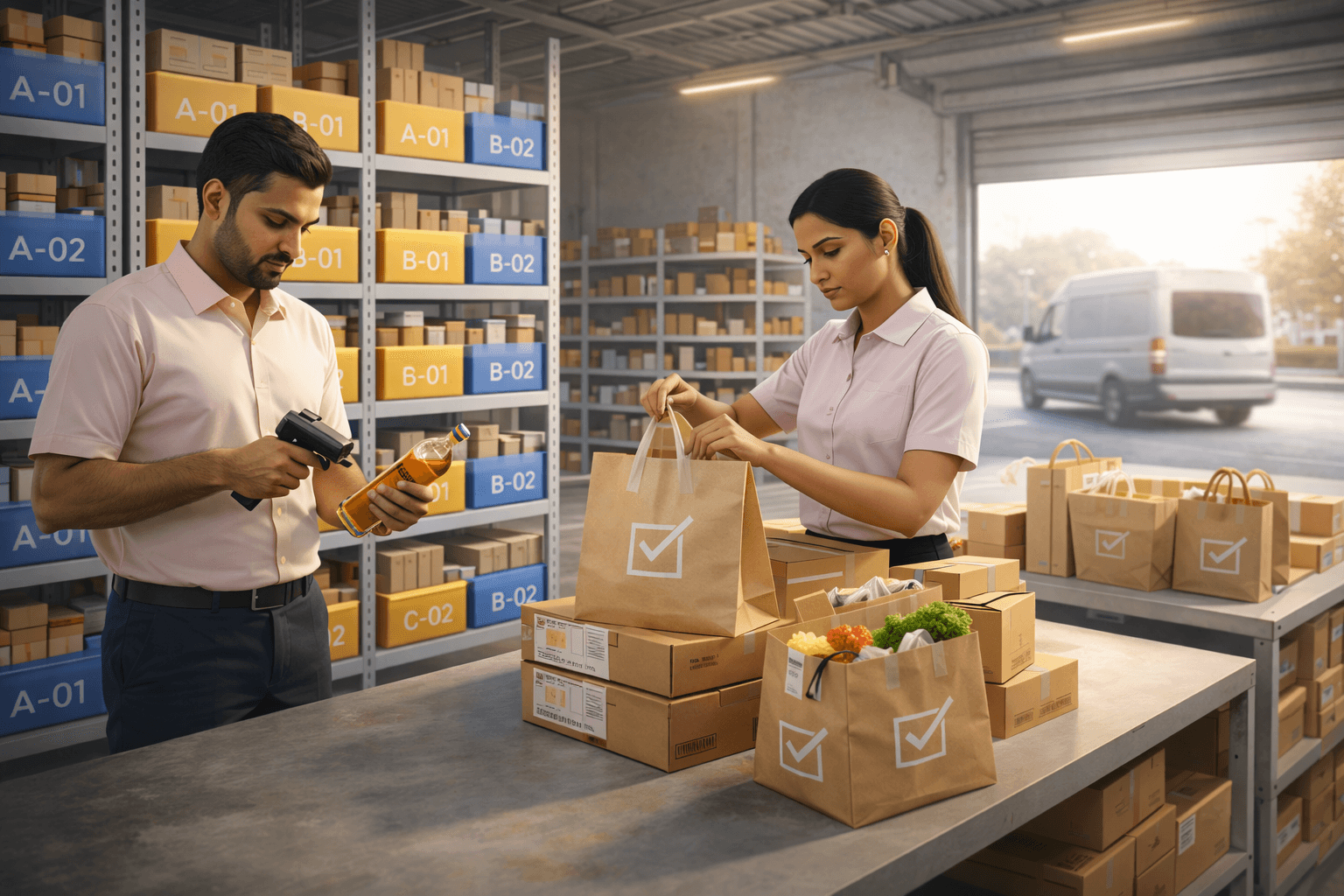
The Bottom Line
Bin management isn't glamorous. Nobody's writing headlines about innovative warehouse storage strategies. But it's what makes quick commerce fulfillment actually work. When you order groceries at midnight and they show up 20 minutes later with everything correct - that's efficient bin management doing its job invisibly. When a dark store can handle 3,000 orders a day without chaos - that's smart inventory optimization.
For anyone running a dark store operation in India, getting this right isn't optional. It's foundational. The app, branding, and marketing all fall apart if you can't consistently fulfill orders quickly through proper warehouse logistics management.
Start with the basics: clear bin location systems, fast-moving items in accessible spots, real-time warehouse tracking, and proper team training. Master these fundamentals of retail inventory management before adding complexity.
The good news? Once you nail warehouse bin organization, the benefits compound.
Faster fulfillment
Fewer errors,
Happier customers,
Lower costs,
Better unit economics in your online grocery business.
All from organizing where stuff lives.
Not bad for something as mundane as bin management systems.
Need help optimizing your dark store or quick commerce operations? Peddle Plus One ERP specializes in warehouse management solutions and retail fulfillment optimization for India's fast-growing e-commerce sector. From inventory control systems to complete dark store setup, we help businesses build operations that scale.
Visit peddleplus.in to learn how we can transform your quick delivery operations with proven warehouse optimization strategies.
Frequently Asked Questions
What is dark store management and how does it benefit business management?
Dark store management is a strategic business approach that focuses on optimizing retail operations in non-customer-facing warehouses. It benefits business management by improving inventory efficiency, reducing picking time, and enabling rapid order fulfillment, which enhances customer satisfaction and operational efficiency.
How does inventory management software support dark stores?
Inventory management software plays a crucial role in supporting dark stores by providing real-time tracking and smart inventory mapping. This helps reduce errors, streamline operations, and optimize picking processes, ultimately ensuring fast and accurate deliveries.
What role does a retail management system play in dark store management?
A retail management system integrates various aspects of dark store management, such as order processing, inventory control, and delivery logistics. By centralizing these functions, a retail management system enhances efficiency and supports the streamlined operations necessary for rapid fulfillment in dark stores.
Can dark store management be a viable business idea for expanding retail operations?
Yes, dark store management can be a viable business idea for retailers looking to expand their operations. By utilizing dark stores, businesses can tap into the growing demand for quick delivery services, optimize resources, and increase the scalability of their retail operations.
What are the benefits of using a retail bill management system in multi-store operations?
In multi-store operations, a retail bill management system helps consolidate billing processes across different locations, ensuring consistency and accuracy. It enhances financial oversight, streamlines billing workflows, and allows businesses to efficiently manage invoicing, ultimately contributing to improved operational efficiency.
How do structured bins and real-time tracking enhance dark store operations?
Structured bins and real-time tracking enhance dark store operations by optimizing space and streamlining item storage and retrieval. This organization reduces picking time and human error, ensuring orders are fulfilled quickly and accurately, which is essential for meeting customer expectations in fast-paced retail environments.

Tamanna Bhardwaj
EditorContent Strategist at Peddle Plus with 4+ years of experience in brand growth and marketing, specializing in retail technology, ERP adoption, and business operations for Indian SMEs.