How Indian Retail Chains Are Killing Fraud With ERP in 2026
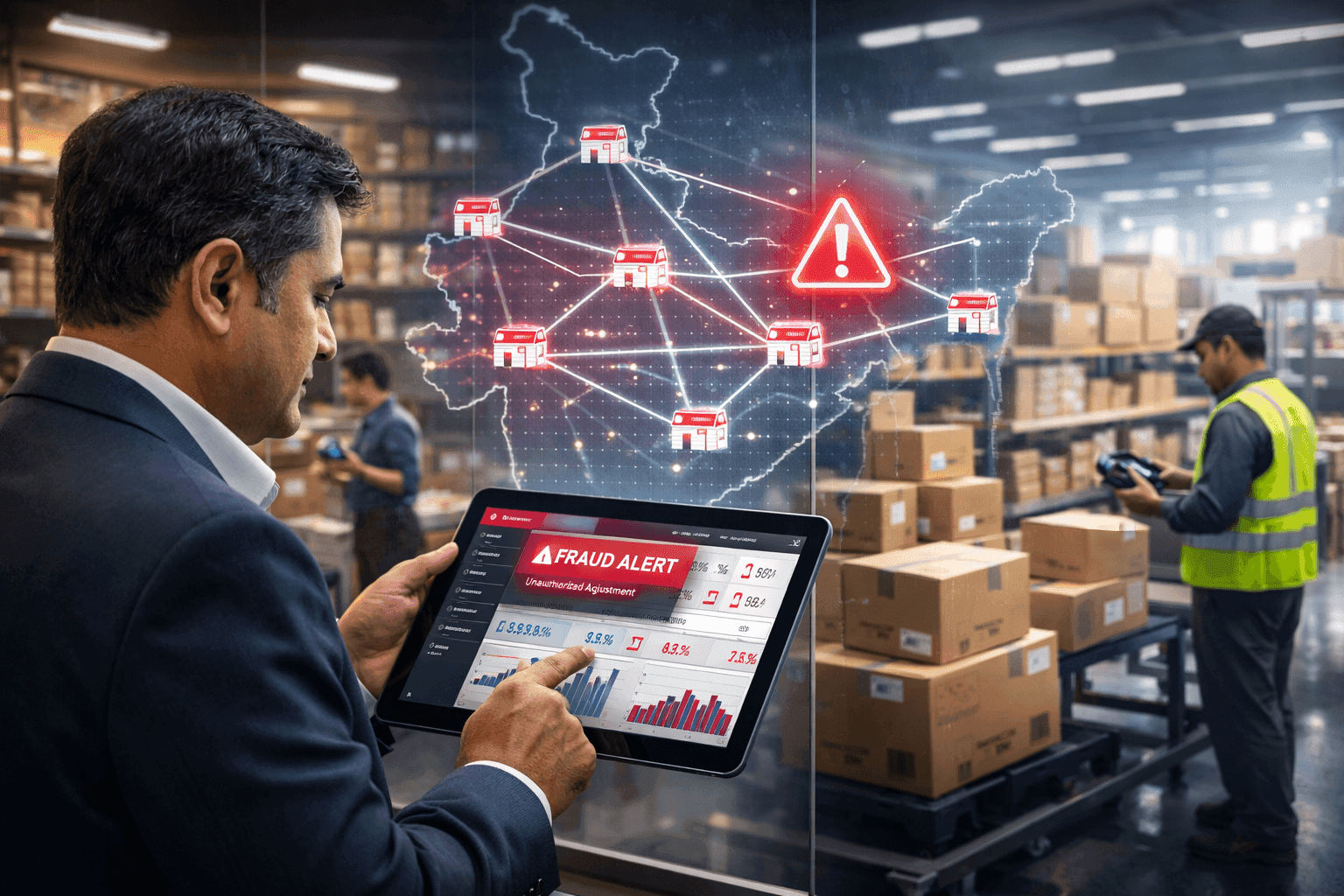
For retail chain owners across India who are tired of staring at inventory reports and wondering, where did the stock actually go?
Sunil runs seven apparel stores across three cities in Uttar Pradesh.
He's built the business over eleven years. He knows his suppliers, his bestselling categories, his peak seasons. He's sharp, experienced, and genuinely good at retail.
But every month-end, the same knot forms in his stomach.
The inventory report never quite adds up. One store consistently shows higher shrinkage than the others. A warehouse transfer went through, but the receiving store claims the quantity was short. A flash sale moved units but the system numbers and the physical count disagree by an amount that's too large to be a rounding error.
Nobody's pointing fingers. Nobody's being accused of anything. But Sunil knows, somewhere in those numbers, profit is leaking. And he can't tell exactly where.
If you recognize that feeling, this guide is for you.
Table of Contents
The Inventory Problem That No One Talks About Honestly
What Inventory Shrinkage Actually Costs Indian Retailers
Why Spreadsheets and Manual Counts Are Fighting a Losing Battle
What Real-Time Inventory ERP Actually Does (Beyond Just Tracking Boxes)
The Fraud Prevention Layer: How ERP Closes the Gaps Staff Exploit
Centralized Visibility: What Head Office Can Finally See
The Warehouse-to-Store Journey: Where Stock Goes Missing
Role-Based Access Control: Why Not Everyone Should See Everything
How ERP Handles High-Velocity Retail - Festivals, Sales, and Demand Spikes
Integration: How ERP Connects Your POS, Accounts, and Supply Chain
The Trust Problem: Building Accountability Without Creating a Surveillance Culture
Eight Signs Your Current Inventory System Is Failing You
How to Move to Real-Time Inventory ERP Without Disrupting Operations
What to Evaluate Before Choosing a Multi-Chain Inventory ERP
Conclusion: From Inventory Anxiety to Inventory Confidence
The Inventory Problem That No One Talks About Honestly
There's a version of the inventory problem that gets discussed openly: theft. Someone stole something. You catch them, you deal with it, you move on.
But that's actually the smaller, simpler version of the problem.
The larger, messier version looks like this:
A transfer of 200 units was logged, but only 183 arrived at the destination store. Nobody knows where 17 went or whether they ever left.
A store manager does a manual count and finds 12 units of a fast-moving SKU that the system says were sold. Are they returns that weren't logged? Supplier extras that were never entered? No one knows.
An end-of-month reconciliation takes three days of cross-referencing between Excel files, WhatsApp messages, and handwritten receiving notes. And it still doesn't fully balance.
One location's shrinkage is consistently 2-3x higher than all the others. Is it theft? Process failure? A data entry issue? You can't tell because there's no clean audit trail.
None of these are dramatic. None of them involve a single villain. But collectively, across a chain of stores and months of operations, they drain crores from retail businesses every year.
And the worst part? Most business owners know it's happening. They just don't have the tools to see it clearly enough to fix it.
What Inventory Shrinkage Actually Costs Indian Retail
The word "shrinkage" sounds almost gentle, like stock is just quietly evaporating.
The reality is less poetic. For most Indian multi-store retailers, shrinkage sits somewhere between 1.5% and 3% of annual turnover. For a retail chain doing ₹5 crore a year, that's ₹7.5 lakh to ₹15 lakh disappearing annually. For a chain doing ₹20 crore, the number becomes deeply uncomfortable.
But the financial loss is only part of it. The hidden costs are just as significant:
Decision quality degrades. When your inventory numbers are unreliable, every business decision that depends on them, reorder quantities, promotional planning, cash flow forecasting, gets made on shaky ground.
Vendor relationships suffer. When stock discrepancies can't be explained, both parties get defensive. Audits become confrontational. Relationships that took years to build get strained.
Staff morale takes a hit. When there's persistent shrinkage with no explanation, honest employees feel implicitly suspected. The culture of trust that good retail operations run on starts to erode.
Management time gets burned. Every unexplained variance requires investigation. That investigation usually falls on the most senior people, business owners, operations heads, because they're the ones who care most. And it eats time that should be spent growing the business.
Solving the inventory problem isn't just a cost-saving exercise. It's an investment in the entire quality of how the business operates.
Why Spreadsheets and Manual Counts Are Fighting a Losing Battle
Let's be fair to the systems that got Indian retail this far.
Spreadsheets are flexible, familiar, and free. Manual stock counts, when done properly, are genuinely accurate. WhatsApp groups for store-to-store coordination are fast and practical. These tools built real businesses.
But they have a ceiling and most growing retail chains are hitting it.
The speed problem. A manual stock count at a single location with 500+ SKUs takes hours. By the time it's done, stock has moved. The snapshot is already stale. For a chain of seven or ten stores, doing this simultaneously is nearly impossible.
The reconciliation problem. Every store maintains its own records. Centralizing them requires someone to collect, format, and cross-reference data from multiple sources. That process introduces errors, takes days, and produces a picture of the business that's already several days old.
The accountability gap. Spreadsheets record what someone typed. They don't record who moved what, when, or why. When a discrepancy shows up, there's no trail to follow, just a number that doesn't match, and a room full of people who don't know why.
The scale problem. Adding a new store means adding a new set of spreadsheets, a new person to manage them, and a new reconciliation process. The complexity grows faster than the business does.
At a certain point and most multi-location retailers reach it sooner than they expect, the manual approach stops being a cost-saving measure and starts being the reason growth is hard.
What Real-Time Inventory ERP Actually Does (Beyond Just Tracking Boxes)
When people hear "inventory ERP," they often picture a more sophisticated version of what they already have, a digital spreadsheet with better reporting.
That's not what it is.
A real-time inventory ERP is a live, connected system that knows the state of your inventory across every location, at every moment, because every action that affects stock is recorded at the point it happens.
Here's what that looks like in practice:
Stock movement is logged at the source. When a store receives a delivery, the receiving team scans or inputs the quantity. That update happens in real time not at end of day, not during the weekly sync. Within seconds of the goods being confirmed, head office can see that the transfer has arrived and in what quantity.
Every transaction creates a permanent record. Every sale, every return, every transfer, every write-off has a timestamp, a user ID, and a before/after inventory state. Nothing can be quietly adjusted without a trace.
Variances surface automatically. If sales data and stock data diverge beyond a defined threshold, the system flags it automatically, before anyone has to run a report. The alert goes to whoever needs to see it.
The whole chain is visible from one screen. A head office manager doesn't have to call each store for a stock update. They can see the inventory position of every location, in real time, from a single dashboard.
Replenishment becomes proactive. Instead of discovering that a fast-moving item has run out, the system flags when stock is approaching the reorder point, before the shelf goes empty.
This is the difference between knowing what happened and knowing what's happening. For a retail chain, that distinction is enormous.
The Fraud Prevention Layer: How ERP Closes the Gaps Staff Exploit
This section is uncomfortable but necessary. Most inventory loss isn't dramatic heist-movie theft. It's small, repeated, and often opportunistic and it happens in the gaps that manual systems leave open.
Here are the most common patterns, and how a properly implemented ERP closes them:
The unrecorded return. A customer returns an item. The staff member accepts it, doesn't log the return in the system, and the item goes back onto the shelf or into a bag at the end of the shift. ERP closes this by requiring every return to be processed through the system before it can be counted as received, with a user ID attached.
The short receive. A delivery of 100 units arrives. The system says 100 units were received. But only 95 made it onto the shelf because 5 were "damaged" or "missing" in a way that's impossible to verify after the fact. ERP closes this by requiring receiving to be done with barcode scanning or RFID at the point of receipt, with discrepancies flagged for manager approval before they're accepted.
The transfer ghost. A store-to-store transfer is logged in the sending store but never confirmed at the receiving end. The units disappear in transit or were never actually sent. ERP closes this by requiring both ends of a transfer to confirm the transaction, with automatic alerts when a transfer is pending confirmation beyond a set timeframe.
The phantom discount. Sales are logged, but at discounted prices that weren't authorized, with the difference pocketed or goods simply taken. ERP closes this through role-based pricing controls, where discounts above a certain threshold require manager approval, and all discount activity is logged with user IDs.
The end-of-shift adjustment. Just before closing, small quantity adjustments are made to "correct" discrepancies, covering up removals. ERP closes this by requiring adjustments above a threshold to be approved by someone other than the person making them, with full audit trails.
None of these controls require you to treat your staff like criminals. They require you to build a system where the right thing to do is also the easy thing to do and where anything else leaves a trail.
Centralized Visibility: What Head Office Can Finally See
One of the most immediate transformations that multi-location ERP delivers is simple but profound: head office can finally see what's happening across the entire chain, in real time, without making phone calls.
For business owners who currently operate on a diet of daily WhatsApp updates, weekly Excel reports, and surprise findings during store visits, this is a genuinely different experience.
What a centralized inventory dashboard shows:
Live stock positions by location. Not yesterday's numbers, right now's numbers. Which store has surplus stock of a slow-moving item? Which location is about to run out of your bestseller?
Comparative performance across stores. Which location has the highest shrinkage rate? Which one has the most accurate inventory counts? Patterns that were invisible when each store was an island become obvious when you can see them side by side.
Transfer status in real time. Every inter-store transfer has a status, initiated, in transit, received, discrepancy flagged. Nothing sits in limbo without someone being accountable for it.
Variance alerts as they happen. Instead of discovering a shrinkage problem at month-end, you get an alert the moment stock levels diverge unexpectedly from expected values.
Historical audit trails on demand. When a discrepancy needs investigation, every action that touched that SKU in any location, by any user, over any time period, is retrievable in minutes, not days.
The mental model shift this creates for business owners is significant. Instead of operating on information that's already old, you're operating on information that reflects the current state of the business. The decisions you make are grounded in reality rather than in hope.
The Warehouse-to-Store Journey: Where Stock Most Often Goes Missing
If there's one leg of the inventory journey where things go wrong most consistently, it's the transfer from warehouse to store.
The reasons are structural. This is the point where:
Goods change hands from one team to another
Physical movement creates opportunity for discrepancy
Accountability is blurry, is the warehouse responsible until the store confirms receipt? Or from the moment the goods left?
Delays between dispatch and receipt create windows where problems can be "explained away"
In a manual system, the process typically looks like this: warehouse creates a dispatch note, goods are loaded, driver takes them to the store, store manager signs a paper receipt, someone eventually updates the spreadsheet. Every one of those steps is a potential failure point.
In an ERP-driven system, the process is fundamentally different:
The transfer is initiated in the system with the exact quantities being dispatched
At dispatch, quantities are confirmed against the system record (barcode scan or count)
At receipt, the store team confirms quantities against the system record, any discrepancy is flagged immediately, not absorbed silently
Both ends of the transaction are time-stamped, user-attributed, and permanently recorded
No transfer is considered complete until both ends confirm pending confirmations generate automatic alerts
This single change properly managing the warehouse-to-store journey can recover a significant portion of the shrinkage that multi-location retailers experience. Because it's often not theft. It's just a broken handover process that lets units disappear without anyone being accountable.
Role-Based Access Control: Why Not Everyone Should See Everything
One of the most valuable but least glamorous features of a good inventory ERP is role-based access control.
The principle is simple: every user of the system can only see and do what their role requires. A store cashier can process sales and returns but can't adjust inventory quantities. A store manager can approve adjustments within their store but can't see other locations' financial data. A warehouse supervisor can manage dispatch and receipt but can't override pricing.
This matters for several reasons:
It reduces fraud exposure. Most inventory fraud doesn't require sophisticated hacking. It requires access to a system and the knowledge that no one is watching. When access is limited to what's necessary for each role, the attack surface for opportunistic fraud shrinks dramatically.
It creates clear accountability. When an action in the system can only have been taken by one of three people with the relevant permissions, investigations become much more targeted.
It protects sensitive business information. Margin data, supplier pricing, and overall chain performance are genuinely sensitive. Not every employee at every level needs this and exposing it creates both security risks and management complications.
It makes the system less intimidating for staff. When a store cashier opens the ERP and sees only the screens relevant to their job, the system feels manageable. When they see 40 modules they'll never use, the system feels overwhelming and adoption suffers.
A well-configured role structure is often the difference between a system that staff actually use and one they work around.
How ERP Handles High-Velocity Retail - Festivals, Sales, and Demand Spikes
Any Indian retailer knows that "normal operations" is a relative concept.
Diwali, Holi, back-to-school season, end-of-season sales, the Indian retail calendar is punctuated by periods where transaction volumes multiply, customer traffic surges, and supply chains stretch. These are exactly the moments when manual inventory systems break down and when shrinkage opportunities multiply.
The pressures during peak periods are unique:
Staff are rushed and stressed, making honest errors more likely
Temporary staff are brought in, often without thorough training on procedures
High footfall creates more opportunities for customer theft
Supplier deliveries become compressed and harder to verify carefully
Returns surge after gifting seasons, creating complex re-inventory challenges
A retail ERP built for these conditions handles peak periods differently from normal operations:
Bulk receiving tools allow warehouse and store teams to process large deliveries quickly without sacrificing accuracy, scanning rather than manually counting.
Automated reorder triggers prevent the scramble to restock mid-sale, ensuring popular items are replenished before they run out rather than after.
Temporary staff access profiles allow seasonal employees to be given exactly the system access they need for their specific role, nothing more, nothing less and that access can be revoked cleanly when the season ends.
High-volume audit trails scale with transaction volume, so even on the busiest day of the year, every sale, return, and transfer is fully logged.
The goal is that the controls that protect your inventory don't disappear the moment business gets busy. Because that's exactly when they're needed most.
Integration: How ERP Connects Your POS, Accounts, and Supply Chain
Inventory doesn't exist in isolation. Every sale affects inventory. Every purchase order changes what's incoming. Every return reverses a transaction. Every financial report depends on accurate stock valuation.
This is why a standalone inventory system, one that doesn't connect to the rest of the business, creates as many problems as it solves.
A well-integrated retail ERP connects:
Point of Sale (POS): Every sale at any store counter is immediately reflected in inventory levels. No end-of-day batch sync. No manual transfer of data. The moment a product is sold, inventory updates across the chain.
Accounts and GST compliance: Stock valuation flows directly into financial reporting. GST-applicable transactions are recorded with the correct tax codes automatically. Month-end reconciliation between inventory and accounts becomes a verification exercise rather than a data-matching exercise.
Supplier and purchase management: Purchase orders are raised in the system, deliveries are confirmed against those orders, and accounts payable reflects what was actually received, not what was ordered. Supplier discrepancies are documented, not swallowed.
E-commerce and omnichannel: For retailers selling across both physical stores and online platforms, unified inventory prevents the painful problem of selling the same item twice once in-store and once online because both channels are drawing from the same live stock pool.
Logistics and delivery tracking: For businesses using third-party logistics, integration with delivery partners means transfer status can be tracked in real time, and discrepancies flagged before goods are signed off.
Integration isn't a luxury feature. It's what makes inventory data trustworthy across the whole business not just accurate in isolation.
The Trust Problem: Building Accountability Without Creating a Surveillance Culture
Here's a tension that business owners navigating this topic often feel but rarely say out loud:
I want my inventory to be secure. But I don't want my staff to feel like they're working in a police state.
This is a legitimate concern. The way you implement inventory controls sends a message to your team about how much you trust them. Get it wrong and you breed resentment, defensiveness, and the kind of passive disengagement that creates its own operational problems.
Get it right, and you build something far more valuable: a culture of accountability where transparency is normal, processes are clear, and the system is understood as a tool that protects everyone, including honest staff who would otherwise be unfairly suspected when things go wrong.
Here's the distinction that matters:
Surveillance culture is reactive and adversarial. It starts from the assumption that staff are likely dishonest and focuses on catching them. It feels like cameras everywhere, spot checks, and management that never quite trusts anyone.
Accountability culture is structural and neutral. It starts from the assumption that most people are honest, and builds systems that make honest behavior easy and dishonest behavior visible. The system doesn't accuse anyone, it records facts.
In practice, implementing ERP-based inventory controls with an accountability-culture mindset looks like:
Communicating clearly to staff why the system exists - not to spy on them, but to give the business clarity it currently lacks
Involving store teams in how processes are designed, so they feel ownership over the controls rather than subjected to them
Using audit trails to investigate specific anomalies, not to monitor people's every action looking for something to criticize
Recognizing and praising stores that maintain excellent inventory accuracy, making it a point of pride, not just an absence of punishment
Addressing genuine problems privately and specifically, with evidence, rather than making sweeping accusations that damage the whole team
The goal isn't a business where everyone is watched. It's a business where the numbers are trustworthy because the processes are solid.
Eight Signs Your Current Inventory System Is Failing You
If you're running a multi-location retail business and questioning whether your current approach is working, here are the honest warning signs:
1. Your monthly stock count takes more than two days. If reconciling inventory across your locations is a multi-day project every month, that's time and resource that should be going elsewhere.
2. You discover shrinkage but can't trace where it happened. If the end-of-month number is wrong but you have no way to narrow down when, where, or how your system has no audit trail.
3. One location consistently shows higher shrinkage than others, and you don't know why. A persistent outlier without explanation is a structural problem, not a coincidence.
4. Warehouse-to-store transfers regularly have unexplained discrepancies. If the number dispatched and the number received don't match, and no one can explain why, your handover process is broken.
5. You're making reorder decisions based on gut feel rather than data. If you don't trust the system enough to let it inform restocking, you're operating with unnecessary risk.
6. Your store managers maintain their own parallel records. If every store has a backup spreadsheet "just in case," the central system has failed to earn trust.
7. Vendor audits are stressful because your records are incomplete. If a supplier dispute would be difficult to resolve because you can't produce a clean transaction history, you're exposed.
8. Adding a new store feels like a nightmare for inventory management. If scaling up means the inventory problem gets proportionally worse, the current approach doesn't scale.
Any two or three of these is a sign that the current approach has reached its limits. More than four is an urgent signal.
How to Move to Real-Time Inventory ERP Without Disrupting Operations
The transition to a new inventory system is genuinely disruptive if it's done carelessly. Done thoughtfully, it can be managed with minimal impact on daily operations.
Here's what the transition looks like when it goes well:
Start with a data cleanup, not a go-live date. Before any system goes live, get your product master clean. Deduplicate SKUs. Do a full physical count at every location and establish accurate opening stock in the new system. The quality of your data at go-live determines whether the system is trustworthy from day one.
Pilot in one or two locations first. Pick stores with reasonably straightforward operations, not your highest-volume, highest-complexity location. Get the system running well there before expanding to the rest of the chain.
Involve store teams early. The people who will use the system daily know where the current process breaks down. They'll have valuable input on configuration, and their buy-in will make adoption dramatically smoother.
Run parallel systems for a defined period. For 2-4 weeks after go-live at each location, run your old system alongside the new one. Compare outputs daily. This builds confidence in the new data before you rely on it completely.
Train for the job, not the system. Training should focus on "here's how you receive a delivery" and "here's how you process a return," not "here's how to navigate the menu." Role-specific, task-specific training drives adoption far better than general system overviews.
Set a "settled" date, not just a go-live date. Plan for a date 6–8 weeks after go-live when you consider the system fully operational. In the period between, expect and plan for issues they're normal, not signs of failure.
What to Evaluate Before Choosing a Multi-Chain Inventory ERP
Not every ERP is built for the realities of Indian multi-chain retail. Here's a practical evaluation framework:
Retail-first architecture. Does the system understand high SKU volumes, promotions, returns, and fast-moving stock natively or were these added as modules to a system built for something else?
True real-time sync. When a transaction happens at one store, how long before it's reflected at head office? Minutes is acceptable. Hours is not.
Scalability. Can the system handle your chain at twice its current size without a fundamental re-implementation? What does adding a new location actually involve?
Indian compliance. Does it handle GST correctly across different product categories and states? Can it generate the reports your CA and auditors actually need?
Integration depth. How well does it connect with your current POS, accounting software, and any e-commerce platforms? Are these native integrations or third-party connectors that break periodically?
Role-based access granularity. Can you configure access controls to match how your business is actually structured- down to specific actions within specific modules?
Support model. What happens when something goes wrong at 7pm on a Saturday during Diwali sales? Is there a support team that responds, or a ticket that waits until Monday?
Implementation track record in Indian retail. Has the vendor actually implemented this in businesses similar to yours similar size, similar sector, similar geography? Ask for references and speak to them.
Conclusion: From Inventory Anxiety to Inventory Confidence
The knot in the stomach at month-end, the staring at numbers that don't add up, the investigations that go nowhere, the slow leakage of margin that nobody can quite explain, this isn't the permanent reality of running a retail chain in India.
It's the reality of running one without the right system.
Real-time inventory ERP doesn't just make stock tracking more efficient. It changes the fundamental quality of information that a retail business runs on. It creates accountability without accusation. Visibility without micromanagement. Confidence without complacency.
For Indian retail chain owners who have built their businesses through hard work and sharp instinct, ERP is what takes the next phase of growth, more stores, more products, more transactions from a source of anxiety to a source of genuine control.
You don't have to know where every unit went in the last 12 months. But from the moment the right system is in place, you will.
And that changes everything.
Frequently Asked Questions
How does real-time inventory control ERP benefit multi-chain retail operations?
Real-time inventory control ERP enhances multi-chain retail operations by providing accurate, up-to-date inventory data across all locations. This centralized system ensures efficient stock management, reduces errors, and minimizes costs related to overstocking or stockouts, ultimately boosting overall retail performance.
What role does retail ERP play in fraud prevention for Indian businesses?
Retail ERP systems play a crucial role in fraud prevention for Indian businesses by tracking every transaction and inventory movement. This real-time visibility helps identify discrepancies, detect fraudulent activities, and maintain a transparent audit trail, protecting businesses from losses due to fraud.
How can multi-location inventory management in India be optimized with ERP solutions?
Multi-location inventory management in India can be optimized with ERP solutions by integrating all store data into a single platform. This approach streamlines operations, facilitates accurate stock tracking, and ensures seamless coordination between different locations, minimizing errors and improving overall efficiency.
In what ways does the Peddle Plus One ERP enhance inventory visibility in India?
Peddle Plus One ERP enhances inventory visibility in India by offering comprehensive tools to monitor stock levels in real-time across all retail locations. This system ensures managers have the insights needed to make informed decisions, minimize shrinkage, and efficiently allocate resources.
What is the impact of shrinkage detection ERP retail systems on business profitability?
Shrinkage detection ERP retail systems positively impact business profitability by identifying and reducing losses due to theft, fraud, or operational errors. By maintaining accurate inventory records and monitoring movement, these systems help retailers conserve resources and protect their bottom line.
Why is real-time stock tracking important for success in a multi-store environment?
Real-time stock tracking is essential for success in a multi-store environment as it ensures that inventory levels across all locations are continuously monitored and optimized. This capability prevents stock discrepancies, enables swift response to demand changes, and ensures a seamless customer experience.

Tamanna Bhardwaj
EditorContent Strategist at Peddle Plus with 4+ years of experience in brand growth and marketing, specializing in retail technology, ERP adoption, and business operations for Indian SMEs.